• Astronaut Hazza Al Mansouri and Simonetta Di Pippo, director of the United Nations Office for Outer Space Affairs, at a plenary session on the first day of the Global Space Exploration Conference in St Petersburg. Courtesy: All photos by Global Space Exploration Conference
    Astronaut Hazza Al Mansouri and Simonetta Di Pippo, director of the United Nations Office for Outer Space Affairs, at a plenary session on the first day of the Global Space Exploration Conference in St Petersburg. Courtesy: All photos by Global Space Exploration Conference
  • Hazza Al Mansouri called for more joint international efforts at the conference.
    Hazza Al Mansouri called for more joint international efforts at the conference.
  • Hazza Al Mansouri also spoke of the importance of the involvement of the youth in space programmes.
    Hazza Al Mansouri also spoke of the importance of the involvement of the youth in space programmes.
  • The event is taking place at the Tauride Palace in St Petersburg, Russia.
    The event is taking place at the Tauride Palace in St Petersburg, Russia.
  • Mr Al Mansouri has taken a small break from his training at Nasa's Johnson Space Centre in Houston to attend the conference.
    Mr Al Mansouri has taken a small break from his training at Nasa's Johnson Space Centre in Houston to attend the conference.
  • Mr Al Mansouri speaking during a plenary session.
    Mr Al Mansouri speaking during a plenary session.

UAE's first astronaut tells global summit in Russia: 'We're all speaking the same language when it comes to space'


  • English
  • Arabic

The UAE has urged heads of the world's space agencies to co-operate and bring success to their exploration programmes.

Maj Hazza Al Mansouri, the UAE's first astronaut, called for more joint efforts in his address to a conference in St Petersburg, Russia.

The Global Space Exploration Conference runs from Monday to Friday, June 14 to 18.

It brings together engineers, scientists, entrepreneurs, educators, space agency representatives and policymakers.

It's really important that we work together. Despite our backgrounds and beliefs, space exploration will always unite us

The first major gathering of space agencies since the start of the coronavirus pandemic is organised by the International Astronautical Federation and the Russian space agency, Roscosmos.

Maj Al Mansouri also spoke of the importance of the involvement of the youth in space programmes.

As a newcomer to the space sector, the UAE has relied heavily on international partnerships to reach major milestones.

Maj Al Mansouri went into space on board a Russian rocket, and the UAE's Hope probe reached Mars through a collaboration with several institutions including three US universities.

For its lunar mission, the Mohammed bin Rashid Space Centre is using a Japanese lander to send its Rashid rover to the Moon's surface.

"It's really important that we work together," Maj Al Mansouri said during a plenary session.

"Despite our backgrounds and beliefs, space exploration will always unite us. We speak one common language, which is science.

“We successfully reached Mars and now we’re taking pictures for the entire scientific community. Without international partnerships and young minds, we couldn’t have done this.”

The International Space Station has been an example of countries working together, despite their political differences.

However, Russia now plans to leave the project and build its own station.

Dmitry Rogozin, Roscosmos chief, said they would not build a Russian station if the US lifted sanctions on the agency.

Mr Rogozin has also described the Nasa-led Artemis Accords, an international treaty that outlines peaceful Moon exploration, as "too US-centric".

Instead, Roscosmos has partnered with China to build the International Lunar Research Station and is encouraging other nations to join.

The UAE, Japan, Australia and several other nations have signed the accords.

For years, Nasa relied on Russian Soyuz craft to take its astronauts into space and to the space station.

But the US' latest commercial space model has revived its programme, with astronauts now travelling on SpaceX rockets and Nasa planning to send humans to the Moon.

Sergey Krikalev, an adviser at Roscosmos and a former cosmonaut, said the UAE and other countries that are new in space could benefit from the growth of space technology being built by nations such as Russia, Europe and the US.

“It could help the countries that want to launch their astronauts to space,” he said at the conference.

Russia is also trying to modernise its space programme and is building a commercial model.

An agreement between the UAE, Russia and Kazakhstan to upgrade and commercialise the Gagarin’s Start launch pad in Kazakhstan is in discussions, which could give the UAE access to Soyuz rockets.

Sarah Al Amiri, the Minister of State for Advanced Technology and chairwoman of the UAE Space Agency, confirmed to The National during an interview in April that the agreement was in discussion.

On Tuesday, the heads of space agencies will speak during the conference.

Mr Rogozin, Nasa administrator Bill Nelson, UAE astronaut programme chief and deputy director-general of MBRSC Salem Al Marri will speak to the conference online.

Mr Rogozin said Roscosmos will hold discussions on Moon exploration partnerships with Chinese officials on the sidelines of the conference.

On June 16, a Chinese official will present a blueprint for a lunar research station.

Photos of the International Space Station

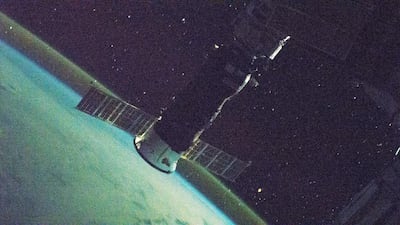
  • The International Space Station, pictured with Russia's ISS Progress 77 cargo craft attached to the Pirs docking compartment, orbits into a sunset 270 miles above the South Pacific on February 21, 2021. Nasa
    The International Space Station, pictured with Russia's ISS Progress 77 cargo craft attached to the Pirs docking compartment, orbits into a sunset 270 miles above the South Pacific on February 21, 2021. Nasa
  • The ISS Progress 76 resupply ship backs away from the International Space Station after it had undocked moments earlier from the Pirs docking compartment on February 9, 2021. In the foreground is the Soyuz MS-17 crew ship docked to the Rassvet module. Nasa
    The ISS Progress 76 resupply ship backs away from the International Space Station after it had undocked moments earlier from the Pirs docking compartment on February 9, 2021. In the foreground is the Soyuz MS-17 crew ship docked to the Rassvet module. Nasa
  • Astronauts Mike Hopkins and Victor Glover, Jr. finish a four-year effort to upgrade the International Space Station’s power system during a spacewalk on February 1, 2021. AFP
    Astronauts Mike Hopkins and Victor Glover, Jr. finish a four-year effort to upgrade the International Space Station’s power system during a spacewalk on February 1, 2021. AFP
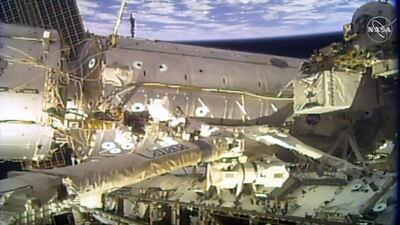
  • The SpaceX Crew Dragon, centre right, the Japanese H-II Transfer Vehicle-9 resupply ship, centre bottom, and Europe's Columbus laboratory module as they figure prominently in this photograph taken during a spacewalk conducted by astronauts Bob Behnken and Chris Cassidy on July 1, 2020. Nasa
    The SpaceX Crew Dragon, centre right, the Japanese H-II Transfer Vehicle-9 resupply ship, centre bottom, and Europe's Columbus laboratory module as they figure prominently in this photograph taken during a spacewalk conducted by astronauts Bob Behnken and Chris Cassidy on July 1, 2020. Nasa
  • The Cygnus resupply ship, with its prominent cymbal-shaped UltraFlex solar arrays, from Northrop Grumman pictured on March 28, 2021 attached to the International Space Station's Unity module. AFP
    The Cygnus resupply ship, with its prominent cymbal-shaped UltraFlex solar arrays, from Northrop Grumman pictured on March 28, 2021 attached to the International Space Station's Unity module. AFP
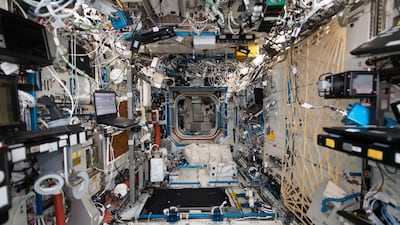
  • A View of the Destiny US Laboratory aboard the International Space Station. The US Laboratory Module, called Destiny, is the primary research laboratory for US payloads, supporting a wide range of experiments and studies contributing to health, safety, and quality of life for people all over the world. Nasa
    A View of the Destiny US Laboratory aboard the International Space Station. The US Laboratory Module, called Destiny, is the primary research laboratory for US payloads, supporting a wide range of experiments and studies contributing to health, safety, and quality of life for people all over the world. Nasa
MATCH INFO

Quarter-finals

Saturday (all times UAE)

England v Australia, 11.15am 
New Zealand v Ireland, 2.15pm

Sunday

Wales v France, 11.15am
Japan v South Africa, 2.15pm

The specs: 2018 Nissan 370Z Nismo

The specs: 2018 Nissan 370Z Nismo
Price, base / as tested: Dh182,178
Engine: 3.7-litre V6
Power: 350hp @ 7,400rpm
Torque: 374Nm @ 5,200rpm
Transmission: Seven-speed automatic
​​​​​​​Fuel consumption, combined: 10.5L / 100km

Brief scores:

Toss: Sindhis, elected to field first

Pakhtoons 137-6 (10 ov)

Fletcher 68 not out; Cutting 2-14

Sindhis 129-8 (10 ov)

Perera 47; Sohail 2-18

The%20specs
%3Cp%3E%3Cstrong%3EEngine%3A%3C%2Fstrong%3E%206.5-litre%20V12%20and%20three%20electric%20motors%0D%3Cbr%3E%3Cstrong%3EPower%3A%20%3C%2Fstrong%3E1%2C015hp%0D%3Cbr%3E%3Cstrong%3ETorque%3A%20%3C%2Fstrong%3E1%2C500Nm%20(estimate)%0D%3Cbr%3E%3Cstrong%3ETransmission%3A%3C%2Fstrong%3E%20Eight-speed%20dual-clutch%20auto%0D%3Cbr%3E%3Cstrong%3EOn%20sale%3A%3C%2Fstrong%3E%20Early%202024%0D%3Cbr%3E%3Cstrong%3EPrice%3A%20%3C%2Fstrong%3EFrom%20Dh2%20million%20(estimate)%3C%2Fp%3E%0A
Who's who in Yemen conflict

Houthis: Iran-backed rebels who occupy Sanaa and run unrecognised government

Yemeni government: Exiled government in Aden led by eight-member Presidential Leadership Council

Southern Transitional Council: Faction in Yemeni government that seeks autonomy for the south

Habrish 'rebels': Tribal-backed forces feuding with STC over control of oil in government territory

COMPANY%20PROFILE
%3Cp%3E%3Cstrong%3EName%3A%3C%2Fstrong%3E%20SupplyVan%3Cbr%3E%3Cstrong%3EBased%3A%3C%2Fstrong%3E%20Dubai%2C%20UAE%3Cbr%3E%3Cstrong%3ELaunch%20year%3A%3C%2Fstrong%3E%202017%3Cbr%3E%3Cstrong%3ENumber%20of%20employees%3A%3C%2Fstrong%3E%2029%3Cbr%3E%3Cstrong%3ESector%3A%3C%2Fstrong%3E%20MRO%20and%20e-commerce%3Cbr%3E%3Cstrong%3EFunding%3A%3C%2Fstrong%3E%20Seed%3C%2Fp%3E%0A
The specs
  • Engine: 3.9-litre twin-turbo V8
  • Power: 640hp
  • Torque: 760nm
  • On sale: 2026
  • Price: Not announced yet
The biog

Birthday: February 22, 1956

Born: Madahha near Chittagong, Bangladesh

Arrived in UAE: 1978

Exercise: At least one hour a day on the Corniche, from 5.30-6am and 7pm to 8pm.

Favourite place in Abu Dhabi? “Everywhere. Wherever you go, you can relax.”

Lexus LX700h specs

Engine: 3.4-litre twin-turbo V6 plus supplementary electric motor

Power: 464hp at 5,200rpm

Torque: 790Nm from 2,000-3,600rpm

Transmission: 10-speed auto

Fuel consumption: 11.7L/100km

On sale: Now

Price: From Dh590,000