


The head of the UAE's booming astronaut programme and the country's first man in space will take part in an in-person global conference in Russia this week, setting out missions to the Moon, Mars and beyond.
The Global Space Exploration Conference (Glex) will involve heads of space agencies from around the world.
Hazza Al Mansouri, the UAE’s first astronaut, is expected to speak during a plenary session with other astronauts and scientists.
Salem Al Marri, head of the astronaut programme and deputy director general of the Mohammed bin Rashid Space Centre, will also participate and discuss challenges of lunar exploration.
Organised by the International Astronautical Federation (IAF), the event will take place in St Petersburg from Monday until Friday.
“This first in-person conference since the beginning of the global pandemic shows the evidence of the great interest there is for space exploration,” said Pascale Ehrenfreund, president of IAF.
“After the United States in 2012, and China in 2017, the IAF is proud to offer the space community and the greater public, the unique opportunity to gather again in Russia, another leading nation in space exploration, for the third edition of the Global Space Exploration Conference.”
The National's Sarwat Nasir will be covering the event live from Tauride Palace in St Petersburg. Here's what to expect.
UAE’s blossoming space programme
With the UAE becoming an active player in space exploration, it is likely to become a regular fixture at global space events.
On June 15, Mr Al Mansouri is scheduled to speak during a plenary session titled ‘60th anniversary of Yuri Gagarin’s spaceflight’. Other experts include Nasa astronaut Mike Baker and cosmonaut Alexandar Alexandrov.
During a ‘high-level space leaders’ panel, Mr Al Marri will share insights into the UAE’s space programme, including current and future plans.
-

The first image of Mars as taken by the UAE's Hope probe, which arrived at the planet on February 9. -
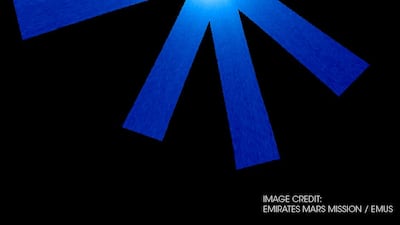
This image taken by the Hope probe's ultraviolet spectrometer (one of its three scientific instruments) shows sunlight reflecting off the extended cloud of atomic hydrogen gas that surrounds the planet Mars. The sunlight is visible only as a dark disk hidden inside the fog of gas. The Emirates Mars Mission team said that no other mission have made such kind of recordings before. -
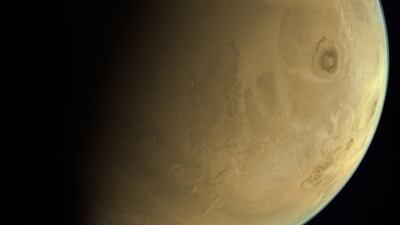
The UAE's Hope probe captured a high-resolution photo of Mars. -
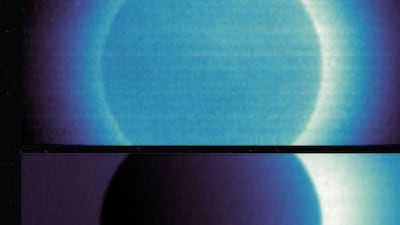
The Hope probe has shared new images from its journey in the orbit of Mars. -
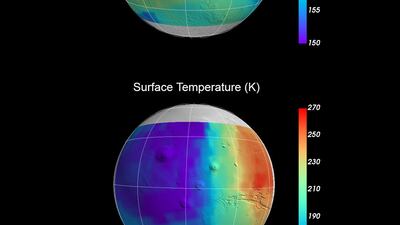
This image was taken by the infrared spectrometer, another instrument on the Hope probe, from an altitude of about 15,000 kilometres. The image shows the surface temperature (left), centred on the Tharsis region of Mars. Dawn can be seen towards the right side. The low surface temperatures observed are due to the dusty nature of the Martian surface. An elevated nighttime atmospheric temperature at 25 km altitude (right) is also observed over the Tharsis region. -
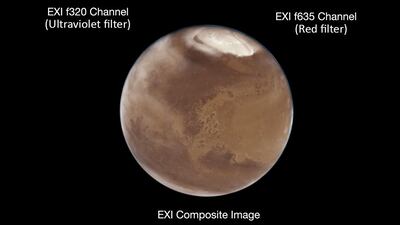
These images were captured by the eXploration imager, a high-resolution camera on the Hope probe. The red channel clearly shows the dark and light features of the Martian surface, while the water ice clouds stand out in the ultraviolet channel. -
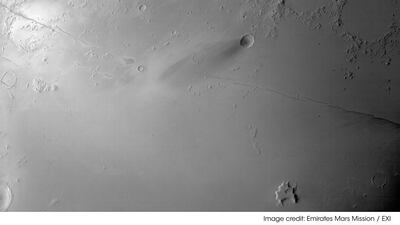
Hope probe sent back an image of the Cerberus Fossae, an area on the planet known for 'Marsquakes'. -
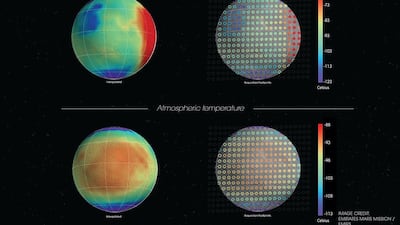
Surface and atmospheric temperature readings collected by the UAE's Hope probe. -

Discrete aurora on Mars captured by UAE's Hope probe -

Discrete aurora on Mars captured by UAE's Hope probe


The UAE has already sent an Emirati into space, a spacecraft around Mars orbit and there are plans to launch a small robotic rover to the Moon in 2022.
There are also ambitious plans to build a city on Mars by 2117.
Nasa’s new administrator Bill Nelson will participate in the panel remotely.
Russian space chief Dmitry Rogozin will speak in-person, as well as Turkey’s space agency head Serdar Huseyin Yildirim.
Adnan Al Rais, programme manager of Mars 2117, will give the highlight lecture on June 17.
He is expected to share some of the country’s upcoming projects, including a Space Venture programme, the UAE Analog Mission – which involves an Emirati living in isolation for several months as part of a space simulation project – and give updates on the Mars Science City and lunar mission.
Dubai will host the next big IAF event in October. The world's largest space conference, the International Astronautical Congress will take place at the World Trade Centre.
Russia puts ISS future on agenda
Russian space agency Roscosmos is the local organising committee of the conference, which is being held in a landmark year for the nation's proud history in space.
In April, Russia celebrated the 60th anniversary of Yuri Gagarin, the cosmonaut who was the first person in space.
-
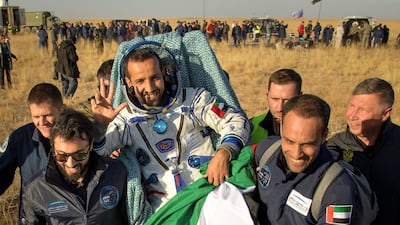
UAE astronaut Hazza al-Mansouri is carried from the landing site. AFP / NASA -
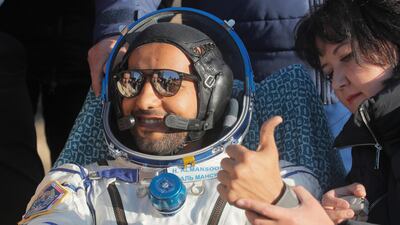
Hazza Al Mansouri gestures to spectators. AP Photo -
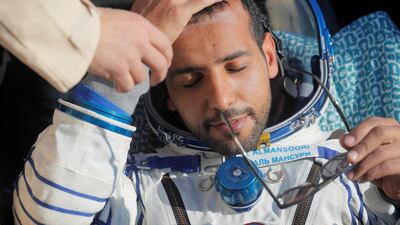
Hazza Al Mansouri reacts shortly after landing. Reuters -
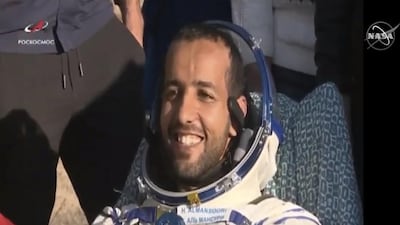
Hazza Al Mansouri is all smiles on landing. Nasa / YouTube screengrab -

Hazza Al Mansouri is tended to by ground crews. Nasa / Youtube screengrab -
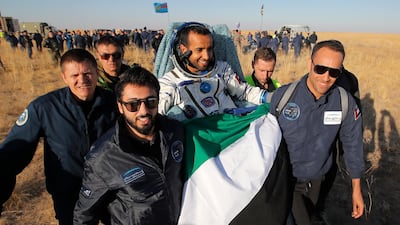
Russian space agency rescue team members and United Arab Emirates specialists carry Maj Al Mansouri. AP Photo -
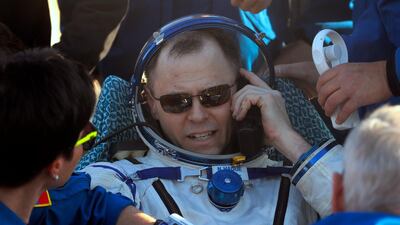
US astronaut Nick Hague calls his relatives. AP Photo -

US astronaut Nick Hague, Russian cosmonaut Alexey Ovchinin, and UAE astronaut Hazzaa Ali Almansoori, sit in chairs shortly after landing. AP Photo -
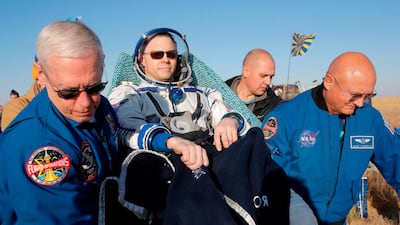
NASA specialists carry US astronaut Nick Hague. AP Photo -
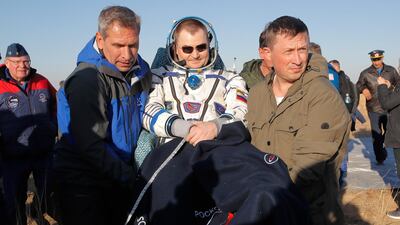
Russian space agency rescue team members and United Arab Emirates specialists carry Maj Al Mansouri. AP Photo -
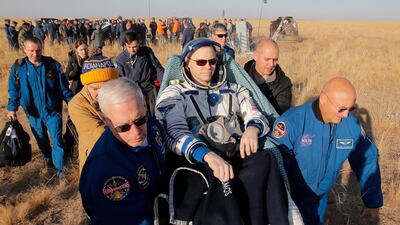
NASA specialists carry US astronaut Nick Hague. AP Photo -
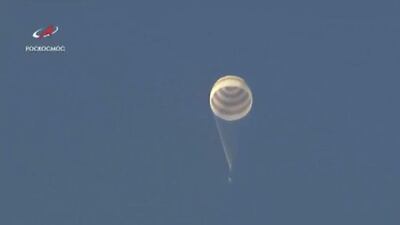
The first sighting of the MS-12 upon re-entry into the Earth's atmosphere. Screengrab Nasa / YouTube -
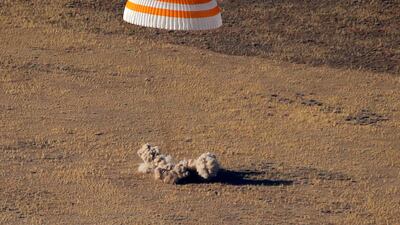
The Russian Soyuz MS-12 space capsule lands about 150km south-east of the Kazakh town of Zhezkazgan. AP Photo -
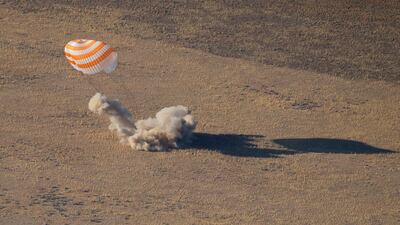
The Russian Soyuz MS-12 space capsule lands about 150km south-east of the Kazakh town of Zhezkazgan. AP Photo -
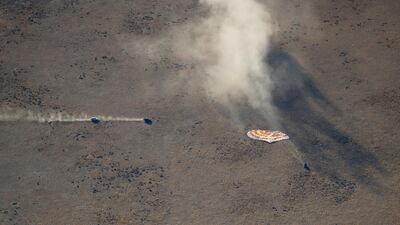
Rescue vehicles approach the capsule. AP Photo -
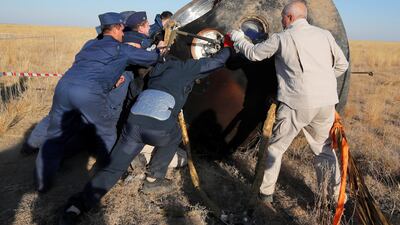
Specialists turn a Russian Soyuz MS-12 space capsule after the landing near the town of Zhezkazgan, Kazakhstan. Reuters -
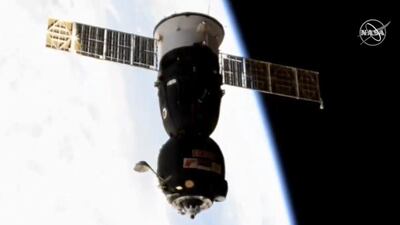
The Soyuz MS-12 free of the International Space Station. Screengrab via Nasa / YouTube -
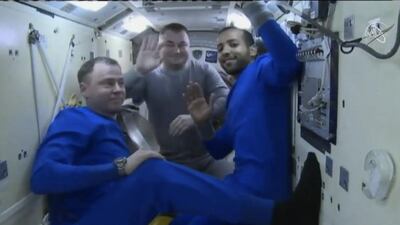
Hazza Al Mansouri before entering the hatch. Screegrab via Nasa / YouTube


Roscosmos is expected to discuss the future of the International Space Station, which has been operational since 2000 through a joint international effort by Russia, Nasa, the European Space Agency, Japan and Canada.
However, the Russian space agency recently announced plans of exiting the space station and building an independent one.
Mr Rogozin said last week that it would consider not building one of its own if the US lifts the sanctions placed on the space agency.
"The ball is in the court of our American partners. If sanctions against the Progress Rocket and Space Center and TsNIIMash remain in place, the issue of Russia’s withdrawal from the ISS is a problem for American partners. It will be their zone of responsibility," he said.
“Either we are working together and then sanctions should be lifted immediately, or we won’t work together and then national systems will be deployed.”
China to discuss bold plans
Chinese space officials will attend the conference remotely.
Yanhua Wu, vice administrator of the China National Space Administration, will speak during a ‘high-level space leaders’ panel, alongside the Indian space agency chairman, president of JAXA and Mr Rogozin.
They will tell of their enterprising plans for the future.
-
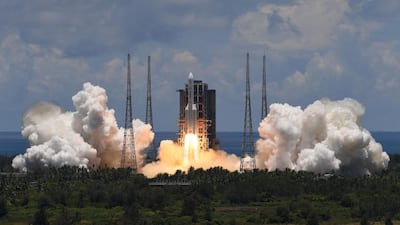
A Long March-5 rocket, carrying an orbiter, lander and rover as part of the Tianwen-1 mission to Mars, lifts off from the Wenchang Space Launch Centre in southern China's Hainan Province in 2020. AFP -
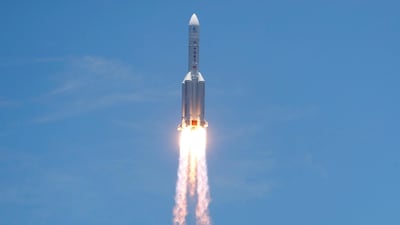
The Long March 5 Y-4 rocket, carrying an unmanned Mars probe of the Tianwen-1 mission, takes off from Wenchang Space Launch Center in Wenchang, Hainan Province, China. REUTERS -
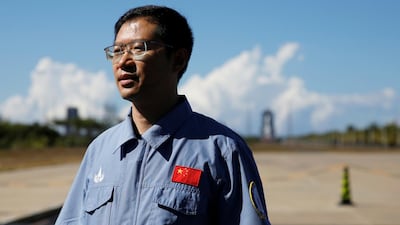
Liu Tongjie, spokesman for China's Mars exploration mission, talks to the media before the launch of Tianwen-1 Mars exploration mission by Long March 5 Y-4 rocket, at Wenchang Space Launch Center in Wenchang, Hainan Province, China. REUTERS -
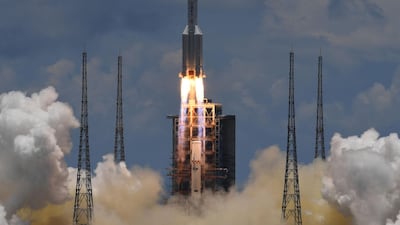
A Long March-5 rocket, carrying an orbiter, lander and rover as part of the Tianwen-1 mission to Mars, lifts off from the Wenchang Space Launch Centre in southern China's Hainan Province. AFP -
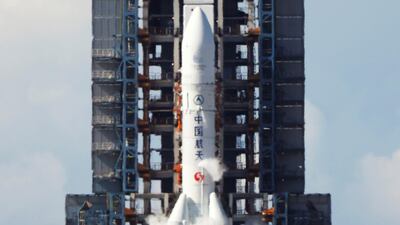
The Long March 5 Y-4 rocket, carrying an unmanned Mars probe of the Tianwen-1 mission, is seen before the launch at Wenchang Space Launch Center in Wenchang, Hainan Province, China. REUTERS -
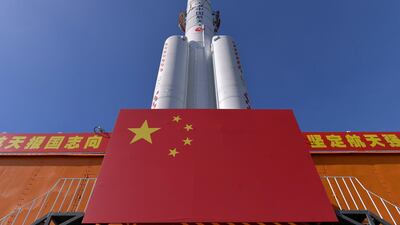
A Long March-5 rocket is seen at the Wenchang Space Launch Center in south China's Hainan Province, Friday, July 17, 2020. AP -
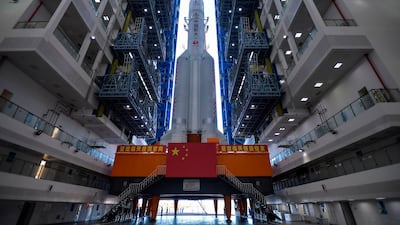
This photo taken on July 17, 2020 shows a Long March 5 rocket being transferred before a planned launch in Wenchang in China's southern Hainan province. AFP -
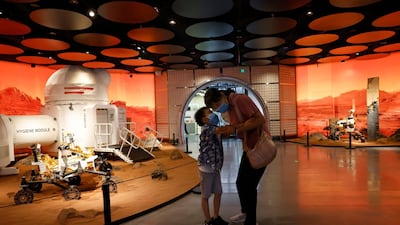
A child whispers to a woman as they visit an exhibition depicting rovers and bio-domes in Mars, in Beijing. AP Photo -
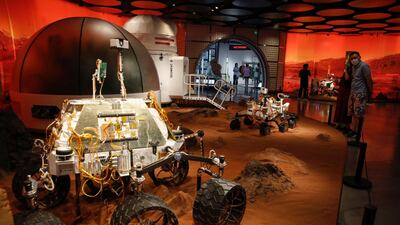
A replica of Mars lander and rovers on display at a shopping mall in Beijing, China. EPA


China has a probe that is orbiting Mars and a rover on the surface. Its Chang’e-5 mission returned Moon samples from the lunar surface last year.
The country is building a space station, with the core stage already in orbit. Chinese astronauts are expected to launch into space this month.
China has partnered with Roscosmos to build the International Lunar Research Station.
A roadmap for the construction of the station is expected to be revealed during one of the plenary sessions on June 16, as well as the main stages of implementation.
Earlier this month, both space agencies called on other nations to join the project.
In another plenary session, Xiaojun Wang, president of the China Academy of Launch Vehicle Technology, is scheduled to discuss China’s future deep space exploration plans and share details of ongoing missions.
Nasa to outline Mars successes
Several Nasa officials will also be participating in the conference.
Lori Glaza, director of Science Mission Directorate’s Planetary Science Division at Nasa, and her colleagues will discuss the Perseverance mission.
Nasa landed one of its most advanced rover, called Perseverance, on the Martian surface earlier this year. Ingenuity, a small helicopter, hitched a ride with the rover and has accomplished several flights.
-
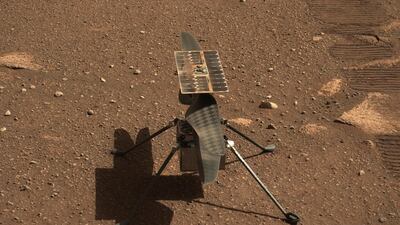
Nasa's Ingenuity helicopter on the Martian surface. Nasa -
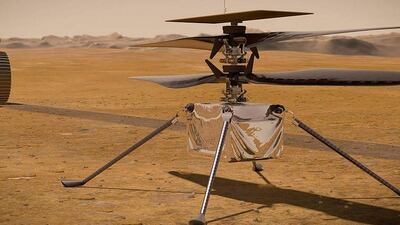
Nasa will try to fly Ingenuity on Mars. If successful, it will be the first powered, controlled flight on another planet. Pictured is an illustration of the rotorcraft. Nasa -
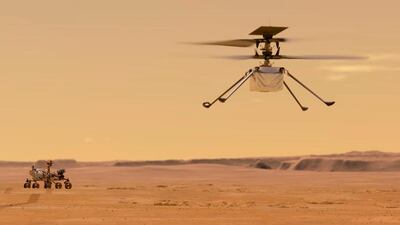
As part of the first test flight, Ingenuity will climb three metres, hover for 30 seconds and then descend back on the Martian surface. Nasa -
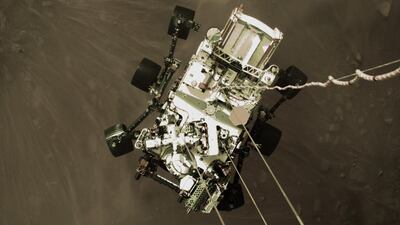
Ingenuity hitched a ride on the Perseverance rover to reach the Red Planet. The rover landed at the Jezero Crater on February 18. This is a high-resolution image captured by the on-board cameras during the landing. Nasa -
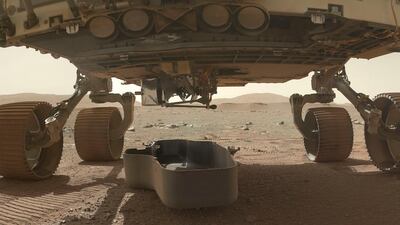
Ingenuity was resting beneath a protective shield under the Perseverance rover. Last week, it dropped the shield on the Martian surface in preparation for the first test flight. Nasa -
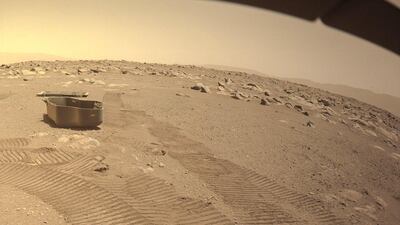
The Perseverance rover had been driving around the selected 'airfield' to scout for a drop-off location for Ingenuity. Nasa -
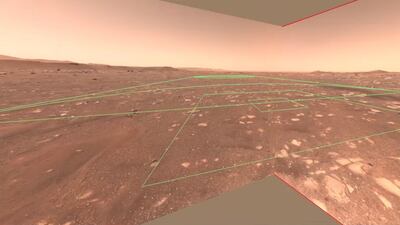
Nasa used an image taken by the Perseverance rover to map out an 'airfield' on Mars, where Ingenuity will take flight. Nasa -
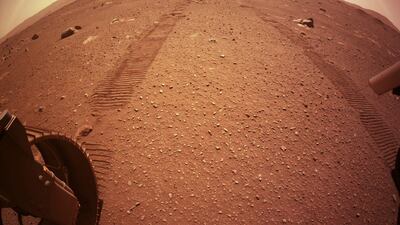
Tracks left behind the Perseverance rover on the Martian surface as it scouted for a drop off location for Ingenuity. Nasa -

Ingenuity is currently unfolding from its stowed position and will soon touch down on the Martian surface. Nasa


The panel will discuss the mission’s milestones and upcoming science plans, including Mars sample return and human exploration.
Other leading Nasa figures who will speak at the event remotely include Kathryn Lueders, associate administrator of the Human Exploration and Operations Mission Directorate, and Thomas Zurbuchen, associate administrator for the Science Mission Directorate.
Some of the other plenary sessions will involve speakers from private space companies, such as Airbus and Lockheed Martin.
Topics will include building a Moon economy and the infrastructure required for deep space missions.
The full agenda is available online.
Emirati astronauts learn to perform spacewalks - in pictures
-
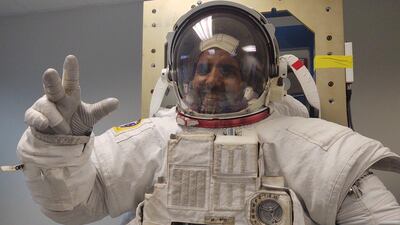
Hazza Al Mansouri, first Emirati man in space, wears a 130 kilogram-heavy extravehicular activities suit for spacewalk training. All photos courtesy of Mohammed bin Rashid Space Centre -
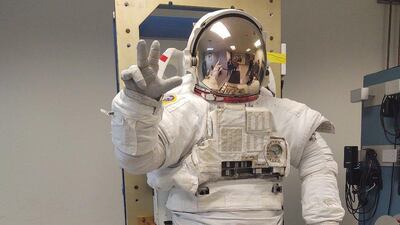
The suit is worn during spacewalks outside of the International Space Station and for training at the world's largest indoor pool at the Johnson Space Centre in Houston, Texas -
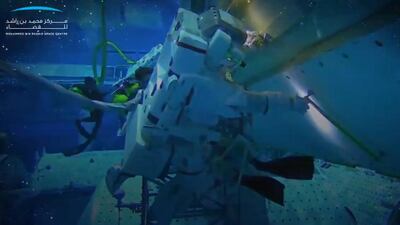
Located at the Neutral Buoyancy Lab (NBL), the indoor pool is 12-metres deep and has 2.4 million litres of water. It helps simulate microgravity and allows astronauts to work on a replica of the International Space Station placed underwater -
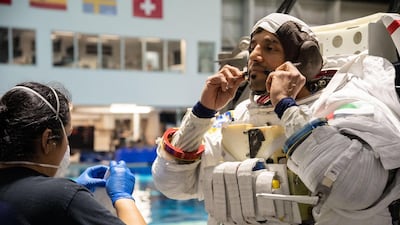
Sultan Al Neyadi, part of the UAE astronaut corps, wears his EVA suit for spacewalk training in the indoor pool -
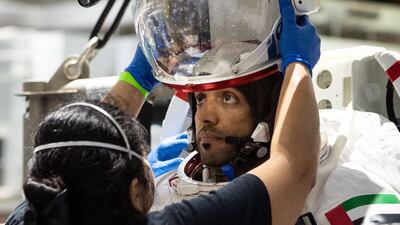
Sultan Al Neyadi puts his helmet on for spacewalk training under water. Mr Al Neyadi was one of two people selected from 4,022 candidates to become the first Emirati astronauts. Mbrsc -
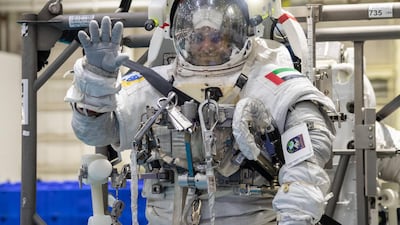
Mr Al Neyadi prepares to go underwater -
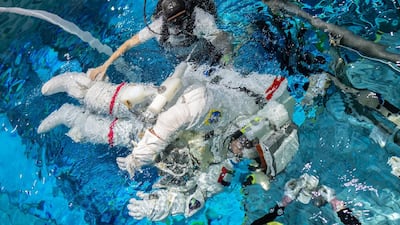
Mr Al Neyadi goes underwater with his EVA suit on for spacewalk training -
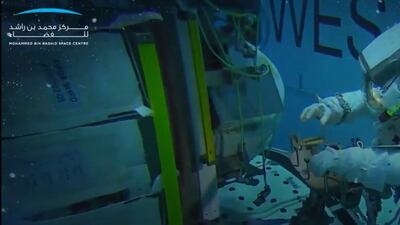
Astronauts can spend up to 10 hours per day at the bottom of the pool to practise maintenance work on the space station model and refine spacewalk techniques. -
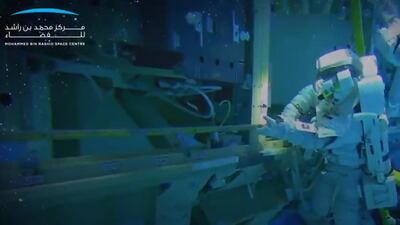
An Emirati astronaut underwater, refining his spacewalk technique. Performing a spacewalk is an extremely dangerous task and requires practise and skill. In 2013, Italian astronaut Luca Parmitano nearly drowned when water leaked into his helmet during a spacewalk. In 2019, Nasa astronaut Chris Cassidy’s wrist mirror broke off, releasing thousands of pieces of space junk -
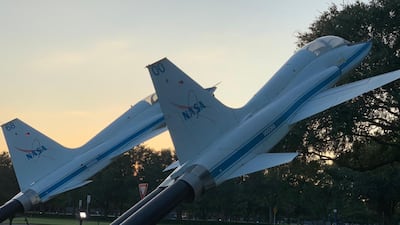
The Emirati astronauts are training for long-haul space missions at the Johnson Space Centre in Houston, Texas. They are also training on T-38 jets, which helps a pilot experience seven G-forces because of the speed. It can fly up to Mach 1.6 and 12,000 metres high – that is 3,000m higher than average airliners.



