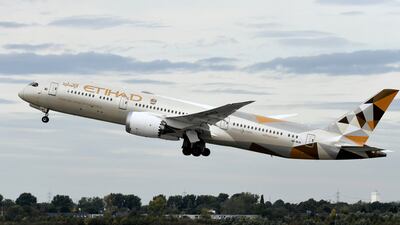
Etihad has cancelled flights between Abu Dhabi and Madinah until March 28. Photo: Unsplash / Sultan Auliya

Etihad Airways cancels flights from Abu Dhabi to Madinah until March


Hayley Skirka
  • English
  • Arabic

Etihad Airways has temporarily cancelled flights from Abu Dhabi to Madinah in Saudi Arabia.

Travellers booked to fly to the kingdom's holy city from the UAE capital will no longer be able to, as the airline has paused flights between the destinations until the end of March.

The decision has been made because of “operational reasons”, said a representative for the UAE’s national airline.

“Etihad regrets to advise that passenger services between Abu Dhabi and Madinah have been cancelled until March 28, 2022, due to operational reasons.

"Our teams are actively reaching out to affected travellers to provide them with alternative travel options or full refunds,” said the Etihad representative.

Etihad is offering travellers alternative flights or full refunds. Unsplash / Fabien Joy

Travellers who purchased flight tickets for the route via a travel agent should contact their agency directly for assistance on rebooking and refunds.

The airline also apologised for the inconvenience caused to guests by the operational change.

Located in the Hejaz region of western Saudi Arabia, Madinah is a three-hour flight from Abu Dhabi.

The city is home to the Prophet Mohammed’s Mosque and burial site and is an important holy place for Muslim pilgrims.

Etihad resumed thrice-weekly flights to the city in November last year, making it the airline’s fourth destination in the kingdom after Dammam, Jeddah and Riyadh.

___________________

World's safest airlines 2022 revealed: Etihad Airways and Emirates among best

  • 1. Air New Zealand. AFP
    1. Air New Zealand. AFP
  • 2. Etihad Airways. AFP
    2. Etihad Airways. AFP
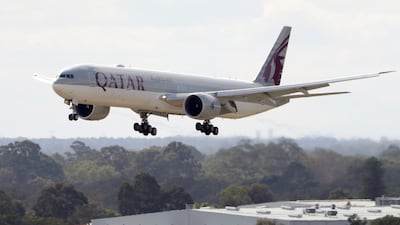
  • 3. Qatar Airways. EPA
    3. Qatar Airways. EPA
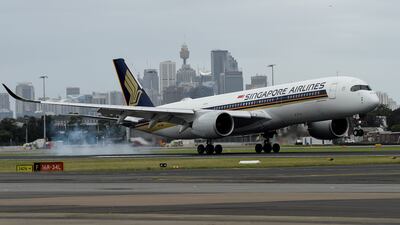
  • 4. Singapore Airlines. EPA
    4. Singapore Airlines. EPA
  • 5. TAP Air Portugal. Reuters
    5. TAP Air Portugal. Reuters
  • 6. Scandinavian Airlines (SAS). Reuters
    6. Scandinavian Airlines (SAS). Reuters
  • 7. Qantas. Reuters
    7. Qantas. Reuters
  • 8. Alaska Airlines. AFP
    8. Alaska Airlines. AFP
  • 9. EVA Air. EPA
    9. EVA Air. EPA
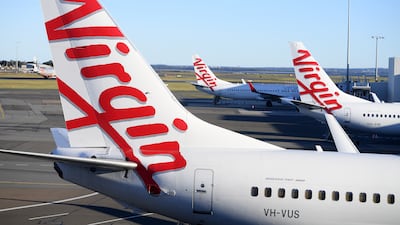
  • 10. Virgin Australia/Atlantic. EPA
    10. Virgin Australia/Atlantic. EPA
  • 11. Cathay Pacific. Getty Images
    11. Cathay Pacific. Getty Images
  • 12. Hawaiian Airlines. Reuters
    12. Hawaiian Airlines. Reuters
  • 13. American Airlines. AFP
    13. American Airlines. AFP
  • 14. Lufthansa/Swiss Group. AFP
    14. Lufthansa/Swiss Group. AFP
  • 15. Finnair. AFP
    15. Finnair. AFP
  • 16. Air France-KLM Group. Getty Images
    16. Air France-KLM Group. Getty Images
  • 17. British Airways (BA). EPA
    17. British Airways (BA). EPA
  • 18. Delta Air Lines. EPA
    18. Delta Air Lines. EPA
  • 19. United Airlines. AFP
    19. United Airlines. AFP
  • 20. Emirates. Reuters
    20. Emirates. Reuters
How to help

Call the hotline on 0502955999 or send "thenational" to the following numbers:

2289 - Dh10

2252 - Dh50

6025 - Dh20

6027 - Dh100

6026 - Dh200

The squad traveling to Brazil:

Faisal Al Ketbi, Ibrahim Al Hosani, Khalfan Humaid Balhol, Khalifa Saeed Al Suwaidi, Mubarak Basharhil, Obaid Salem Al Nuaimi, Saeed Juma Al Mazrouei, Saoud Abdulla Al Hammadi, Taleb Al Kirbi, Yahia Mansour Al Hammadi, Zayed Al Kaabi, Zayed Saif Al Mansoori, Saaid Haj Hamdou, Hamad Saeed Al Nuaimi. Coaches Roberto Lima and Alex Paz.


Ferrari
%3Cp%3E%3Cstrong%3EDirector%3A%3C%2Fstrong%3E%20Michael%20Mann%26nbsp%3B%3C%2Fp%3E%0A%3Cp%3E%3Cstrong%3EStarring%3A%3C%2Fstrong%3E%20Adam%20Driver%2C%20Penelope%20Cruz%2C%20Shailene%20Woodley%2C%20Patrick%20Dempsey%3C%2Fp%3E%0A%3Cp%3E%3Cstrong%3ERating%3A%3C%2Fstrong%3E%203%2F5%3C%2Fp%3E%0A
Ten tax points to be aware of in 2026

1. Domestic VAT refund amendments: request your refund within five years

If a business does not apply for the refund on time, they lose their credit.

2. E-invoicing in the UAE

Businesses should continue preparing for the implementation of e-invoicing in the UAE, with 2026 a preparation and transition period ahead of phased mandatory adoption. 

3. More tax audits

Tax authorities are increasingly using data already available across multiple filings to identify audit risks. 

4. More beneficial VAT and excise tax penalty regime

Tax disputes are expected to become more frequent and more structured, with clearer administrative objection and appeal processes. The UAE has adopted a new penalty regime for VAT and excise disputes, which now mirrors the penalty regime for corporate tax.

5. Greater emphasis on statutory audit

There is a greater need for the accuracy of financial statements. The International Financial Reporting Standards standards need to be strictly adhered to and, as a result, the quality of the audits will need to increase.

6. Further transfer pricing enforcement

Transfer pricing enforcement, which refers to the practice of establishing prices for internal transactions between related entities, is expected to broaden in scope. The UAE will shortly open the possibility to negotiate advance pricing agreements, or essentially rulings for transfer pricing purposes. 

7. Limited time periods for audits

Recent amendments also introduce a default five-year limitation period for tax audits and assessments, subject to specific statutory exceptions. While the standard audit and assessment period is five years, this may be extended to up to 15 years in cases involving fraud or tax evasion. 

8. Pillar 2 implementation 

Many multinational groups will begin to feel the practical effect of the Domestic Minimum Top-Up Tax (DMTT), the UAE's implementation of the OECD’s global minimum tax under Pillar 2. While the rules apply for financial years starting on or after January 1, 2025, it is 2026 that marks the transition to an operational phase.

9. Reduced compliance obligations for imported goods and services

Businesses that apply the reverse-charge mechanism for VAT purposes in the UAE may benefit from reduced compliance obligations. 

10. Substance and CbC reporting focus

Tax authorities are expected to continue strengthening the enforcement of economic substance and Country-by-Country (CbC) reporting frameworks. In the UAE, these regimes are increasingly being used as risk-assessment tools, providing tax authorities with a comprehensive view of multinational groups’ global footprints and enabling them to assess whether profits are aligned with real economic activity. 

Contributed by Thomas Vanhee and Hend Rashwan, Aurifer

Some of Darwish's last words

"They see their tomorrows slipping out of their reach. And though it seems to them that everything outside this reality is heaven, yet they do not want to go to that heaven. They stay, because they are afflicted with hope." - Mahmoud Darwish, to attendees of the Palestine Festival of Literature, 2008

His life in brief: Born in a village near Galilee, he lived in exile for most of his life and started writing poetry after high school. He was arrested several times by Israel for what were deemed to be inciteful poems. Most of his work focused on the love and yearning for his homeland, and he was regarded the Palestinian poet of resistance. Over the course of his life, he published more than 30 poetry collections and books of prose, with his work translated into more than 20 languages. Many of his poems were set to music by Arab composers, most significantly Marcel Khalife. Darwish died on August 9, 2008 after undergoing heart surgery in the United States. He was later buried in Ramallah where a shrine was erected in his honour.

The%20specs
%3Cp%3E%3Cstrong%3EEngine%3A%20%3C%2Fstrong%3E6.5-litre%20V12%3Cbr%3E%3Cstrong%3EPower%3A%20%3C%2Fstrong%3E725hp%20at%207%2C750rpm%3Cbr%3E%3Cstrong%3ETorque%3A%20%3C%2Fstrong%3E716Nm%20at%206%2C250rpm%3Cbr%3E%3Cstrong%3ETransmission%3A%20%3C%2Fstrong%3E8-speed%20dual-clutch%20auto%3Cbr%3E%3Cstrong%3EOn%20sale%3A%20%3C%2Fstrong%3EQ4%202023%3Cbr%3E%3Cstrong%3EPrice%3A%20%3C%2Fstrong%3EFrom%20Dh1%2C650%2C000%3C%2Fp%3E%0A

Where to Find Me by Alba Arikha
Alma Books 

The burning issue

The internal combustion engine is facing a watershed moment – major manufacturer Volvo is to stop producing petroleum-powered vehicles by 2021 and countries in Europe, including the UK, have vowed to ban their sale before 2040. The National takes a look at the story of one of the most successful technologies of the last 100 years and how it has impacted life in the UAE. 

Read part four: an affection for classic cars lives on

Read part three: the age of the electric vehicle begins

Read part two: how climate change drove the race for an alternative 

The specs

Engine: 2.0-litre 4-cylinder turbo

Power: 258hp from 5,000-6,500rpm

Torque: 400Nm from 1,550-4,000rpm

Transmission: Eight-speed auto

Fuel consumption: 6.1L/100km

Price: from Dh362,500

On sale: now

Updated: January 18, 2022, 10:02 AM