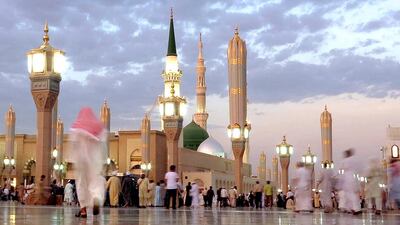
Saudi Arabia’s King Salman has approved the reopening of the Prophet’s Mosque in Madinah.
The mosque will begin reopening on Sunday, allowing only 40 per cent capacity at first in the courtyards and extension.
The old building and holy site will not be opened yet, as the lifting of restrictions will be carried out in stages.
The mosque has taken a variety of precautions to keep worshippers safe, including the removal of carpets to allow for easier cleaning, requiring visitors to wear masks and enabling parking payments to be made electronically.
The decision to allow worshippers back to the mosque is part of a wider policy of relaxing restrictions across the kingdom, including the opening of mosques. The city of Makkah, however, remains locked down.
In preparation for Sunday's reopening, Minister of Islamic Affairs Dr Abdullatif bin Abdulaziz Al Sheikh inspected a number of mosques to ensure hygiene and safety measures were being taken.
“Throughout our inspection trips, we found our mosques to have completed preparations and are in the best condition,” Dr Al Sheikh said.
He also stressed the importance of providing notices in several languages in all mosques to encourage adherence to guidance to prevent the spread of coronavirus, SPA reported.
Umrah trips to Makkah and Madinah remain halted.
Saudi Arabia also altered restrictions on gatherings and workplaces to allow larger meet-ups on Saturday, but instituted heavy fines for rule-breakers.
All areas of Saudi Arabia except Makkah have begun a three-stage lifting of the nationwide stay-at-home order imposed in late March to contain the kingdom’s coronavirus outbreak.
Gatherings of up to 50 people will be allowed in homes and farms, and for social events such as mourning and parties, a statement released by the Ministry of the Interior confirmed.
Earlier this month, the kingdom banned gatherings of more than five people to stem the spread of the coronavirus.
As restaurants and businesses prepare to reopen following a government announcement on Friday, new penalties have been set for those flouting the rules.
Businesses that allow entry to customers not wearing masks or which don’t provide appropriate handwashing or sterilising facilities risk being fined up to 10,000 riyals.
Play areas and fitting rooms in shops must remain closed.
People who refuse to wear masks or to adhere to social distancing guidelines will be fined 1,000 riyals, the statement said.
All penalties will double for repeat offenders.
______________
Gallery: Coronavirus around the region
-

Kuwaiti children cycle in a street in the Salwa district of Kuwait City. AFP -

Palestinian students have their body temperature checked as they arrive to take high school exams in Gaza City. Reuters -

An Iraqi woman, who had been stranded in Iran due to the novel coronavirus pandemic, gets her temperature checked by a health worker upon her arrival to Iraq via the Al-Shalamija border crossing, west of the southern city of Basra. AFP -

Palestinian students take high school exams in a classroom, amid concerns about the spread of coronavirus, in Gaza City. Reuters -

A woman wearing a protective face mask walks past a Starbucks coffee shop in Hamra street, Beirut, Lebanon. Reuters -

Imad Fawzi Shueibi, 59, professor of epistemology at Damascus University, speaks during an interview with AFP via video call from his home in the Syrian capital Damascus. The coronavirus pandemic could create a new world order in which everyone is a loser and new alliances are born to overcome disaster, according to the Syrian thinker. AFP -

A man walks past the Damascus Gate as it sits empty near the Dome of the Rock and al-Aqsa mosque compound, which remains shut to prevent the spread of coronavirus in Jerusalem's Old City. AP Photo -

An anti-government protester shouts slogans in font of riot policemen during a protest in Beirut, Lebanon. AP Photo -

An elderly man and woman walk next to closed shops in central Baghdad, Iraq. EPA -

Moroccans in a street in Casablanca, as authorities start to ease restrictions. AFP -

A teacher wearing face mask gives a lesson at a classroom at 'Riadh' high school, in La Marsa in the suburbs of Tunis, Tunisia, after authorities approved the easening of measures put in place due to the coronavirus pandemic. EPA -

Passengers waiting to board a repatriation flight from the Algerian capital Algiers to France. AFP



