Albania seems to be popular this year, with holidaymakers flocking to the Balkan country for its dramatic coastline dotted with seaside towns.
Last year, according to UN Tourism, the country received over 10 million visitors and I was lucky enough to be one of them, although I bypassed the popular coastal tourist trails to explore the roaming countryside, where farmhouses and family-run lodges make for a slow, cultural getaway.
Arriving late at night in Shkoder, an hour and a half north of Tirana International Airport, my Airbnb host welcomes me with a plate of petulla (traditional fried dough) served with home-made jam and feta. I instantly feel welcome, and it is a feeling that sets the tone for my entire visit.
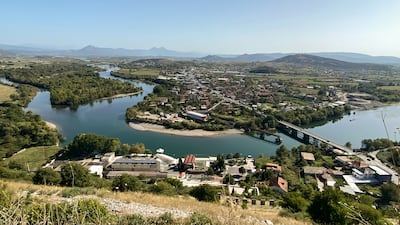
With a population of about 200,000, Shkoder is often used as a pit stop for travellers between Montenegro and the snow-capped Albanian Alps, but the city is worth exploring with its bougainvillaea-lined pathways leading to the 400-year-old Rozafa Castle where two rivers form ribbons across the surrounding landscape. It’s also perfect for exploring on two-wheels, and I enjoy a few days cycling around its cobbled streets before heading to the countryside.

A 70-minute boat ride through the towering canyons of the Lake Koman reservoir brings me to Neomalsore, a quaint guesthouse in the northern mountains. The farmhouse has been in the Koceku family for generations and overlooks an emerald blue water lake flanked by rugged cliffs. A flock of chickens, a baby goat and a lazy cat keep me company during my stay.
The guesthouse is just one of a many new farm stays and family-run accommodation options that embrace Albania's rural way of life, culinary customs and traditional hospitality. The agritourism movement is helping to put rural Albania on the tourism map while creating new economic opportunities.
Neomalsore is run by a Molla tribal family belonging to one of Albania’s Highland clans. Marjana Koceku is the youngest daughter and welcomes me with a glass of home-made fruit raki. She tells me that many travellers visit for a day trip, but that spending a few nights allows people to really enjoy the slow, sustainable local lifestyle.
At night, we sit outside for a candlelit dinner with other travellers. Koceku’s mum whips up a feast: home-made cornbread, goat cheese, fire-grilled freshwater fish and farm-bred chicken served with garden-picked vegetables and wild honey.

Not to be missed off my itinerary is Berat, a 2,400-year-old Unesco World Heritage Site. Here, the Osum River snakes past the city, and the town’s old quarter houses Ottoman-era residences with red ceramic roofs, white walls, and wooden windows. So closely packed together, it almost feels like the wide windows are stacked upon one another, giving the town its nickname, ‘the city of one over one windows.’ On top of a steep hill nearby is Berat Castle, a 13th-century citadel with preserved ancient walls, churches, local houses-turned-homestays, and restaurants.
While Berat is charming, it can get quite crowded, particularly in Albanian summers. So I opt to stay at Alpeta Agrotourism, a winery and guesthouse that offers guided hiking and kayaking tours in Roshnik village some 15km from Berat. At the open-air restaurant here I dine surrounded by grapevines, and the staff serve a traditional lunch of grilled mutton and seasonal vegetables.
“The concept of agritourism helps locals to promote rural areas as attractive travel destinations,” says owner Petrit Fiska. “It also helps farmers embrace our age-old agricultural practices while earning extra income.”

Delights await for those in search of outdoor pursuits and a quiet retreat across the Albanian countryside. In Rubik, a small town south of Shkoder, I stay for almost a week in a cosy wood cabin at Baven Toven.
Owner Bajron Nikolli, who migrated to Italy at the age of 14, returned to his homeland nearly two decades later to open the secluded mountain getaway which has five independent cabins. Nikolli now runs the guesthouse with the help of his parents and grandmother.
“I worked for many years in Italy and invested my savings to build this place. It was a sacrifice,” he says. “But I’m happy everything worked out. It’s a beautiful thing to see people arrive here every day from all over the world. And we have now employed two people. We’ve created jobs.”
At the cabin, Nikolli’s grandmother greets me every morning with a smile and an espresso. Breakfast is local and seasonal with byrek (meat, spinach, and cheese pie), pispili (leeks and feta cheese cornbread), and deep-fried Albanian pancakes served with local fig jam.
Days are spent visiting the village church and hiking to a secluded natural pool along the river or enjoying a leisurely lunch at the nearby Bar Restorant Aleksi. Packed with locals, this countryside restaurant with alfresco seating serves traditional qofte (grilled and pan-fried chicken, mutton, and lamb meatballs), stuffed peppers, and tasty seasoned pilau rice.
Proud of his country, Nikolli has a positive outlook on Albania’s evolving tourism industry. “In my area, there are no other industries. So without tourism, I couldn’t stay here, and would have to return to Italy,” he says.
“Luckily, Albania is beautiful. Within a few kilometres, you find the sea, mountains, lakes, and so much more.”
Getting to Albania from UAE
Flydubai has direct flights from Dubai to Tirana while Wizz Air operates non-stop from Abu Dhabi to Tirana.

