
The Olympics are generally the culmination of a life-long journey for athletes whose sole aim is to bring glory to their country and compatriots.
However, for some, the Games represent an outlet for their repressed dreams and a chance to make a fresh start. Hadi Tiranvalipour will be carrying such hopes at the Paris Games as part of the Refugee Olympic Team.
Tiranvalipour grew up in a province near Karaj and was a member of the Iranian taekwondo team for eight years, winning multiple national and international competitions. While studying for a masters in sports science and physical education, he also became a sports presenter.
Tiranvalipour publicly supported women's freedom in Iran, which did not go down well in his homeland. He was forced to flee the Iranian regime in 2022, arriving in Rome via Turkey and spending his first 10 days in Italy living in a forest.
His hardships did not end there as he was a refugee in a foreign country. The champion athlete had to wash dishes in restaurants to survive. But it was taekwondo that provided him a way out.
“When I arrived here, I didn't know anybody,” Tiranvalipour told Olympics.com. “And I told myself, ‘you only have one friend. Taekwondo is your friend.’ Taekwondo is not just a sport for me, taekwondo is my life and it gave me everything.”
He did not know how to restart his sporting journey so decided to simply ask for an opportunity, writing an email to the Italian taekwondo federation.
He went to the federation office and when he told them about his story again, they took him in. Tiranvalipour says he will forever be grateful to the Italian federation and sports minister Andrea Abodi for opening up a new pathway.
Competing at the Paris Games will be a dream come true for Tiranvalipour, who had taken up the sport after drawing inspiration from national champion Hadi Saei, who won three medals in taekwondo at the Olympics.
“I told my mother I would like to be like him, and one day I would like to participate in the Olympics like him. After 20 years, my Olympic dream has come true and I’m really happy. I would really like to get a medal like him,” Tiranvalipour recalls.
Tiranvalipour will compete in the 58kg category alongside Tokyo Olympics gold medalist Vito Dell’Aquila of Italy. Tiranvalipour and Dell’Aquila train together in the Italian taekwondo team and the former is grateful for his motivation.
"He is one of the best taekwondo players in the world,” Tiranvalipour said. “We are in the same category and always fighting each other. Whenever I’m tired, I look to Vito as an example and it motivates me.”
Having left his homeland, family and friends behind, Tiranvalipour admits finding a new purpose is difficult. But he now wants to represent the hopes and aspirations of refugees who only wish to lead a peaceful life.
“A refugee athlete is nothing like a normal athlete,” he admits. “They have a really difficult life, and we are far away from our family. I want to be at the Olympics to represent 120 million people. I know life for refugees and displaced people are so difficult, so I want to be a good example.
“We don’t have a flag, but we have 120 million people behind us, so we have to represent all of them. If you have a dream, you have to keep going. This is our responsibility to tell them.
“If you have a dream, if you have a target, if you have a purpose, you have to keep going.”
Tiranvalipour is among 14 Iranian athletes who make up the 37-member Refugee Team.
Olympic Refugee Team athletes
-

Iranian wrestler Iman Mahdavi, 28, practices at the Lotta Club Seggiano gym in Pioltello, Italy. Mahdavi fled his home country in October 2020. Now, he will compete in Paris as part of the Refugee Olympic Team. AP -

Iranian wrestler Iman Mahdavi, 28, is part of the IOC Refugee Olympic Team for the Paris Games. AP -
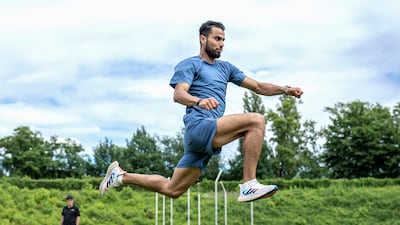
Syrian refugee Mohammad Amin Alsalami, 29, trains at the Wilmersdorf Stadium in Berlin. He now compete in Paris as part of the Refugee Olympic Team. AP -
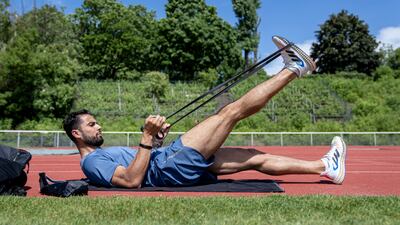
Syrian refugee Mohammad Amin Alsalami trains at the Wilmersdorf Stadium in Berlin. After leaving his war-torn hometown of Aleppo, he made it by foot to Germany through Turkey, Greece and the Balkans in 2015. AP -
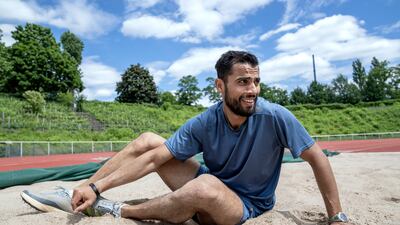
Mohammad Amin Alsalami trains for the Paris Olympics. AP -

Manizha Talash, originally from Afghanistan, practices outside the Parish of the Inmaculado Corazon de Maria in Madrid. The 21-year-old will compete with the Refugee Olympic Team at the Paris Olympics, where breaking has been included for the first time. AP -
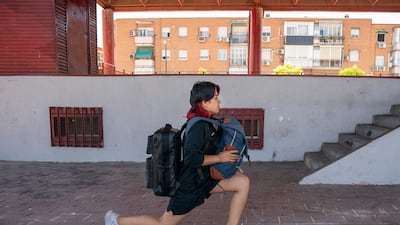
Manizha Talash practices in Madrid for the Paris Olympics. AP -
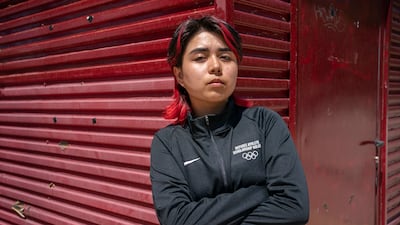
Manizha Talash, originally from Afghanistan, outside the Parish of the Inmaculado Corazon de Maria in Madrid, where she was granted asylum. AP -
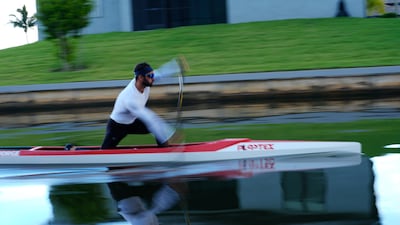
Rower Fernando Dayan Jorge paddles his canoe during a training session ahead of the Paris Olympics. Jorge, who will compete in canoe sprint for the Refugee team, rowed for his native country Cuba at the Rio 2016 and the Toyko 2020 Olympics, where he won a gold medal in men's canoe double 1000m and finished seventh in the singles event. AP -
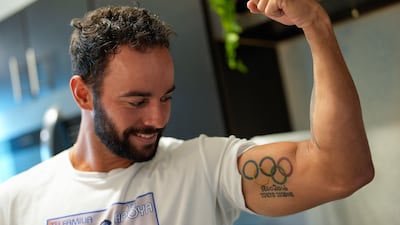
Fernando Dayan Jorge during a training session ahead of the Paris Olympics. AP



