


This weekend, a group of competition yachts will be sailed from Sir Bani Yas Island, south-west of Abu Dhabi, in a race to Dubai. For the victors it will be a perfect finale to a week’s worth of sailing up and down the UAE’s coastline, and the entire competition will have served as a forerunner to the Volvo Ocean Race, which will return to these shores later in the year. All photos courtesy TDIC
-
-
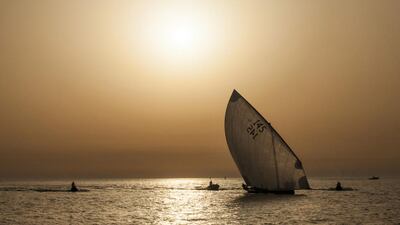
The Arabian Gulf has a rich maritime tradition of providing natural resources that have provided people with a living for centuries, and now it’s providing them with all manner of sporting activities. -
The competitions often last for many months, and it has been impossible to accurately portray the excitement, the challenges and the dedication of the crews taking part to a wide audience, simply because there was no way of seeing first-hand what’s been going on. -
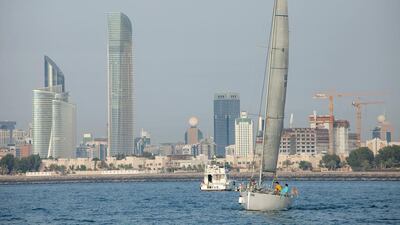
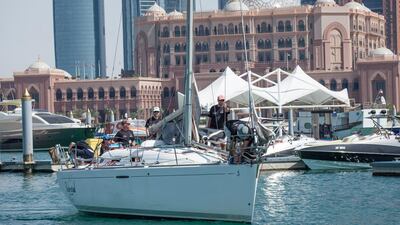
A flotilla of 13 different yachts raced from Dubai to Abu Dhabi, where they stopped before heading off to Sir Bani Yas (this leg was a cruise, rather than a timed competition), after which, some of them stayed for a short break on the island. -
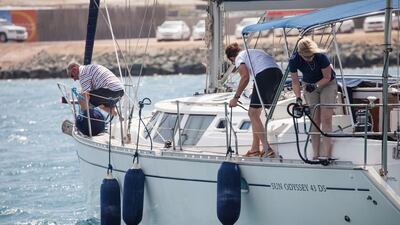
The others flew back to either Abu Dhabi or Dubai. The second leg of the race this weekend involves the teams flying back to Sir Bani Yas and getting back to Dubai — no stop — in the shortest possible time. The points gained go towards the tallies already accrued by competitors in the Dubai Off Shore Series championship. -
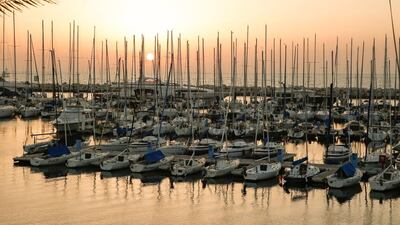
Delving into what’s involved in competing on the open sea, you soon come to realise that this is a most technically challenging sport — right up there with flying when it comes to strategy and the skill of getting to where you need to be in the shortest possible time. It’s all too much for someone like me, who can just about keep up with the rules of tennis. -
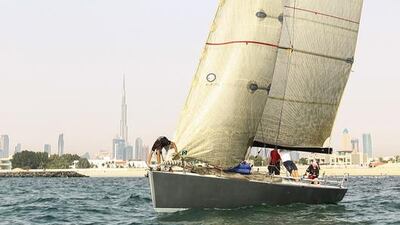
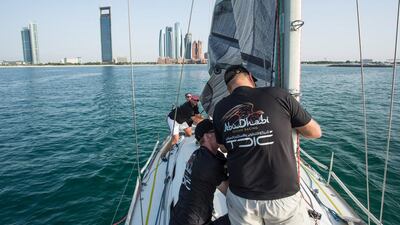
But the rewards involved can be extraordinary for those taking part. To get the best time and stay ahead of the competition (and often the other yachts can’t be seen from the one you happen to be aboard) takes efficient teamwork. -
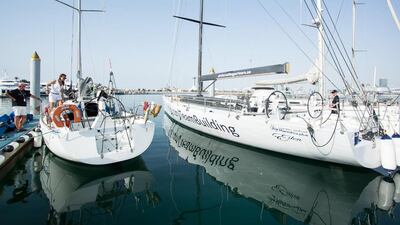
“Our season runs from mid-September till the end of May and in that time there’s something going on almost every weekend. So it’s a busy few months. One weekend it might be racing dinghies, the next it could be racing huge yachts — DOSC is a very active club,” said competitor Calum McKie. -
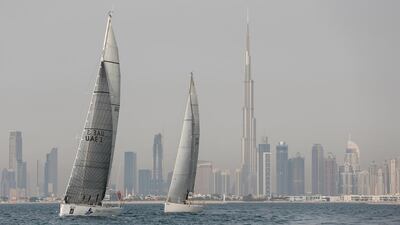
“In many ways Abu Dhabi is better for sailors than Dubai, where the currents have kept the coast fairly straight. Here it’s a lagoon environment, you have the mangroves along the coast and then there are the islands — there’s a great deal of beauty to be enjoyed here for people on the sea,” added McKie. -
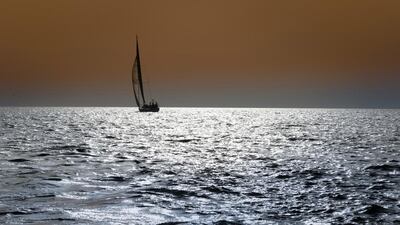
The official route from Abu Dhabi to Sir Bani Yas is about 120 nautical miles, which means an overnight sail, setting off at about 3pm and arriving at the island the following day. So it’s not for those just starting out, unless you’re a crew member rather than captain of the ship. -

“It’s completely about teamwork — a physical effort combined with a lot of technical knowledge, meteorology and luck. And when that all comes together it’s incredibly satisfying,” said Mckie. -
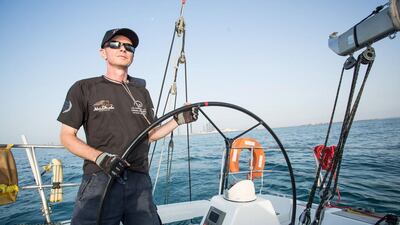
Butti Al Muhairi, an Emirati crew member for the Abu Dhabi Ocean Racing Team, sailed his first dhow in 1991. Over the years, he has raced them with great success before graduating to yacht racing. “Of course, the people of this country have been racing on the sea for centuries,” he said. “But this is something different. It’s a very exciting sport that is now capturing the imaginations of people all over the world, and we’re seeing more and more Emiratis getting involved. It will take time, obviously, a bit like it has been with motor racing, but young people here are starting to embrace sailing and that has to be a good thing.” -
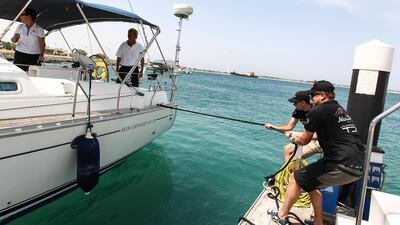
The event is expected to bring together 90 sailing euthsistas abroad 13 different yachts on a non-stop race from Yas Island to Dubai.
In pictures: Previewing the Sir Bani Yas Island Race and Rally
Most popular today

