

Amoory’s impact likely limited
It took almost one year, and those first 73 minutes in Kuala Lumpur last month, but Omar Abdulrahman returned finally to the UAE side, coming on as a second-half substitute in the 2-1 victory against Malaysia.
The celebrated playmaker, the 2016 Asian player of the year, has since featured sporadically for new club Al Jazira: 14 minutes against Al Dhafra, 31 against Al Wahda, 10 against Shabab Al Ahli.
Clearly, Jazira are intent on easing Abdulrahman back into action following last October’s serious knee injury and subsequent surgery while on the books at Al Hilal.
The UAE are similarly cautious – understandably – so the country’s most talented player looks set to be named on the bench once more, even though he has been an enthusiastic presence in training.
After Indonesia, the UAE travel to Thailand for what is sure to be a trickier test next Tuesday. Abdulrahman will likely be given more of a run out there.
Too much can’t be expected of Khalil
Like Abdulrahman, the return of Ahmed Khalil to the squad represents a welcome boost. The Shabab Al Ahli striker has long been the UAE’s go-to man, scoring decisive goals during qualifying and at major tournaments, stepping up to the plate when his team most needed it.
It’s just a shame, then, that for the past few seasons Khalil has been racked with fitness and form issues. It has left Ali Mabkhout as the UAE’s only reliable frontman, although against Malaysia he proved up to the task yet again.
The Jazira forward scored a goal in either half to turn potential defeat in the Group G opener into a win. Still, though, Mabkhout could do with someone easing the burden.
Youngsters Ali Saleh, Zayed Al Ameri and Yassim Yaqoub promise much, but remain untested at this level. Yet Indonesia has most probably come too soon for Khalil, given he has made only four substitute appearances for his club this season. He is set for a brief cameo, at best.
Starting better than in Malaysia
It was the worst possible start to Van Marwijk’s reign. In his first competitive match since his appointment last March, his new-look UAE conspired to concede after 33 seconds.
From there, the visitors to Kuala Lumpur were visibly rocked. Unable to gain an early foothold in the game, they should have gone further behind, with Malaysia missing a number of chances before the half hour.
However, Mabkhout restored parity just before half-time and clinched victory 15 minutes from the conclusion.
Fielding four players aged 23 and under, and with competitive debuts for Saleh, Yaqoub, Khalil Ibrahim and Mohammed Al Attas, the UAE could be forgiven somewhat for the shaky start. Against Indonesia, though, they must begin better.
Clearly a superior side, the hosts need to press home home advantage, especially considering their opponents are expected to sit back and attempt to suffocate. Eradicating mistakes made in Malaysia is necessary.
-
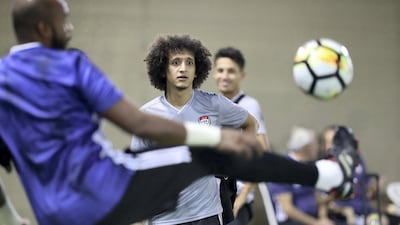
UAE playmaker Omar Abdulrahman training at Al Wasl Sports Club, Dubai, before their upcoming World Cup qualifier against Indonesia . Chris Whiteoak / The National -
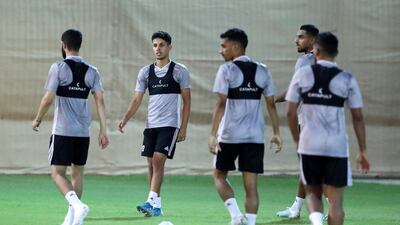
The UAE squad training at Al Wasl Sports Club, Dubai, before their upcoming World Cup qualifier against Indonesia . Chris Whiteoak / The National -

The UAE squad training at Al Wasl Sports Club, Dubai, before their upcoming World Cup qualifier against Indonesia . Chris Whiteoak / The National -

UAE goalkeeper Khalid Essa. Chris Whiteoak / The National -
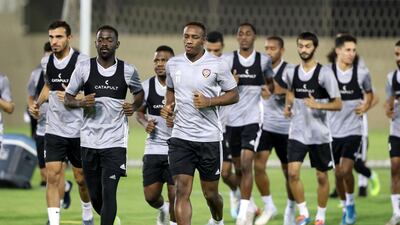
The UAE squad training at Al Wasl Sports Club, Dubai, before their upcoming World Cup qualifier against Indonesia . Chris Whiteoak / The National -
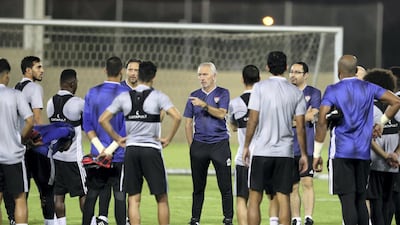
UAE manager Bert van Marwijk, centre, talking to the squad at training. Chris Whiteoak / The National -

The UAE squad training at Al Wasl Sports Club, Dubai, before their upcoming World Cup qualifier against Indonesia . Chris Whiteoak / The National -
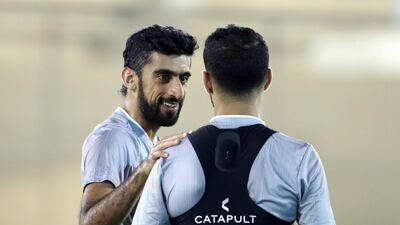
UAE's Hamdan Al Kamali, left, training at Al Wasl Sports Club, Dubai, before their upcoming World Cup qualifier against Indonesia . Chris Whiteoak / The National -
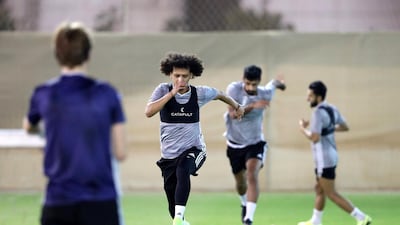
UAE's Omar Abdulrahman, second left, training at Al Wasl Sports Club, Dubai, before their upcoming World Cup qualifier against Indonesia . Chris Whiteoak / The National -

UAE's Ahmed Khalil. Chris Whiteoak / The National


Striking a balance in defence
It was always one of Van Marwijk’s most pressing concerns: the UAE had relied for too long on an ageing defence with Al Ain duo Ismail Ahmed and Mohanad Salem at its heart, so the backline needed significant remodelling.
Options were further restricted when Mahmoud Khamis’ disciplinary issues starved the UAE of their best left-back.
Against Malaysia, Van Marwijk opted for Walid Abbas there instead, with Khalifa Al Hammadi, 20, and Al Attas, 22 at centre-back.
For a large portion of the first-half, they all struggled, with the hosts enjoying considerable success down their right: Malaysia’s goal took root there, where Abbas, long ago reverted to centre-back at Shabab Al Ahli, appeared every bit his 34 years.
Undoubtedly, the return of experienced centre-back Hamdan Al Kamali will help, as will the availability of the hugely promising Salim Rashid. For Abbas, though, Al Hassan Saleh might get the nod out wide.
Full focus on Indonesia
Thursday’s opponents seem, on the surface, a pretty straightforward test. Indonesia have lost their opening two qualifiers, both at home, when they were defeated 3-2 by Malaysia and 3-0 by Thailand. At 167th in the Fifa rankings, they sit 101 places below the UAE.
Thus, Van Marwijk’s men go into the match as heavy favourites, with the qualifier against Thailand near Bangkok next Tuesday viewed – rightly, of course – as the sterner assignment.
However, the management and coaching staff have been stressing the importance of Thursday, guarding against complacency and warning of the threat posed by Indonesia.
The Southeast Asians were unlucky to lose the opener last month against fierce rivals Malaysia, beaten by a 96th-minute winner.
Against Thailand, they should have scored early. At home, Indonesia are urged to attack; in Dubai, they will presumably seek to frustrate the UAE. Full focus on the task at hand is required.

