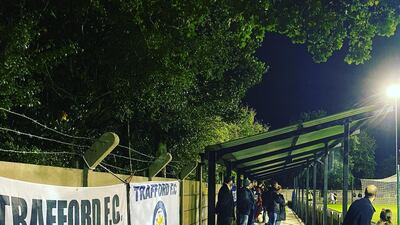

To the untrained eye, they look like two slabs of concrete behind a football pitch – because that’s what they are. To those involved in their recent construction, they’re an act of love and devotion.
Volunteer fans of Trafford FC, a Manchester based semi-professional football team, raised the best part of the £6,500 ($8,400) needed to improve the tree-lined Shawe View stadium by adding two steps of terracing.
Manchester’s Football Association chipped in with £2,000 and the volunteers set to work. Most had no construction experience, but they dug out the foundations and waited by wheelbarrows for the cement mixer truck, before pouring the cement on the earth and into a rough wooden mould.
They hope to add a third and fourth step, maybe a fifth and even a roof so that fans can gather in the dry and support their team.
On Tuesday evening against Kendal Town from England’s Lake District, they had no such luxury. Young men stood apart and chorused about singing in the rain as they did just that. They saw their team win for the first time this season – they had drawn the first three league games.
They were also among the very fortunate few able to watch live football in the United Kingdom right now.
October was supposed to be the month when fans were allowed back into stadiums, but they’re still banned in the top six tiers. At the closest football ground to Trafford, Manchester United don’t anticipate having fans back until at Old Trafford until March.
Fans are allowed back at step 7, though limited to 600 and step 8, where Trafford play. They are limited to 400, but that’s an ample figure for Trafford – just as there’s ample space for fans to socially distance around the pitch.
“Our average crowd was 287 last season but we sold all 400 tickets for our first home game,” explains chairman John Eadie.
“We could have sold many more, the demand coming from United and City fans who just want to see some live football. They want their football fix, they don’t get it from a screen.”
One such fan, Matthew Spellman, stands behind the goal.

“I’m coming here because I can’t go to United,” he says. “The return of Premier League football has a serious missing ingredient – the fans. It’s synthetic. It was a huge reality check for me coming here, but I like it.”
United and Trafford are close, geographically and in their connections.
United’s coaches bring their under 13 and under 14 players to watch Trafford play, to get them out of the nearby bubble of the hi-spec training ground and to see how the other half live.
Dominic Calvert-Lewin, the Premier League’s top scorer, said that the month spent playing at non-league Stalybridge Celtic as a teenager on the other side of Manchester was “the most I have ever enjoyed my football. It just gave me that sense of what it was to play in front of fans, to play proper men’s football and it was definitely a catalyst in propelling me forward.”
“Men’s football,” agrees Kieran O’Hara, long a goalkeeper at Manchester United and now with Burton Albion in England’s third tier.
He spent a year at Trafford aged 17. “I wasn’t ready for it but I wanted it and I needed to play football. Trafford were offering me 40 games a season so I went to watch my first game, a night match in the rain. I liked it, you don’t play many night matches as a youth footballer. The game was tough; there were 200 fans there. The pitch was beautiful. Paul McGuinness said that playing for Trafford would be good for me and I trusted that judgement. He was right. I was a kid, I was skinny but the lads looked after me. I had mental strength too and was fine playing at that level.” O’Hara still checks Trafford’s results but getting to a game could be more problematic.
Unfortunately, because Covid rates are now higher around Manchester than any English city, Trafford’s capacity has been cut to 200 by the local council.
“I’m fearful of more restrictions, but we simply can’t play games behind closed doors,” says the chairman Eadie.
“We won’t survive. We can easily hold 400 fans socially distancing. We’ve done over and above what we were asked to do. Every fan has their temperature checked, connect using the test and trace system, there’s sanitiser.”
It might not be enough. While the leagues above are expecting financial support from the government, it doesn’t apply to clubs like Trafford.

“We did get £7,000 from the Premier League from their match day support fund initiative which we greatly appreciated,” says Eadie, “but our main revenue is the money we take over the turnstile.”
Football clubs at this level play an important part in their community. It’s not just about the football, but an asset, a source of local pride which brings people together from all ages in real life.
There are junior teams, while three volunteer women in the portable hut served those English football ground staples of pies, peas, gravy and Bovril. Women and men on the turnstiles sell raffle tickets or match programmes too. It’s the same at every non-league football club.
“For some of our fans, this might be the only bit of social interaction they get,” says Eadie. “It’s cheap (£8, £5 or £2) and they enjoy it.” With mental well-being become a big concern and issues like loneliness prevalent, sport can be a positive.
One of those enjoying the game the most is Dave Brown, 74. He stands on the sides watching the club he helped found in 1990. A successful builder, he put his time and money into the club, helping finance and build the stands, the floodlights, the portable buildings and concrete fences around the pitch.
He analyses the players, purring with excitement when someone makes a good pass or tackle.
“He should be at a much higher level,” he says, pointing to one, “but don’t mention him in any articles because they’ll all come and try to sign him.”
The bigger fish are everywhere. Manchester and its environs are a hotbed for football, professional and semi-professional, but it’s a troubling time for all. Bury and Macclesfield Town, clubs with over 100 years of history, have gone under since last year while fans of Bolton and Wigan have been pushed to the brink by their owners.
They will probably get government support as games continue to be played with no fans, as should the non-league clubs at tier 5 and 6. It’s the clubs like FC United in level seven who fear they will fall between the cracks. At present, FC can allow 600 fans into games.
“That’s 1,068 below our average last season,” explains FC’s chairman Adrian Seddon. “It’s a lot of lost revenue and there’s no talk of a bailout for us or other clubs at our level with high crowds like South Shields and Scarborough. We’re caught between the now subsidised elite and grassroots. It all makes planning our budget a nightmare and the restrictions are simply unsustainable for us.”
Football needs its fans more than ever.
“Even if Premier League football returns, I’ll come back,” says Spellman. “My eight year old has just signed for Trafford’s under 9s team and has set his sights on the first team. Hopefully the club will still exist for that to be a possibility. The terrace at the end might even have six steps and a roof by then.”

