

After a decade of intense rivalry, the rougher edges have smoothed. As the Jose Mourinho-Pep Guardiola duel rolls back onto the calendar, in its fifth different guise, it scarcely seems right to call it a feud any longer. There has been little sniping since a Manchester derby more than two years ago ended with Mourinho confronting celebrating City players in the Old Trafford tunnel.
It seems even longer ago that these managers were competing with a equal chance of seizing titles.
In the build-up to Sunday's visit by Guardiola’s Premier League champions to London, where Mourinho takes on Guardiola for the first time as Spurs manager, the Portuguese has been preoccupied not with past tussles but with issues closer to home.
In the old days of what became a toxic relationship between the two leading club coaches of their generation, Mourinho would complain about how often his teams had to take on Guardiola’s a man short, because somebody in his Internazionale, or his Real Madrid, or his Chelsea teams had been sent off.
Ahead of Spurs against City, he talked not of the habit of 10 versus 11, but about the absence of his number 10, the jersey the injured Harry Kane wears for Spurs, and, in passing, the departure of Tottenham’s most natural ‘number 10’ in terms of the football he plays, Christian Eriksen, who has joined Internazionale.
Both are significant figures to have to compensate for, and a glance at City’s squad – four places and 16 points above Spurs – reminds him of what Mourinho sees as a gulf in the two clubs’ strength in depth.
“To me, [City] have 20 players of the same quality,” said Mourinho, listing the luxury of choice Guardiola has at his disposal.
“To play Kyle Walker or Joao Cancelo, to play Nicolas Otamendi or Aymeric Laporte, to play Kun Aguero or Gabriel Jesus, to play Bernardo Silva or David Silva? This is the kind of squad that I think could play four matches a week."
________________
United win but City through to League Cup final
-
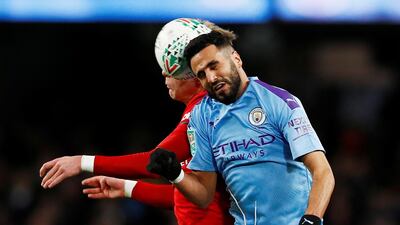
Manchester United's Brandon Williams takes on Manchester City's Riyad Mahrez. Reuters -
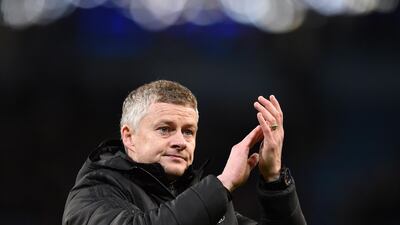
Manchester United manager Ole Gunnar Solskjaer applauds the fans following the League Cup semi-final second leg against Manchester City at the Etihad Stadium. AFP -
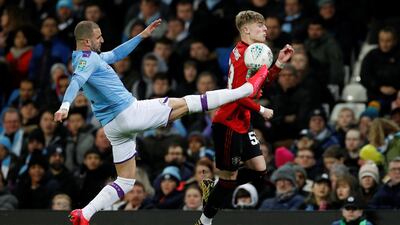
Manchester United's Brandon Williams vies for the ball with Manchester City's Kyle Walker in the League Cup semi-final second leg. Reuters -
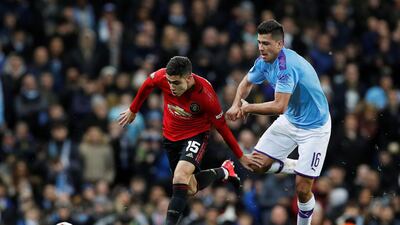
Manchester City's Rodri with Manchester United's Andreas Pereira. Reuters -
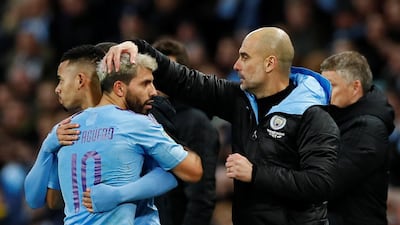
Manchester City's Sergio Aguero with manager Pep Guardiola as he was substituted for Gabriel Jesus. Reuters -
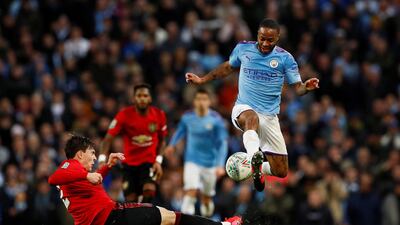
Manchester City's Raheem Sterling takes on Manchester United's Victor Lindelof. Reuters -
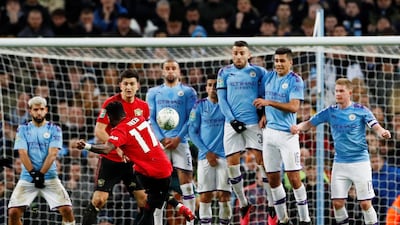
Manchester United's Fred takes a free kick. Reuters -
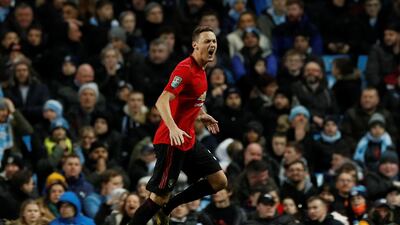
Manchester United's Nemanja Matic celebrates scoring during the League Cup semi-final second leg against Manchester City. Reuters -
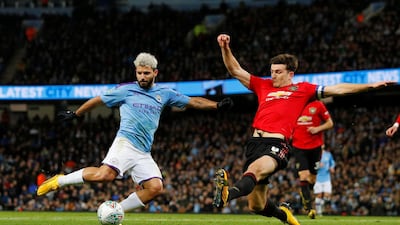
Manchester City's Sergio Aguero misses a chance to score. Reuters -
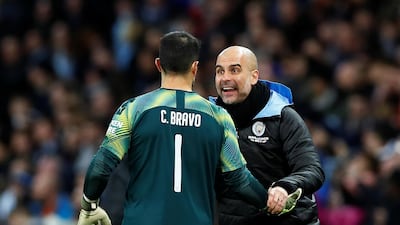
Manchester City manager Pep Guardiola with Claudio Bravo Action. Reuters -
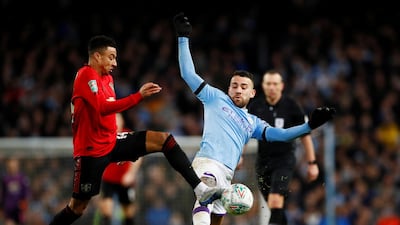
Manchester United's Jesse Lingard battles with Manchester City's Nicolas Otamendi. Reuters


________________
Time was that Mourinho and Guardiola seemed to be dueling, tooth and nail, about four times a week, their every press conference liable to contain a barb from one towards the other, or at least be interpreted as if each remark was laced with personal venom.
The crackling nadir was when Mourinho coached Real Madrid, from 2010, and Guardiola was in his third and fourth seasons as coach at Barcelona. At one stage they had to play one another four times in 17 days, across Liga and Champions League, and in a Copa del Rey final that yielded a rare Mourinho victory over Guardiola’s admired Barca.
Those days were wearying, Guardiola recalled ahead of this, the 23rd head-to-head between the pair. “Every time we played, people were talking not about who is going to win, just my performance or his.” The dynamic had altered since then, said Guardiola. “Maybe we are older and more experienced.”
The Catalan certainly is. He was in his first senior job while at Barcelona; Mourinho had already won leagues with Porto, Chelsea and Internazionale, and the Champions League twice, the second time via a highly-charged, emotional semi-final win for Inter over Guardiola’s Barcelona.
During one of their duels-via-microphone, ahead of a Madrid-Barca confrontation, Guardiola acknowledged Mourinho had a head-start in certain aspects of the job. “I cannot compete with you Jose, in press conferences,” he said. “You are the king of that arena.”
Since then, Guardiola has more than caught up, if not in the preparation of so-called ‘mind games,’ certainly in trophies, with his hauls at Bayern Munich – where his first silverware came from a tight victory over Mourinho’s Chelsea in the Uefa Super Cup – and at City.
The head-to-heads, incidentally, have Guardiola well on top – 11 wins to Mourinho’s five – in a saga that has crossed two different leagues, three distinct Cup competitions, European contests, and, most recently, local derbies in Manchester, but which has its roots further back, as Guardiola sometimes chooses to remind his friend-turned-foe-turned-fellow-traveller through their arduous profession.
Once upon a time, in the 1990s, when Mourinho was a young, ambitious assistant coach at Barcelona and Guardiola was their cerebral midfielder, they genuinely sought out one another’s company, and felt like allies.
“I have always had incredible respect,” said Guardiola, “for what he has done.”
Many times, that respect has been bruised. But it will be acknowledged at kick-off in London. It may even endure to the final whistle – as long as Spurs still have 11 men on the pitch.

