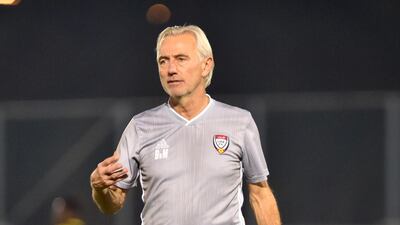
Seeking a third manager since Bert van Marwijk’s departure last December, the UAE looked to a former incumbent. That is, they sought to employ Bert van Marwijk.
On Monday, the Football Association announced they had agreed upon a deal for the Dutchman to return, little more than a year after his shock release. Aged 68, he will succeed Jorge Luis Pinto once the contract, believed to stretch to two years, is finalised this week.
While Van Marwijk appeared a surprising candidate when news first emerged on Thursday that he was being considered, he feels once more a suitable choice.
The same logic that made sense upon his appointment in March last year applies now: Van Marwijk had already known Gulf football, the players and the practices, having served with distinction as Saudi Arabia manager from 2015 to 2017. Before his tenure there reached a similarly abrupt conclusion, he had guided the country to a first World Cup in 12 years.
Now, thanks to that nine-month stint in the Emirates last year, Van Marwijk and his staff possess a deeper understanding of UAE football, of the need to push ahead with regenerating an ageing and battle-weary squad, of what it would take to lift the national team to a second World Cup in their history. For that was, and remains, his primary remit.
Admittedly, there was criticism last year that Van Marwijk had placed too much emphasis on youth as the UAE embarked on qualification - in their opening Group G match, against Malaysia, Ali Saleh (19), Jassim Yaqoub (22), and Mohammad Al Attas (22) were handed competitive debuts, with the latter partnering 20-year-old Khalifa Al Hammadi in central defence. But it was clear this marked a fresh era, a separation from the recent past. Which was needed.
While signs of progress were evident, the UAE won two and lost two of their opening four qualifiers, despite performing better than Vietnam, when they almost survived 60 minutes in Hanoi with 10 men. Injury and fitness issues to star men, most notably Omar Abdulrahman and Ahmed Khalil, were a recurring theme.
Ultimately, the group-stage exit from a hastily arranged Gulf Cup of Nations prompted Van Marwijk's dismissal. In came Ivan Jovanovic, who lasted 106 days, followed by Pinto this June. The Colombian, always a difficult fit given his lack of Gulf-game knowledge and the considerable pinch of the pandemic, was gone within five months. Neither he nor Jovanovic took charge of a competitive match.
So the criterion for a new man was set: wisely, the FA coveted someone who knew the players and the league. A preliminary list included Zoran Mamic, Mahdi Ali, Rodolfo Arruabarrena and Henk ten Cate. In the end, they opted for Van Marwijk.
Now the hard work begins again, albeit from a stronger vantage point. Because of the pandemic, Van Marwijk finds the UAE in exactly the same position in the standings as when he left.
Despite the 376 days passed, the UAE remain fourth in Group G, five points behind leaders Vietnam. They retain the game in hand on their rivals.
The qualifiers, postponed and postponed again, resume in March, with a double-header at home to Malaysia and away to Indonesia - eminently winnable ties - before what promises to be a decisive five-day spell at home in June against Thailand and Vietnam.
Van Marwijk’s staff has apparently kept abreast of the Arabian Gulf League and the national talent, while they will embrace the enhanced options in attack supplied by the naturalization earlier this year of Sebastian Tagliabue, Fabio De Lima and Caio Canedo.
Meanwhile, and unlike previously, Van Marwijk is said to have agreed to spend the majority of his time based in the UAE, from where he will attend the Arabian Gulf League matches more often. A seemingly standard stipulation, Van Marwijk has long chosen to reside in the Netherlands even when employed outside it. It was one of the major contentions of his time with the UAE and, more prominently, Saudi.
Whatever opinion held of the decision to part company with Van Marwijk in the first place, a line should be drawn in the Arabian sand. The short period between now and the resumption of qualification demands it. Full focus is required. And, although the national-team committee has changed, the FA can be given credit for the courage to reverse that initial call, when Gulf football rarely finds time for concessions or corrections.
For now until June, Van Marwijk must be given the trust to lead the UAE through four must-win fixtures. The former manager, who always considered business unfinished, should return with renewed conviction. Patently, he has a point to prove in the UAE’s forge forward towards 2022.
Volvo ES90 Specs
Engine: Electric single motor (96kW), twin motor (106kW) and twin motor performance (106kW)
Power: 333hp, 449hp, 680hp
Torque: 480Nm, 670Nm, 870Nm
On sale: Later in 2025 or early 2026, depending on region
Price: Exact regional pricing TBA
Race card:
6.30pm: Maiden; Dh165,000; 2,000m
7.05pm: Handicap; Dh165,000; 2,200m
7.40pm: Conditions; Dh240,000; 1,600m
8.15pm: Handicap; Dh190,000; 2,000m
8.50pm: The Garhoud Sprint Listed; Dh265,000; 1,200m
9.25pm: Handicap; Dh170,000; 1,600m
10pm: Handicap; Dh190,000; 1,400m
The Details
Kabir Singh
Produced by: Cinestaan Studios, T-Series
Directed by: Sandeep Reddy Vanga
Starring: Shahid Kapoor, Kiara Advani, Suresh Oberoi, Soham Majumdar, Arjun Pahwa
Rating: 2.5/5
Mercer, the investment consulting arm of US services company Marsh & McLennan, expects its wealth division to at least double its assets under management (AUM) in the Middle East as wealth in the region continues to grow despite economic headwinds, a company official said.
Mercer Wealth, which globally has $160 billion in AUM, plans to boost its AUM in the region to $2-$3bn in the next 2-3 years from the present $1bn, said Yasir AbuShaban, a Dubai-based principal with Mercer Wealth.
“Within the next two to three years, we are looking at reaching $2 to $3 billion as a conservative estimate and we do see an opportunity to do so,” said Mr AbuShaban.
Mercer does not directly make investments, but allocates clients’ money they have discretion to, to professional asset managers. They also provide advice to clients.
“We have buying power. We can negotiate on their (client’s) behalf with asset managers to provide them lower fees than they otherwise would have to get on their own,” he added.
Mercer Wealth’s clients include sovereign wealth funds, family offices, and insurance companies among others.
From its office in Dubai, Mercer also looks after Africa, India and Turkey, where they also see opportunity for growth.
Wealth creation in Middle East and Africa (MEA) grew 8.5 per cent to $8.1 trillion last year from $7.5tn in 2015, higher than last year’s global average of 6 per cent and the second-highest growth in a region after Asia-Pacific which grew 9.9 per cent, according to consultancy Boston Consulting Group (BCG). In the region, where wealth grew just 1.9 per cent in 2015 compared with 2014, a pickup in oil prices has helped in wealth generation.
BCG is forecasting MEA wealth will rise to $12tn by 2021, growing at an annual average of 8 per cent.
Drivers of wealth generation in the region will be split evenly between new wealth creation and growth of performance of existing assets, according to BCG.
Another general trend in the region is clients’ looking for a comprehensive approach to investing, according to Mr AbuShaban.
“Institutional investors or some of the families are seeing a slowdown in the available capital they have to invest and in that sense they are looking at optimizing the way they manage their portfolios and making sure they are not investing haphazardly and different parts of their investment are working together,” said Mr AbuShaban.
Some clients also have a higher appetite for risk, given the low interest-rate environment that does not provide enough yield for some institutional investors. These clients are keen to invest in illiquid assets, such as private equity and infrastructure.
“What we have seen is a desire for higher returns in what has been a low-return environment specifically in various fixed income or bonds,” he said.
“In this environment, we have seen a de facto increase in the risk that clients are taking in things like illiquid investments, private equity investments, infrastructure and private debt, those kind of investments were higher illiquidity results in incrementally higher returns.”
The Abu Dhabi Investment Authority, one of the largest sovereign wealth funds, said in its 2016 report that has gradually increased its exposure in direct private equity and private credit transactions, mainly in Asian markets and especially in China and India. The authority’s private equity department focused on structured equities owing to “their defensive characteristics.”
Sweet%20Tooth
%3Cp%3E%3Cstrong%3ECreator%3A%20%3C%2Fstrong%3EJim%20Mickle%3Cbr%3E%3Cstrong%3EStarring%3A%20%3C%2Fstrong%3EChristian%20Convery%2C%20Nonso%20Anozie%2C%20Adeel%20Akhtar%2C%20Stefania%20LaVie%20Owen%3Cbr%3E%3Cstrong%3ERating%3A%20%3C%2Fstrong%3E2.5%2F5%3C%2Fp%3E%0A
Hot%20Seat
%3Cp%3EDirector%3A%20James%20Cullen%20Bressack%3Cbr%3E%3Cbr%3EStars%3A%20Mel%20Gibson%2C%20Kevin%20Dillon%2C%20Shannen%20Doherty%2C%20Sam%20Asghari%3Cbr%3E%3Cbr%3ERating%3A%201%2F5%3C%2Fp%3E%0A
Company Profile
Founder: Omar Onsi
Launched: 2018
Employees: 35
Financing stage: Seed round ($12 million)
Investors: B&Y, Phoenician Funds, M1 Group, Shorooq Partners
Mane points for safe home colouring
- Natural and grey hair takes colour differently than chemically treated hair
- Taking hair from a dark to a light colour should involve a slow transition through warmer stages of colour
- When choosing a colour (especially a lighter tone), allow for a natural lift of warmth
- Most modern hair colours are technique-based, in that they require a confident hand and taught skills
- If you decide to be brave and go for it, seek professional advice and use a semi-permanent colour
ELECTION%20RESULTS
%3Cp%3EMacron%E2%80%99s%20Ensemble%20group%20won%20245%20seats.%26nbsp%3B%3C%2Fp%3E%0A%3Cp%3EThe%20second-largest%20group%20in%20parliament%20is%20Nupes%2C%20a%20leftist%20coalition%20led%20by%20Jean-Luc%20Melenchon%2C%20which%20gets%20131%20lawmakers.%26nbsp%3B%3C%2Fp%3E%0A%3Cp%3EThe%20far-right%20National%20Rally%20fared%20much%20better%20than%20expected%20with%2089%20seats.%3C%2Fp%3E%0A%3Cp%3EThe%20centre-right%20Republicans%20and%20their%20allies%20took%2061.%3C%2Fp%3E%0A
more from Janine di Giovanni
MATCH INFO
Austria 2
Hinteregger (53'), Schopf (69')
Germany 1
Ozil (11')
Karwaan
Producer: Ronnie Screwvala
Director: Akarsh Khurana
Starring: Irrfan Khan, Dulquer Salmaan, Mithila Palkar
Rating: 4/5
Racecard
%3Cp%3E%0D5pm%3A%20Al%20Maha%20Stables%20%E2%80%93%20Maiden%20(PA)%20Dh80%2C000%20(Turf)%201%2C400m%0D%3Cbr%3E5.30pm%3A%20Al%20Anoud%20Stables%20%E2%80%93%20Handicap%20(PA)%20Dh80%2C000%20(T)%201%2C200m%0D%3Cbr%3E6pm%3A%20Wathba%20Stallions%20Cup%20%E2%80%93%20Handicap%20(PA)%20Dh70%2C000%20(T)%201%2C400m%0D%3Cbr%3E6.30pm%3A%20Arabian%20Triple%20Crown%20Round%202%20%E2%80%93%20Group%203%20(PA)%20Dh%20300%2C000%20(T)%202%2C200m%0D%3Cbr%3E7pm%3A%20Liwa%20Oasis%20%E2%80%93%20Group%202%20(PA)%20Dh300%2C000%20(T)%201%2C400m%0D%3Cbr%3E7.30pm%3A%20Dames%20Stables%20%E2%80%93%20Handicap%20(TB)%20Dh80%2C000%20(T)%201%2C400m%3C%2Fp%3E%0A
Timeline
2012-2015
The company offers payments/bribes to win key contracts in the Middle East
May 2017
The UK SFO officially opens investigation into Petrofac’s use of agents, corruption, and potential bribery to secure contracts
September 2021
Petrofac pleads guilty to seven counts of failing to prevent bribery under the UK Bribery Act
October 2021
Court fines Petrofac £77 million for bribery. Former executive receives a two-year suspended sentence
December 2024
Petrofac enters into comprehensive restructuring to strengthen the financial position of the group
May 2025
The High Court of England and Wales approves the company’s restructuring plan
July 2025
The Court of Appeal issues a judgment challenging parts of the restructuring plan
August 2025
Petrofac issues a business update to execute the restructuring and confirms it will appeal the Court of Appeal decision
October 2025
Petrofac loses a major TenneT offshore wind contract worth €13 billion. Holding company files for administration in the UK. Petrofac delisted from the London Stock Exchange
November 2025
180 Petrofac employees laid off in the UAE
Ten tax points to be aware of in 2026
1. Domestic VAT refund amendments: request your refund within five years
If a business does not apply for the refund on time, they lose their credit.
2. E-invoicing in the UAE
Businesses should continue preparing for the implementation of e-invoicing in the UAE, with 2026 a preparation and transition period ahead of phased mandatory adoption.
3. More tax audits
Tax authorities are increasingly using data already available across multiple filings to identify audit risks.
4. More beneficial VAT and excise tax penalty regime
Tax disputes are expected to become more frequent and more structured, with clearer administrative objection and appeal processes. The UAE has adopted a new penalty regime for VAT and excise disputes, which now mirrors the penalty regime for corporate tax.
5. Greater emphasis on statutory audit
There is a greater need for the accuracy of financial statements. The International Financial Reporting Standards standards need to be strictly adhered to and, as a result, the quality of the audits will need to increase.
6. Further transfer pricing enforcement
Transfer pricing enforcement, which refers to the practice of establishing prices for internal transactions between related entities, is expected to broaden in scope. The UAE will shortly open the possibility to negotiate advance pricing agreements, or essentially rulings for transfer pricing purposes.
7. Limited time periods for audits
Recent amendments also introduce a default five-year limitation period for tax audits and assessments, subject to specific statutory exceptions. While the standard audit and assessment period is five years, this may be extended to up to 15 years in cases involving fraud or tax evasion.
8. Pillar 2 implementation
Many multinational groups will begin to feel the practical effect of the Domestic Minimum Top-Up Tax (DMTT), the UAE's implementation of the OECD’s global minimum tax under Pillar 2. While the rules apply for financial years starting on or after January 1, 2025, it is 2026 that marks the transition to an operational phase.
9. Reduced compliance obligations for imported goods and services
Businesses that apply the reverse-charge mechanism for VAT purposes in the UAE may benefit from reduced compliance obligations.
10. Substance and CbC reporting focus
Tax authorities are expected to continue strengthening the enforcement of economic substance and Country-by-Country (CbC) reporting frameworks. In the UAE, these regimes are increasingly being used as risk-assessment tools, providing tax authorities with a comprehensive view of multinational groups’ global footprints and enabling them to assess whether profits are aligned with real economic activity.
Contributed by Thomas Vanhee and Hend Rashwan, Aurifer