
Noussair Mazraoui has played for some of the biggest clubs in world football. Fourteen years at Ajax, including five in the first team. Two seasons with Bayern Munich. And in 2024, he moved to Manchester United and played 57 times in his first season, far more than he’d ever played before.
Multiple United insiders say he is the best signing they have made in years. There are several reasons for this. Mazraoui is technically secure on the ball with both feet, he dribbles well out of pressure, his game understanding impresses teammates and coaches.
United knew they were getting a good player, but have been surprised at how agile and aggressive the Dutch-born Morocco international has been, how strong he is.
Known as ‘Nous’ to his teammates, the 27-year-old is also versatile and can play right-back, left-back and central defender.
He’s a full-back that both cuts inside and plays midfield – both high and low. Like a modern day Denis Irwin, United’s legendary full-back, Mazraoui is consistent week after week, delivering with a seven or an 8/10 performance.
He’s quiet, popular with his teammates, respectful and unassuming. They trust him with the ball and know that he’ll be calm when they pass to him under pressure.
Mazraoui won’t play anything like 57 games for United this season since the team have no European football, nor League Cup commitment, and he’s also missed the start of the season with injury, though he returned for United’s third league game against Burnley and he’s primed to start in Sunday’s Manchester derby.
The National spoke to Mazraoui about life, faith and, of course, United.
How was your first season at Manchester United?
On a personal level, my fitness and the amount of games I played, I can look back to a good season. In fitness, the Premier League is always different than the other competitions. No winter break obviously. The games were following up really fast. So, from that kind of way, it was good.
Of course, I don't think I have to talk about the performances as a team. The result was where we were [at the end of] the season. That says enough, and everybody knows about that.
You played a lot more games than in previous seasons. Was that a surprise and how were the physical demands compared to the other leagues you played in?
You hope to stay fit and play as much as possible. That hadn’t always been the case for me. The Premier League is a bigger demand than other competitions, so you must take even more care of your body.
I had a switch in my mindset – be fit and ready and I think that helped me play so many games. I believe in my own quality too, so I knew if I could reach my own level I would play a lot of games. I knew that beforehand because I know my level.
How is the Premier League different from the other leagues that you've played in?
It was no winter break for me for the first time. Instead, you have even more games. Previously, I’d felt during end of November or at the start of December that your body is looking forward to a little break.
In the Premier League, you don’t get that one. So that was a hard period. I think from December to January were some hard months for me. Because you must get used to it and your body's used to something else, to a little break.
And, also the speed of play. It's high, but I think it has a lot to do also with the quality of the other teams – there's a lot of quality in the Premier League. You see it just now.
We signed two great players from Wolves and Brentford [Matheus Cunha and Bryan Mbeumo] – it shows every team in the Premier League has quality, that the average quality is higher than other competitions.
We're not going to speak too much about last season, but I want you to pull out a couple of positives, on a personal level, from a very difficult season.
For me personally, that I was able to play this many games and minutes. I managed to play more minutes last season than I did the past two and a half seasons [in total]. I played some great games too and reached a first European final. At the end, not winning it hurt, but reaching the first final is already a first step.
I feel like it's always a little bit hard when you come to a new club. You always see that players need time to adapt, but I don't think I really needed any time to adapt. I adapted very quickly, so that's also a big positive from last season.
How would you describe Manchester United, the club, to your friends back home if they knew nothing about the club?
A huge club, really a huge club. Everybody knows Manchester United. Everybody sees them. Everybody likes to talk a lot about them in every kind of way, there's a lot of attention and focus on the club. That's what you see and that's what you feel inside the club. You feel that the pressure is on.
We can’t have a season like last season, and before that even winning the FA Cup but still being seventh or eighth in the league is still not enough for this club, so that's how you know how big this club is.
But Ajax is a big club, Bayern Munich is a big club. I spoke to Erik ten Hag and he said, you know, Ajax is international, it's big, but Man United is global.
I totally agree with that. If you see it that way, pressure -wise, it's the same. If you lose one game, two games, it's crisis. It's the same in Ajax. That's a little bit like what I'm used to – it’s just 10 times bigger. I think the Premier League makes it even, you know, even more international, so it’s a story in India, the US, Africa.
How does that pressure come? Is it online? Is it television? How does it manifest itself daily?
I guess online, but yeah, that's the world we live in. I'm not a person who is really searching the whole internet for all kinds of opinions because there are just way too many for this club.
What's your personality like? Because I spoke to some of your coaches and they talked about you being good under pressure with the ball. How would you describe yourself or how would your friends describe you?
I don't really like to talk about myself, so maybe that says a lot already about my personality. I'm a relaxed guy. I like to be nice with everybody. With teammates, because we see each other every day, I try to have a good bond with everybody.
If you see each other every day and it gives you even the feeling, like in games, that if you are good then in a game you can say some things to each other which is important without anybody getting frustrated or angry.
Away from football I like being with my family and have a few hobbies. This summer I went sea fishing, but didn't catch anything, so now I'm looking for something else.
You didn't catch one fish?
No, I caught one, but it was small, so that's not what I was looking for. I fished for quite a long time. I went three days straight from five in the morning till one o 'clock, two o 'clock and yeah, just a small fish. So now I'm a retired fisherman.
Who's difficult to play against in the Premier League?
[Mohamed] Salah, [Karou] Mitoma, [Anthony] Elanga, so you just keep going. [Asks his wife] Yasmin, which was my toughest, toughest game this season against who? It was, I guess, Mitoma. In the second game, so the first game, I think I really had him, I had him. The second game, he scored two goals, so I really blamed myself.
What's your favourite position?
I've been playing now a very long time as the right full-back. And lately also the right centre-back. Right full-back is my favourite position, my best position as well. That's where everything goes automatic. When I get the ball, I know my options. I know what I can do, what I can't do. I know how to defend. It's less thinking, it's more enjoying.
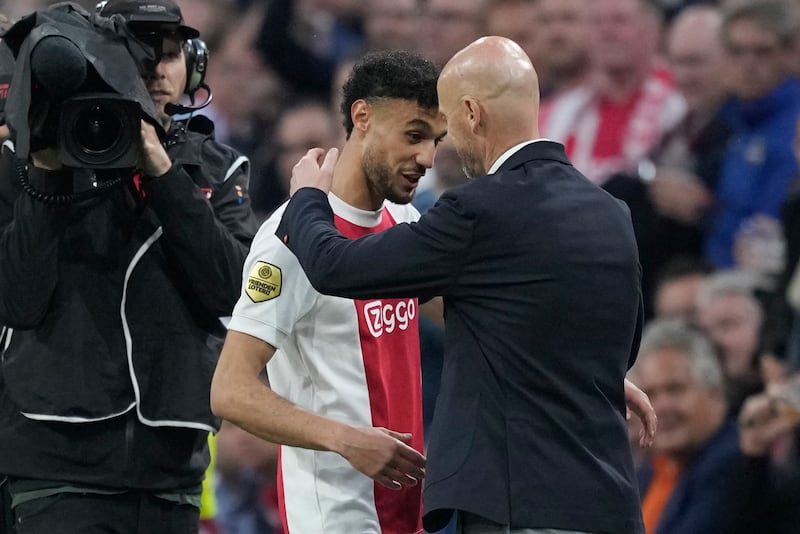
Was it difficult for you when Erik ten Hag left the club?
Yeah, of course, because he was also a reason I came to the club. You come to a club because for the club itself, but also for the manager.
I worked some good years with him at Ajax, so that's also one of the reasons I came here. And then if he's gone after two or three months, that's never nice, because you feel also responsible for that. Because if the players perform, the manager stays, it's that simple.
What’s Ruben Amorim like?
A great manager, a great person. I really love to work with him. I like him a lot. His way of thinking, his way of managing, his way of talking. He's like a manager with a lot of values, which I have the same. So, yeah, that works great together.
What type of values?
Being always respectful, being always honest. Never lies, says how it is without any edge. Sometimes it can be harsh, but I'd rather have that it's the truth and a little bit harsh than a lie. And that it's, you know, it kind of sweetens things up.
What went wrong in Bilbao in the Europa League final?
That's a good question. We could control the game and play, have a lot of passes, but together we couldn’t find a way to score. It was a little summary of the whole season, I guess.
Can not playing in Europe this season help United? With extra time for preparation and a lower workload, for example?
I can't say, I've never not played in Europe, so for me the first time. So, I can't really know if it's something positive or negative. We'll go and see.
How important is your faith to you?
That's number one for me, that's everything.
What's it like playing during Ramadan?
It's like playing like any other month, but then without food or water. I still must play football. I still must run. No excuses. You must dig in deeper. You must get through a lot more pain during the game than normally. But, like I said, my faith is everything for me. So that's a small, small, small price to pay.
Tell us about the Moroccan national team and Morocco hosting Afcon in December and January.
I reckon it's going to be amazing, an amazing Afcon in our own country. We didn't win it for a long, long time so the pressures and expectations are high. We have a great team, a great group of players, a great coach. So yeah, it's going to be an exciting tournament.
And they're building all the incredible new stadiums in Morocco too, some of the biggest ones in the world?
The federation and everybody are busy with making it one of the best experiences for us, for all the other countries and for the supporters. And, a the view the 2030s, the World Cup is going to be there as well.
How would you describe your new home, Manchester, as a city?
I really love it. It's a little bit like where I grew up in the Netherlands. So yeah, I don’t mind really when it's raining or when the sun is shining and the next hour it’s raining. So, I’m not used to anything different. So I really love it. It’s like I’ve been there for a very long time but I’ve just been here for like a year.

LOVE%20AGAIN
%3Cp%3EDirector%3A%20Jim%20Strouse%3C%2Fp%3E%0A%3Cp%3EStars%3A%20Priyanka%20Chopra%20Jonas%2C%20Sam%20Heughan%2C%20Celine%20Dion%3C%2Fp%3E%0A%3Cp%3ERating%3A%202%2F5%3C%2Fp%3E%0A
The burning issue
The internal combustion engine is facing a watershed moment – major manufacturer Volvo is to stop producing petroleum-powered vehicles by 2021 and countries in Europe, including the UK, have vowed to ban their sale before 2040. The National takes a look at the story of one of the most successful technologies of the last 100 years and how it has impacted life in the UAE.
Read part four: an affection for classic cars lives on
Read part three: the age of the electric vehicle begins
Read part one: how cars came to the UAE
HWJN
%3Cp%3EDirector%3A%20Yasir%20Alyasiri%3C%2Fp%3E%0A%3Cp%3EStarring%3A%20Baraa%20Alem%2C%20Nour%20Alkhadra%2C%20Alanoud%20Saud%3C%2Fp%3E%0A%3Cp%3ERating%3A%203%2F5%3C%2Fp%3E%0A%3Cp%3E%3C%2Fp%3E%0A
Director: Laxman Utekar
Cast: Vicky Kaushal, Akshaye Khanna, Diana Penty, Vineet Kumar Singh, Rashmika Mandanna
Rating: 1/5
Where to donate in the UAE
The Emirates Charity Portal
You can donate to several registered charities through a “donation catalogue”. The use of the donation is quite specific, such as buying a fan for a poor family in Niger for Dh130.
The General Authority of Islamic Affairs & Endowments
The site has an e-donation service accepting debit card, credit card or e-Dirham, an electronic payment tool developed by the Ministry of Finance and First Abu Dhabi Bank.
Al Noor Special Needs Centre
You can donate online or order Smiles n’ Stuff products handcrafted by Al Noor students. The centre publishes a wish list of extras needed, starting at Dh500.
Beit Al Khair Society
Beit Al Khair Society has the motto “From – and to – the UAE,” with donations going towards the neediest in the country. Its website has a list of physical donation sites, but people can also contribute money by SMS, bank transfer and through the hotline 800-22554.
Dar Al Ber Society
Dar Al Ber Society, which has charity projects in 39 countries, accept cash payments, money transfers or SMS donations. Its donation hotline is 800-79.
Dubai Cares
Dubai Cares provides several options for individuals and companies to donate, including online, through banks, at retail outlets, via phone and by purchasing Dubai Cares branded merchandise. It is currently running a campaign called Bookings 2030, which allows people to help change the future of six underprivileged children and young people.
Emirates Airline Foundation
Those who travel on Emirates have undoubtedly seen the little donation envelopes in the seat pockets. But the foundation also accepts donations online and in the form of Skywards Miles. Donated miles are used to sponsor travel for doctors, surgeons, engineers and other professionals volunteering on humanitarian missions around the world.
Emirates Red Crescent
On the Emirates Red Crescent website you can choose between 35 different purposes for your donation, such as providing food for fasters, supporting debtors and contributing to a refugee women fund. It also has a list of bank accounts for each donation type.
Gulf for Good
Gulf for Good raises funds for partner charity projects through challenges, like climbing Kilimanjaro and cycling through Thailand. This year’s projects are in partnership with Street Child Nepal, Larchfield Kids, the Foundation for African Empowerment and SOS Children's Villages. Since 2001, the organisation has raised more than $3.5 million (Dh12.8m) in support of over 50 children’s charities.
Noor Dubai Foundation
Sheikh Mohammed bin Rashid Al Maktoum launched the Noor Dubai Foundation a decade ago with the aim of eliminating all forms of preventable blindness globally. You can donate Dh50 to support mobile eye camps by texting the word “Noor” to 4565 (Etisalat) or 4849 (du).
How Voiss turns words to speech
The device has a screen reader or software that monitors what happens on the screen
The screen reader sends the text to the speech synthesiser
This converts to audio whatever it receives from screen reader, so the person can hear what is happening on the screen
A VOISS computer costs between $200 and $250 depending on memory card capacity that ranges from 32GB to 128GB
The speech synthesisers VOISS develops are free
Subsequent computer versions will include improvements such as wireless keyboards
Arabic voice in affordable talking computer to be added next year to English, Portuguese, and Spanish synthesiser
Partnerships planned during Expo 2020 Dubai to add more languages
At least 2.2 billion people globally have a vision impairment or blindness
More than 90 per cent live in developing countries
The Long-term aim of VOISS to reach the technology to people in poor countries with workshops that teach them to build their own device
The specs
Engine: 2.0-litre 4-cyl, 48V hybrid
Transmission: eight-speed automatic
Power: 325bhp
Torque: 450Nm
Price: Dh359,000
On sale: now
The Buckingham Murders
Starring: Kareena Kapoor Khan, Ash Tandon, Prabhleen Sandhu
Director: Hansal Mehta
Rating: 4 / 5
Company%C2%A0profile
%3Cp%3E%3Cstrong%3ECompany%20name%3A%20%3C%2Fstrong%3Eamana%3Cbr%3E%3Cstrong%3EStarted%3A%20%3C%2Fstrong%3E2010%3Cbr%3E%3Cstrong%3EFounders%3A%3C%2Fstrong%3E%20Karim%20Farra%20and%20Ziad%20Aboujeb%3Cbr%3E%3Cstrong%3EBased%3A%20%3C%2Fstrong%3EUAE%3Cbr%3E%3Cstrong%3ERegulator%3A%20%3C%2Fstrong%3EDFSA%3Cbr%3E%3Cstrong%3ESector%3A%20%3C%2Fstrong%3EFinancial%20services%3Cbr%3E%3Cstrong%3ECurrent%20number%20of%20staff%3A%20%3C%2Fstrong%3E85%3Cbr%3E%3Cstrong%3EInvestment%20stage%3A%20%3C%2Fstrong%3ESelf-funded%3Cbr%3E%3C%2Fp%3E%0A
Our legal columnist
Name: Yousef Al Bahar
Advocate at Al Bahar & Associate Advocates and Legal Consultants, established in 1994
Education: Mr Al Bahar was born in 1979 and graduated in 2008 from the Judicial Institute. He took after his father, who was one of the first Emirati lawyers
Why does a queen bee feast only on royal jelly?
Some facts about bees:
The queen bee eats only royal jelly, an extraordinary food created by worker bees so she lives much longer
The life cycle of a worker bee is from 40-60 days
A queen bee lives for 3-5 years
This allows her to lay millions of eggs and allows the continuity of the bee colony
About 20,000 honey bees and one queen populate each hive
Honey is packed with vital vitamins, minerals, enzymes, water and anti-oxidants.
Apart from honey, five other products are royal jelly, the special food bees feed their queen
Pollen is their protein source, a super food that is nutritious, rich in amino acids
Beewax is used to construct the combs. Due to its anti-fungal, anti-bacterial elements, it is used in skin treatments
Propolis, a resin-like material produced by bees is used to make hives. It has natural antibiotic qualities so works to sterilize hive, protects from disease, keeps their home free from germs. Also used to treat sores, infection, warts
Bee venom is used by bees to protect themselves. Has anti-inflammatory properties, sometimes used to relieve conditions such as rheumatoid arthritis, nerve and muscle pain
Honey, royal jelly, pollen have health enhancing qualities
The other three products are used for therapeutic purposes
Is beekeeping dangerous?
As long as you deal with bees gently, you will be safe, says Mohammed Al Najeh, who has worked with bees since he was a boy.
“The biggest mistake people make is they panic when they see a bee. They are small but smart creatures. If you move your hand quickly to hit the bees, this is an aggressive action and bees will defend themselves. They can sense the adrenalin in our body. But if we are calm, they are move away.”
Opening Rugby Championship fixtures: Games can be watched on OSN Sports
Saturday: Australia v New Zealand, Sydney, 1pm (UAE)
Sunday: South Africa v Argentina, Port Elizabeth, 11pm (UAE)
Mercer, the investment consulting arm of US services company Marsh & McLennan, expects its wealth division to at least double its assets under management (AUM) in the Middle East as wealth in the region continues to grow despite economic headwinds, a company official said.
Mercer Wealth, which globally has $160 billion in AUM, plans to boost its AUM in the region to $2-$3bn in the next 2-3 years from the present $1bn, said Yasir AbuShaban, a Dubai-based principal with Mercer Wealth.
“Within the next two to three years, we are looking at reaching $2 to $3 billion as a conservative estimate and we do see an opportunity to do so,” said Mr AbuShaban.
Mercer does not directly make investments, but allocates clients’ money they have discretion to, to professional asset managers. They also provide advice to clients.
“We have buying power. We can negotiate on their (client’s) behalf with asset managers to provide them lower fees than they otherwise would have to get on their own,” he added.
Mercer Wealth’s clients include sovereign wealth funds, family offices, and insurance companies among others.
From its office in Dubai, Mercer also looks after Africa, India and Turkey, where they also see opportunity for growth.
Wealth creation in Middle East and Africa (MEA) grew 8.5 per cent to $8.1 trillion last year from $7.5tn in 2015, higher than last year’s global average of 6 per cent and the second-highest growth in a region after Asia-Pacific which grew 9.9 per cent, according to consultancy Boston Consulting Group (BCG). In the region, where wealth grew just 1.9 per cent in 2015 compared with 2014, a pickup in oil prices has helped in wealth generation.
BCG is forecasting MEA wealth will rise to $12tn by 2021, growing at an annual average of 8 per cent.
Drivers of wealth generation in the region will be split evenly between new wealth creation and growth of performance of existing assets, according to BCG.
Another general trend in the region is clients’ looking for a comprehensive approach to investing, according to Mr AbuShaban.
“Institutional investors or some of the families are seeing a slowdown in the available capital they have to invest and in that sense they are looking at optimizing the way they manage their portfolios and making sure they are not investing haphazardly and different parts of their investment are working together,” said Mr AbuShaban.
Some clients also have a higher appetite for risk, given the low interest-rate environment that does not provide enough yield for some institutional investors. These clients are keen to invest in illiquid assets, such as private equity and infrastructure.
“What we have seen is a desire for higher returns in what has been a low-return environment specifically in various fixed income or bonds,” he said.
“In this environment, we have seen a de facto increase in the risk that clients are taking in things like illiquid investments, private equity investments, infrastructure and private debt, those kind of investments were higher illiquidity results in incrementally higher returns.”
The Abu Dhabi Investment Authority, one of the largest sovereign wealth funds, said in its 2016 report that has gradually increased its exposure in direct private equity and private credit transactions, mainly in Asian markets and especially in China and India. The authority’s private equity department focused on structured equities owing to “their defensive characteristics.”
Killing of Qassem Suleimani
