

During Manchester United’s recent game at home to Ipswich Town – a drama-filled encounter which United didn’t lose – I was sent a statistic: the last time United led at half time in a league game at Old Trafford and then lost that game was against Ipswich Town back in 1984.
And I remembered it well, since that game was my first at Old Trafford. Aged 10, I was invited to attend as part of a friend’s birthday party. My dad, a footballer, didn’t take me to the match since he played every Saturday. That was when Manchester United games were played on a Saturday, rather than on a Thursday, Friday, Saturday, Sunday, Monday, Tuesday and Wednesday as they have been mostly this season. Times have changed and so must football stadiums, but the idea of that pitch, which I first saw in 1984, moving doesn’t invoke happiness.
On that day, we went into the wooden Stretford Paddock terrace, a dark, corner segment between the main stand and the Stretford End. And there it was. Wow! A verdant green oasis amid the billowing smoky, grey industry of Trafford Park. I was mesmerised just staring at the pitch; it remains one of the greatest moments of my life. As kick off approached, the noise built, tens of thousands singing and swaying in harmony. It felt exciting, visceral. I ached to go again and it was the first of hundreds of visits.
Also read: Arda Turan: ‘I cried when Galatasaray drew 3-3 at Manchester United ... they are my biggest love’
I’ve experienced so many great Old Trafford moments. The atmosphere was loudest on the terraces in the late 1980s and becoming all-seater in 1994 sucked so much life out of it. By then, the team were brilliant. Blackburn Rovers at home in 1993 was a day-long party to celebrate a first title in 26 years. Any win against Liverpool or Manchester City; Barcelona at home in ’94, ’98, ’08 and ’23: stunning games with noise to match.
It’s home, a special place, but it had failed to keep pace. Under the Glazers ownership investment stalled, steel girders peeled and rival stadiums closed the gap. In 2006, Old Trafford’s 76,000 capacity was 25,000 seats bigger than the next biggest stadium, at Newcastle United. By next year, six other Premier League clubs had more than 60,000 seats. Others are catching up off the pitch. On it, they’ve already gone past United.
The idea of a new Old Trafford divides opinions among fans. Some want to stay at the existing stadium, others want to move. Opinions are strong – 93 per cent of young supporters polled by United’s youth supporters group are against a new stadium. The club’s own surveys show a preference from fans for a new stadium.
-
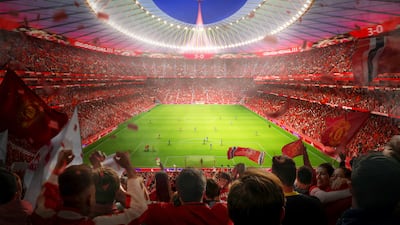
A handout image provided by Foster and Partners of what the new 100,000-seater Manchester United Stadium and surrounding area could look like. PA -
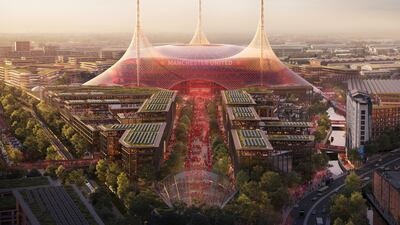
The design will feature three masts described as "the trident", which the architects say will be 200 metres high and visible from 25 miles away. PA -

Architects at Foster and Partners, who will design the project, said the stadium would feature an umbrella design and a new public plaza that is "twice the size of Trafalgar Square". PA -
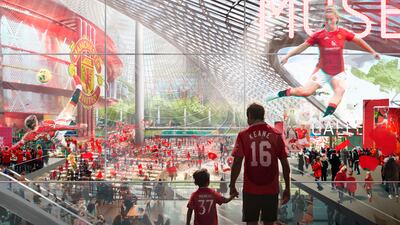
Manchester United's new stadium will form part of a wider regeneration of the Old Trafford area, predicted to be the biggest such project in the United Kingdom since the transformation of the Stratford area that accompanied the 2012 Olympics in London. PA -
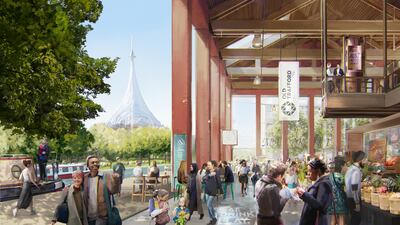
United say the entire project has the potential to create 92,000 new jobs, will involve the construction of 17,000 homes and bring an additional 1.8 million visitors to the area annually. PA -

Co-owner Sir Jim Ratcliffe said he wanted to build the "world's greatest football stadium" which the club hopes could be finished in five years. PA -
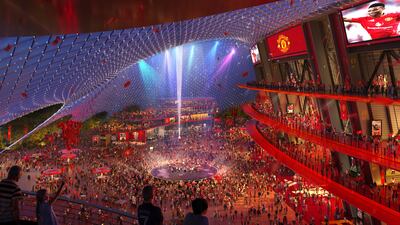
United's decision came after an extensive consultation process around whether to develop the existing stadium or build a new one. PA -
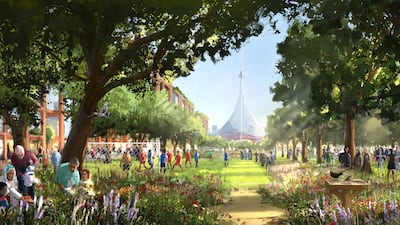
The stadium will be built using pre-fabrication, shipped in 160 components along the neighbouring Manchester Ship Canal. PA -
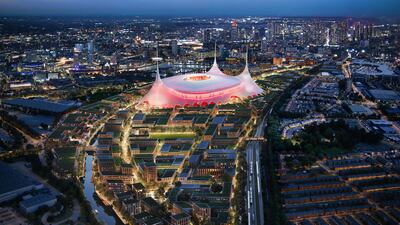
Foster and Partners designed the new Wembley Stadium, which opened in 2007, and the Lusail Stadium, the venue for the 2022 World Cup final in Qatar. PA -

Manchester United predict the project will be worth an additional £7.3bn per year to the UK economy. PA


I was long in the stay and redevelop/expand the existing Old Trafford camp, but I’ve been fortunate to see some of the superb new stadia where United have played their pre-season games in the United States and been impressed with the architecture, if not the price of tickets and refreshments.
Something had to be done and Tuesday’s designs for a new 100,000 capacity home were daring and vast. The biggest question has yet to be answered: how will it be paid for? But Sir Jim Ratcliffe, the leading decision maker at United despite being the minority shareholder, wants a new stadium to underpin a vast regeneration project in west Manchester, with new housing, which the city needs. The location is a privileged one, the transport links already established.
It’s vital that longstanding fans are not priced out of any new stadium, that fans are properly consulted about the atmosphere.
I feel conflicted. Sad that Old Trafford may no longer exist. Don’t listen to the naysayers, it’s a very good stadium, but it’s riddled with fault lines and it’s tired. Yet I’m excited about an idealised brighter future for United, a club currently mired under a cloud of despondency amid a poor season where the first team are 14th in the Premier League.
The design? It’ll take getting used to. It’s an assault on senses and sensibilities, but it’s bold and maybe brilliant. It doesn’t look like Manchester United, but what does? The current team doesn’t, the league table doesn’t. But it didn’t when I first went in 1984 either.
Read more: Christian Eriksen on Rasmus Hojlund, Ruben Amorim and the need to beat Real Sociedad


