Hubris or bad luck? Neymar’s injuries always made Al Hilal move a risk


Steve Luckings
  • English
  • Arabic

The invective flooding social media came soon after Al Hilal announced they had agreed to terminate Neymar's contract by mutual consent.

There was little sugarcoating the fact that most see Neymar's move to the Riyadh giants as the worst piece of transfer business in the history of football. That, of course, is subjective, but when you look at the numbers, it's easy to see why.

Neymar, 32, played only seven games in 18 months after signing from Paris Saint-Germain, a transfer that cost his Saudi club $94 million. If we factor in his reported wages of $104 million per year, it means each appearance by Neymar cost Al Hilal $35 million. There was one goal, a few assists, and a nagging sense Neymar was never going to be the player he once was.

There are those keen to point to Saudi hubris, the kingdom wanting to sign the biggest names even at the expense of waning talent. The pomp and pageantry that accompanied Neymar's Hilal unveiling was designed to send a message to rivals: We have our own superstar to rival Cristiano Ronaldo and Karim Benzema.

There is mitigation. True, Hilal signed a player carrying over an injury from his previous club, but that's by no means uncommon in transfer deals. It seems a stretch to think a club as well established and resourced as Al Hilal would not have done rigorous medical checks and received clearance that Neymar, with the right rehabilitation, would return to full fitness, before agreeing to make the Brazilian the most expensive signing in Saudi football history.

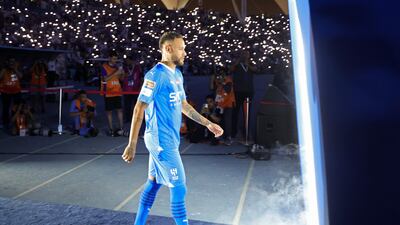
  • Brazilian superstar Neymar enters the pitch during his unveiling at Al Hilal in Riyadh on Saturday, August 19, 2023. AFP
    Brazilian superstar Neymar enters the pitch during his unveiling at Al Hilal in Riyadh on Saturday, August 19, 2023. AFP
  • New signing Neymar is presented to Al Hilal fans at the King Fahd International Stadium in Riyadh. Reuters
    New signing Neymar is presented to Al Hilal fans at the King Fahd International Stadium in Riyadh. Reuters
  • Light show at the King Fahd International Stadium to welcome Al Hilal's new signing Neymar. Reuters
    Light show at the King Fahd International Stadium to welcome Al Hilal's new signing Neymar. Reuters
  • Neymar during his unveiling in Riyadh on Saturday. AFP
    Neymar during his unveiling in Riyadh on Saturday. AFP
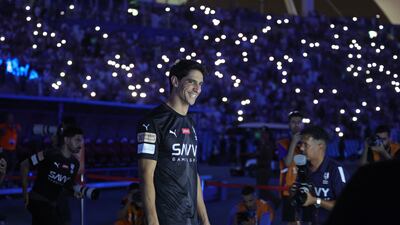
  • Moroccan goalkeeper Yassine Bounou enters the pitch as he is presented to Al Hilal fans. AFP
    Moroccan goalkeeper Yassine Bounou enters the pitch as he is presented to Al Hilal fans. AFP
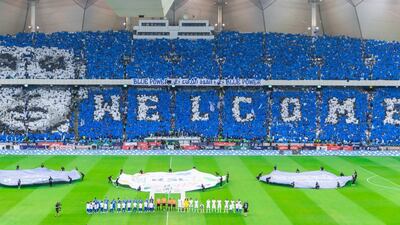
  • Al Hilal fans created a giant tifo. Photo: SPL
    Al Hilal fans created a giant tifo. Photo: SPL
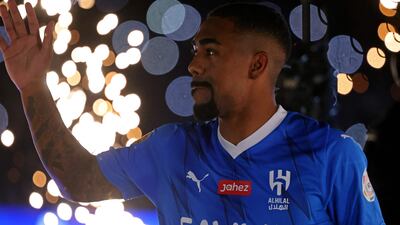
  • Brazilian forward Malcom greets fans as he enters the pitch during his unveiling. AFP
    Brazilian forward Malcom greets fans as he enters the pitch during his unveiling. AFP

The flip side to that argument is that Hilal knew they were signing an injury-prone player, one particularly susceptible to ankle problems, and therefore cannot be surprised by the eventual outcome.

According to transfermarkt.com, Neymar suffered his first ankle injury while at Barcelona in January 2014. That kept him sidelined for 33 days and forced him to miss 10 games. An ankle sprain later that year saw him miss only one Barcelona match, while a succession of other ailments made him unavailable for a further 23 matches before he was transferred to Paris Saint-Germain for a world-record €222 million in 2017.

During his six-year stint at the French club, Neymar missed more than 130 games due to injury, 43 of them due to ankle problems.

Neymar was cruelly cut down while on international duty for Brazil in October 2023, just as he appeared to be returning to full fitness. The forward ruptured the anterior cruciate ligament and meniscus in his left knee during a World Cup qualifier against Uruguay, keeping him sidelined for over a year.

After 368 days, Neymar returned to action for Al Hilal in Al Ain last October in an AFC Champions League match.

His return was a minor incident in the context of the whole match, as Hilal edged a nine-goal thriller 5-4 to avenge their defeat to the UAE club in the previous season's competition.

The delight at seeing their superstar return was short-lived, though. In Hilal's very next encounter in the continent's premier competition, Neymar suffered yet another injury – this time a hamstring tear – with the club said would keep him out of contention for six weeks. It proved to be the last time he would play for the Saudi club.

A return to boyhood club Santos beckons, the Brazilian team where a raw teenager first announced himself as the wunderkind of his generation, where YouTube clips of him pulling off impossible skill still abound and excite, simultaneously offering a time machine into the past whilst laying bare the reality of a future that will never again reach those peaks.

It would be unfair to say Neymar did not deliver on the promise he displayed as a fleet-footed forward at Santos. Alongside Lionel Messi and Luis Suarez, Neymar formed one part of arguably the greatest attacking troika ever seen in club football at Barcelona, winning league titles and, to date, his only Uefa Champions League title.

A world-record move to PSG followed – an amount only ever likely to be eclipsed by Neymar's compatriot Vinicius Jr should he ever leave Real Madrid – and with it a succession of domestic French trophies, though he was never able to take the Parisians to European glory.

For Brazil, Neymar can point to his 79 goals for the Selecao – more than Pele, more than Zico, more than Romario and Ronaldo or anyone else – as a huge source of pride.

Brazil national team coach Dorival Junior has said since the end of last year that Neymar is not part of his plans while his fitness problems persist. Brazil face Argentina in South American World Cup qualifying in March, but there is zero expectation Neymar will force his way into contention.

The World Cup takes place in North America in less than two years, offering Neymar one final shot at a title he saw as his destiny when he started his football journey. Injuries, as much as anything, are likely to ensure it goes unfulfilled.

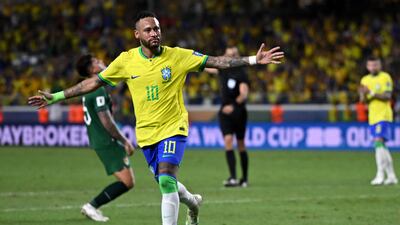
  • Brazil's forward Neymar celebrates after scoring during the 2026 World Cup qualifier against Bolivia in Belem, Brazil. Neymar became Brazil's all-time top scorer on Friday after surpassing Pele's record. AFP
    Brazil's forward Neymar celebrates after scoring during the 2026 World Cup qualifier against Bolivia in Belem, Brazil. Neymar became Brazil's all-time top scorer on Friday after surpassing Pele's record. AFP
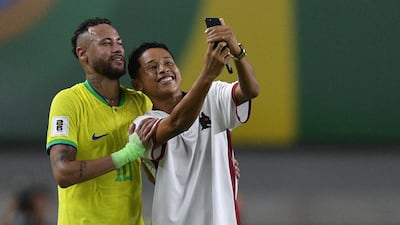
  • Brazil's Neymar poses for a selfie with a fan who ran into the pitch during the World Cup qualifier against Bolivia. AFP
    Brazil's Neymar poses for a selfie with a fan who ran into the pitch during the World Cup qualifier against Bolivia. AFP
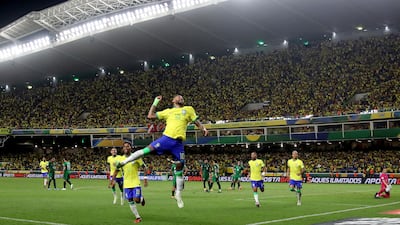
  • Brazil's Neymar celebrates scoring his team's fifth goal. Reuters
    Brazil's Neymar celebrates scoring his team's fifth goal. Reuters
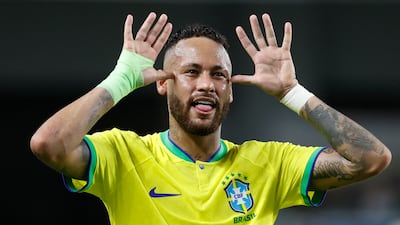
  • Neymar became Brazil's all-time top goal-scorer on Friday. EPA
    Neymar became Brazil's all-time top goal-scorer on Friday. EPA
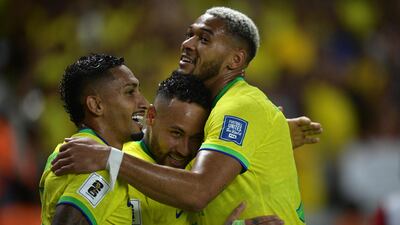
  • Neymar, centre, celebrates with teammates Raphinha, left, and Joelinton after scoring. AFP
    Neymar, centre, celebrates with teammates Raphinha, left, and Joelinton after scoring. AFP
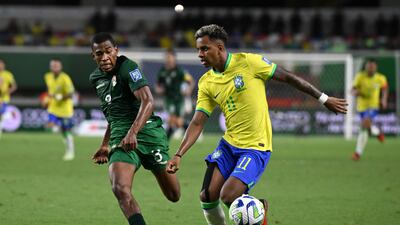
  • Brazil's Rodrygo fights for the ball with Bolivia's Diego Medina. AFP
    Brazil's Rodrygo fights for the ball with Bolivia's Diego Medina. AFP
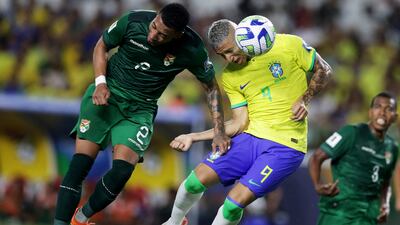
  • Brazil's Richarlison vies for the ball with Bolivia's Jairo Quinteros. Reuters
    Brazil's Richarlison vies for the ball with Bolivia's Jairo Quinteros. Reuters
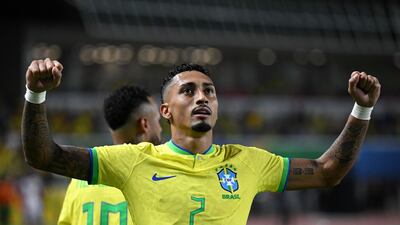
  • Brazil's forward Raphinha celebrates after scoring. AFP
    Brazil's forward Raphinha celebrates after scoring. AFP

W.
Wael Kfoury
(Rotana)

Dubai Creek Open in numbers
  • The Dubai Creek Open is the 10th tournament on this year's Mena Tour
  • It is the first of five events before the season-concluding Mena Tour Championship
  • This week's field comprises 120 players, 21 of which are amateurs
  • 15 previous Mena Tour winners are competing at Dubai Creek Golf and Yacht Club  
How to protect yourself when air quality drops

Install an air filter in your home.

Close your windows and turn on the AC.

Shower or bath after being outside.

Wear a face mask.

Stay indoors when conditions are particularly poor.

If driving, turn your engine off when stationary.

COMPANY PROFILE
Name: Mamo 

 Year it started: 2019 Founders: Imad Gharazeddine, Asim Janjua

 Based: Dubai, UAE

 Number of employees: 28

 Sector: Financial services

 Investment: $9.5m

 Funding stage: Pre-Series A Investors: Global Ventures, GFC, 4DX Ventures, AlRajhi Partners, Olive Tree Capital, and prominent Silicon Valley investors. 

 
Meydan race card

6.30pm: Baniyas (PA) Group 2 Dh125,000 (Dirt) 1,400m
7.05pm: Maiden (TB) Dh165,000 (D) 1,200m​​​​​​​
7.40pm: Maiden (TB) Dh165,000 (D) 1,400m​​​​​​​
8.15pm: Handicap (TB) Dh170,000 (D) 1,900m​​​​​​​
8.50pm: Rated Conditions (TB) Dh240,000 (D) 1,600m​​​​​​​
9.25pm: Handicap (TB) Dh175,000 (D)1,200m
10pm: Handicap (TB) Dh165,000 (D) 1,400m

The specs

Engine: 3.9-litre twin-turbo V8

Transmission: seven-speed

Power: 620bhp

Torque: 760Nm

Price: Dh898,000

On sale: now

Mercer, the investment consulting arm of US services company Marsh & McLennan, expects its wealth division to at least double its assets under management (AUM) in the Middle East as wealth in the region continues to grow despite economic headwinds, a company official said.

Mercer Wealth, which globally has $160 billion in AUM, plans to boost its AUM in the region to $2-$3bn in the next 2-3 years from the present $1bn, said Yasir AbuShaban, a Dubai-based principal with Mercer Wealth.

Within the next two to three years, we are looking at reaching $2 to $3 billion as a conservative estimate and we do see an opportunity to do so,” said Mr AbuShaban.

Mercer does not directly make investments, but allocates clients’ money they have discretion to, to professional asset managers. They also provide advice to clients.

“We have buying power. We can negotiate on their (client’s) behalf with asset managers to provide them lower fees than they otherwise would have to get on their own,” he added.

Mercer Wealth’s clients include sovereign wealth funds, family offices, and insurance companies among others.

From its office in Dubai, Mercer also looks after Africa, India and Turkey, where they also see opportunity for growth.

Wealth creation in Middle East and Africa (MEA) grew 8.5 per cent to $8.1 trillion last year from $7.5tn in 2015, higher than last year’s global average of 6 per cent and the second-highest growth in a region after Asia-Pacific which grew 9.9 per cent, according to consultancy Boston Consulting Group (BCG). In the region, where wealth grew just 1.9 per cent in 2015 compared with 2014, a pickup in oil prices has helped in wealth generation.

BCG is forecasting MEA wealth will rise to $12tn by 2021, growing at an annual average of 8 per cent.

Drivers of wealth generation in the region will be split evenly between new wealth creation and growth of performance of existing assets, according to BCG.

Another general trend in the region is clients’ looking for a comprehensive approach to investing, according to Mr AbuShaban.

“Institutional investors or some of the families are seeing a slowdown in the available capital they have to invest and in that sense they are looking at optimizing the way they manage their portfolios and making sure they are not investing haphazardly and different parts of their investment are working together,” said Mr AbuShaban.

Some clients also have a higher appetite for risk, given the low interest-rate environment that does not provide enough yield for some institutional investors. These clients are keen to invest in illiquid assets, such as private equity and infrastructure.

“What we have seen is a desire for higher returns in what has been a low-return environment specifically in various fixed income or bonds,” he said.

“In this environment, we have seen a de facto increase in the risk that clients are taking in things like illiquid investments, private equity investments, infrastructure and private debt, those kind of investments were higher illiquidity results in incrementally higher returns.”

The Abu Dhabi Investment Authority, one of the largest sovereign wealth funds, said in its 2016 report that has gradually increased its exposure in direct private equity and private credit transactions, mainly in Asian markets and especially in China and India. The authority’s private equity department focused on structured equities owing to “their defensive characteristics.”

Updated: January 29, 2025, 2:33 AM