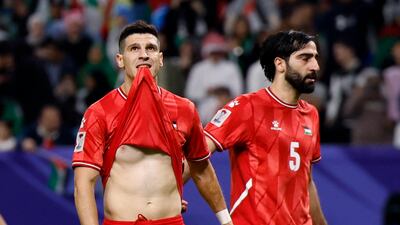
Ali Mabkhout is the UAE's record goalscorer but has not been used at the Asian Cup. Chris Whiteoak / The National

UAE Asian Cup talking points: Mabkhout's role, midfield balance and offensive options


John McAuley
  • English
  • Arabic

Having finished as runners-up in Group C, the UAE will continue their Asian Cup campaign on Sunday in Qatar, with a last-16 tie against tournament debutants Tajikistan. Here we look at some of the national team’s main talking points leading into the knockout stage, as Paulo Bento’s side plot a path to the quarter-finals.

Deciding on the role Ali Mabkhout will play – if any

The decision to opt for Sultan Adil rather than Ali Mabkhout to lead the line for the UAE in the opening two matches surprised somewhat.

At 19, Adil had made only four senior appearances for the national team; Mabkhout, 33, sits as the country’s record goalscorer. But Bento went for the younger, more physical frontman in the games against Hong Kong and Palestine. Adil responded by scoring in both.

Yet a knee injury sustained in the latter ruled out the on-loan Ittihad Kalba striker for Iran on Tuesday – and, dependent on how far the UAE progress, possibly the tournament. However, instead of being restored to the starting XI against the group leaders, Mabkhout was omitted from the squad altogether.

The UAE coaching staff has explained the absence on the grounds of “technical and tactical reasons”. It will be intriguing to see if the 2015 Golden Boot winner, who has nine Asian Cup goals in all, is back in contention for Sunday.

The UAE's record-goalscorer Ali Mabkhout, left, trains with Yahya Al Ghassani in Abu Dhabi ahead of the Asia Cup in Qatar. Chris Whiteoak / The National

Finding the right balance in central midfield

Abdullah Ramadan, the accomplished Al Jazira midfielder, has become a staple at the heart of the UAE side – fitness permitting – dating back to Bert van Marwijk’s first stint as manager.

Ramadan provides the guile in midfield, his long-range passing precise, his eye for a killer through ball sharp. In the past few years, he has offered the invention alongside Ali Salmeen’s industry.

However, Salmeen has had a chequered injury record of late, forcing Bento to look at other candidates to buttress his midfield. Yahia Nader started against Hong Kong, but the balance seemed off, the UAE too porous through the centre.

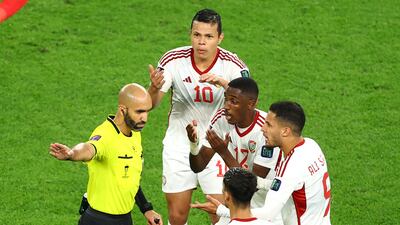
Majid Rashid came in for the Palestine encounter and did well, especially with his side reduced to 10 men from 37 minutes. He was selected again against Iran.

The feeling, though, remains that Salmeen, whose Asian Cup has been limited to almost an hour altogether as a substitute, is the ideal candidate to protect the UAE defence.

  • Sultan Adil celebrates after scoring for the UAE in their 1-1 Asian Cup draw against Palestine at the Al Janoub Stadium in Qatar on January 18, 2024. Getty Images
    Sultan Adil celebrates after scoring for the UAE in their 1-1 Asian Cup draw against Palestine at the Al Janoub Stadium in Qatar on January 18, 2024. Getty Images
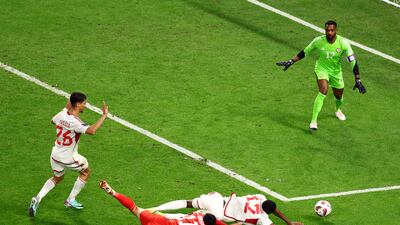
  • Palestine players celebrate after UAE's Bader Nasser, on ground, scored an own goal. Reuters
    Palestine players celebrate after UAE's Bader Nasser, on ground, scored an own goal. Reuters
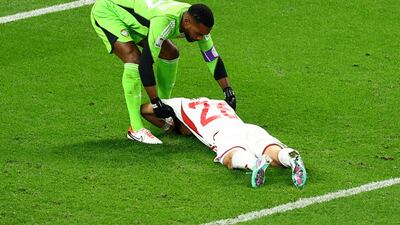
  • UAE goalkeeper Khalid Essa picks up Bader Nasser after his own goal. Reuters
    UAE goalkeeper Khalid Essa picks up Bader Nasser after his own goal. Reuters
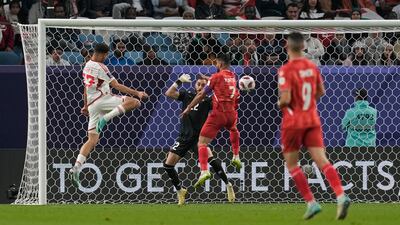
  • UAE attacker Sultan Adil heads home in the first half. AP
    UAE attacker Sultan Adil heads home in the first half. AP
  • Palestine's Oday Dabbagh is fouled by UAE defender Khalifa Al Hammadi to earn his team a penalty. Reuters
    Palestine's Oday Dabbagh is fouled by UAE defender Khalifa Al Hammadi to earn his team a penalty. Reuters
  • UAE's Khalifa Al Hammadi is shown a red card by referee Ahmed Al Ali. Reuters
    UAE's Khalifa Al Hammadi is shown a red card by referee Ahmed Al Ali. Reuters
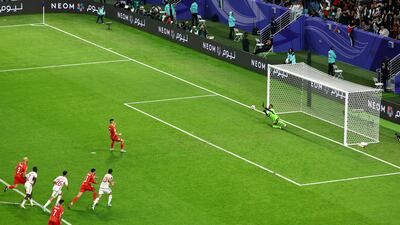
  • Palestine's Tamer Seyam sees penalty saved by UAE goalkeeper Khalid Essa. Reuters
    Palestine's Tamer Seyam sees penalty saved by UAE goalkeeper Khalid Essa. Reuters
  • Palestine defender Mohammed Saleh celebrates after UAE's own-goal. AFP
    Palestine defender Mohammed Saleh celebrates after UAE's own-goal. AFP
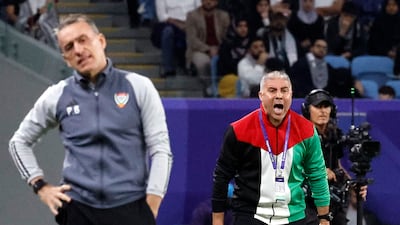
  • Palestine manager Makram Daboub shouts inctructions as his UAE counterpart Paulo Bento looks on. Reuters
    Palestine manager Makram Daboub shouts inctructions as his UAE counterpart Paulo Bento looks on. Reuters
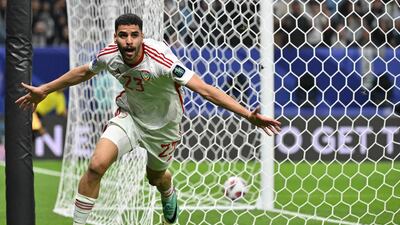
  • UAE's Sultan Adil celebrates after scoring. AFP
    UAE's Sultan Adil celebrates after scoring. AFP
  • A dejected Tamer Seyam of Palestine after missing a penalty. Reuters
    A dejected Tamer Seyam of Palestine after missing a penalty. Reuters
  • UAE's Sultan Adil celebrates with his teammates after scoring. AFP
    UAE's Sultan Adil celebrates with his teammates after scoring. AFP
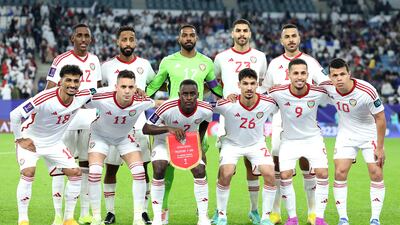
  • The UAE team before the match. Getty Images
    The UAE team before the match. Getty Images
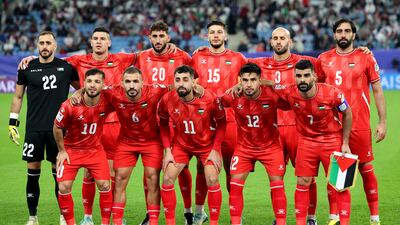
  • The Palestine team before the match. Getty Images
    The Palestine team before the match. Getty Images

Improvement at full-back feels a necessity

It is an issue that has long plagued the UAE. For some time, the obvious choice on either side of the defence appeared to be Mahmoud Khamis, on the left, and Bandar Al Ahbabi, on the right.

However, Khamis slipped from view during Van Marwjik’s tenure, and in truth never did excel with the national team. Al Ahbabi, however, continues to represent an unexpected omission by Bento.

Instead, when employing a flat back four, the Portuguese has plumped for Abdullah Idris at left-back, and either Zayed Sultan or Khalid Al Dhahani at right-back. Idris and Sultan have each looked suspect, but they do have only 10 international appearances between them.

Against Iran, and with standout centre-back Khalifa Al Hammadi suspended, Bento went with a five-man defence, moving Al Dhahani more central and playing Harib Abdullah deeper, at left wing-back.

Although that gave the UAE a strong base from which to build, they are expected to revert to a four in the last 16. The make-up of the full-backs could play a key part in deciding the tie.

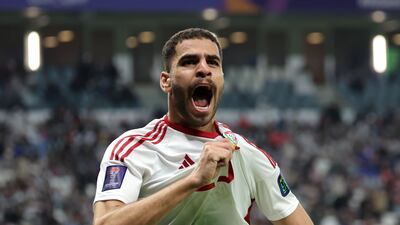
  • Iran's Mehdi Taremi, left, and teammates celebrate after he scored their second goal in their 1-2 Asian Cup Group C game against the UAE at Education City Stadium in Al Rayyan, near Doha, on January 23, 2024. AFP
    Iran's Mehdi Taremi, left, and teammates celebrate after he scored their second goal in their 1-2 Asian Cup Group C game against the UAE at Education City Stadium in Al Rayyan, near Doha, on January 23, 2024. AFP
  • The UAE's Yahya Al Ghassani celebrates after scoring their first goal with teammate Caio Canedo. Reuters
    The UAE's Yahya Al Ghassani celebrates after scoring their first goal with teammate Caio Canedo. Reuters
  • Yahya Al Ghassani of the UAE celebrates scoring his team's goal. Getty Images
    Yahya Al Ghassani of the UAE celebrates scoring his team's goal. Getty Images
  • Iran's Mehdi Taremi, right, is congratulated by teammate Shojae Khalilzadeh after scoring their first goal. AFP
    Iran's Mehdi Taremi, right, is congratulated by teammate Shojae Khalilzadeh after scoring their first goal. AFP
  • Iran's Mehdi Taremi scores their second goal. Reuters
    Iran's Mehdi Taremi scores their second goal. Reuters
  • Mehdi Taremi of Iran celebrates scoring his team's second goal. Getty Images
    Mehdi Taremi of Iran celebrates scoring his team's second goal. Getty Images
  • Khaled Ibrahim of the UAE wins a header. Getty Images
    Khaled Ibrahim of the UAE wins a header. Getty Images
  • Harib Abdalla of the UAE is tackled by Sadegh Moharrami of Iran. Getty Images
    Harib Abdalla of the UAE is tackled by Sadegh Moharrami of Iran. Getty Images
  • Iran's Mehdi Taremi celebrates scoring the opener with teammates. Reuters
    Iran's Mehdi Taremi celebrates scoring the opener with teammates. Reuters
  • The UAE's Yahya Al Ghassani is harried by Iran's Sadegh Moharrami. Reuters
    The UAE's Yahya Al Ghassani is harried by Iran's Sadegh Moharrami. Reuters
  • Iran's Ali Gholizadeh celebrates with teammates after scoring a goal that was later disallowed. Reuters
    Iran's Ali Gholizadeh celebrates with teammates after scoring a goal that was later disallowed. Reuters
  • Iran's Shoja Khalilzadeh grapples with the UAE's Tahnoon Al Zaabi. Reuters
    Iran's Shoja Khalilzadeh grapples with the UAE's Tahnoon Al Zaabi. Reuters
  • Iran's Shoja Khalilzadeh in action with the UAE's Tahnoon Al Zaabi. Reuters
    Iran's Shoja Khalilzadeh in action with the UAE's Tahnoon Al Zaabi. Reuters
  • Iran's Sadegh Moharrami is closed down by the UAE's Tahnoon Al Zaabi. Reuters
    Iran's Sadegh Moharrami is closed down by the UAE's Tahnoon Al Zaabi. Reuters

Al Ghassani aside, extract more from offensive options

Preferring to employ a 4-2-3-1 system, Bento places great emphasis on the three attacking midfielders to support the lone frontman, both in creating chances but also in chipping in with goals.

To the latter point, Yahya Al Ghassani has stepped up in Qatar, converting from the penalty spot against Hong Kong and then striking the all-important goal against Iran that secured runner-up spot in the group – by the finest of margins, on goal difference.

Finishing sublimely after a great solo burst, it also displayed Al Ghassani’s fortitude: he had earlier seen his spot-kick saved as the UAE spurned a golden opportunity to equalise.

Yet Al Ghassani, who played that match as the side’s spearhead, could do with some other players carrying the offensive burden. And, in Ali Saleh, Fabio De Lima, Caio Canedo and Tahnoun Al Zaabi, the UAE should have no shortage of suitors. The country’s chances of going deep will depend on others stepping up.

Embrace being able to quietly go about business

While qualifying for a fourth successive Asian Cup knockout stage should not be taken for granted, the UAE have not been at the forefront of the headlines in Qatar.

The hosts, for one, have rebounded brilliantly from their hugely disappointing World Cup on home soil, winning all three group games.

Iraq registered the greatest result of the opening rounds by defeating Japan, the tournament favourites. Jordan, and then Malaysia, both threatened famous wins against South Korea, only to be pegged back in both to draw. Tajikistan have won hearts by getting into the last 16, on tournament debut while, in joining them there, Syria and Indonesia evoked plenty of emotion.

And, perhaps the story thus far: Palestine will for the first time contest an Asian Cup knockout match, somehow coming through in the most trying circumstances given the devastation back home.

The UAE, therefore, are flying under the radar somewhat. Which, given that can bring with it less expectation and hence reduced pressure, could be used to their advantage.


The specs

Engine: 6.2-litre V8

Power: 502hp at 7,600rpm

Torque: 637Nm at 5,150rpm

Transmission: 8-speed dual-clutch auto

Price: from Dh317,671

On sale: now

Formula Middle East Calendar (Formula Regional and Formula 4)
Round 1: January 17-19, Yas Marina Circuit – Abu Dhabi
 
Round 2: January 22-23, Yas Marina Circuit – Abu Dhabi
 
Round 3: February 7-9, Dubai Autodrome – Dubai
 
Round 4: February 14-16, Yas Marina Circuit – Abu Dhabi
 
Round 5: February 25-27, Jeddah Corniche Circuit – Saudi Arabia
How to protect yourself when air quality drops

Install an air filter in your home.

Close your windows and turn on the AC.

Shower or bath after being outside.

Wear a face mask.

Stay indoors when conditions are particularly poor.

If driving, turn your engine off when stationary.

Mercer, the investment consulting arm of US services company Marsh & McLennan, expects its wealth division to at least double its assets under management (AUM) in the Middle East as wealth in the region continues to grow despite economic headwinds, a company official said.

Mercer Wealth, which globally has $160 billion in AUM, plans to boost its AUM in the region to $2-$3bn in the next 2-3 years from the present $1bn, said Yasir AbuShaban, a Dubai-based principal with Mercer Wealth.

Within the next two to three years, we are looking at reaching $2 to $3 billion as a conservative estimate and we do see an opportunity to do so,” said Mr AbuShaban.

Mercer does not directly make investments, but allocates clients’ money they have discretion to, to professional asset managers. They also provide advice to clients.

“We have buying power. We can negotiate on their (client’s) behalf with asset managers to provide them lower fees than they otherwise would have to get on their own,” he added.

Mercer Wealth’s clients include sovereign wealth funds, family offices, and insurance companies among others.

From its office in Dubai, Mercer also looks after Africa, India and Turkey, where they also see opportunity for growth.

Wealth creation in Middle East and Africa (MEA) grew 8.5 per cent to $8.1 trillion last year from $7.5tn in 2015, higher than last year’s global average of 6 per cent and the second-highest growth in a region after Asia-Pacific which grew 9.9 per cent, according to consultancy Boston Consulting Group (BCG). In the region, where wealth grew just 1.9 per cent in 2015 compared with 2014, a pickup in oil prices has helped in wealth generation.

BCG is forecasting MEA wealth will rise to $12tn by 2021, growing at an annual average of 8 per cent.

Drivers of wealth generation in the region will be split evenly between new wealth creation and growth of performance of existing assets, according to BCG.

Another general trend in the region is clients’ looking for a comprehensive approach to investing, according to Mr AbuShaban.

“Institutional investors or some of the families are seeing a slowdown in the available capital they have to invest and in that sense they are looking at optimizing the way they manage their portfolios and making sure they are not investing haphazardly and different parts of their investment are working together,” said Mr AbuShaban.

Some clients also have a higher appetite for risk, given the low interest-rate environment that does not provide enough yield for some institutional investors. These clients are keen to invest in illiquid assets, such as private equity and infrastructure.

“What we have seen is a desire for higher returns in what has been a low-return environment specifically in various fixed income or bonds,” he said.

“In this environment, we have seen a de facto increase in the risk that clients are taking in things like illiquid investments, private equity investments, infrastructure and private debt, those kind of investments were higher illiquidity results in incrementally higher returns.”

The Abu Dhabi Investment Authority, one of the largest sovereign wealth funds, said in its 2016 report that has gradually increased its exposure in direct private equity and private credit transactions, mainly in Asian markets and especially in China and India. The authority’s private equity department focused on structured equities owing to “their defensive characteristics.”

Quick pearls of wisdom

Focus on gratitude: And do so deeply, he says. “Think of one to three things a day that you’re grateful for. It needs to be specific, too, don’t just say ‘air.’ Really think about it. If you’re grateful for, say, what your parents have done for you, that will motivate you to do more for the world.”

Know how to fight: Shetty married his wife, Radhi, three years ago (he met her in a meditation class before he went off and became a monk). He says they’ve had to learn to respect each other’s “fighting styles” – he’s a talk it-out-immediately person, while she needs space to think. “When you’re having an argument, remember, it’s not you against each other. It’s both of you against the problem. When you win, they lose. If you’re on a team you have to win together.” 

Top 10 in the F1 drivers' standings

1. Sebastian Vettel, Ferrari 202 points

2. Lewis Hamilton, Mercedes-GP 188

3. Valtteri Bottas, Mercedes-GP 169

4. Daniel Ricciardo, Red Bull Racing 117

5. Kimi Raikkonen, Ferrari 116

6. Max Verstappen, Red Bull Racing 67

7. Sergio Perez, Force India 56

8. Esteban Ocon, Force India 45

9. Carlos Sainz Jr, Toro Rosso 35

10. Nico Hulkenberg, Renault 26

GOLF’S RAHMBO

- 5 wins in 22 months as pro
- Three wins in past 10 starts
- 45 pro starts worldwide: 5 wins, 17 top 5s
- Ranked 551th in world on debut, now No 4 (was No 2 earlier this year)
- 5th player in last 30 years to win 3 European Tour and 2 PGA Tour titles before age 24 (Woods, Garcia, McIlroy, Spieth)

Armies of Sand

By Kenneth Pollack (Oxford University Press)
 

Diriyah%20project%20at%20a%20glance
%3Cp%3E-%20Diriyah%E2%80%99s%201.9km%20King%20Salman%20Boulevard%2C%20a%20Parisian%20Champs-Elysees-inspired%20avenue%2C%20is%20scheduled%20for%20completion%20in%202028%0D%3Cbr%3E-%20The%20Royal%20Diriyah%20Opera%20House%20is%20expected%20to%20be%20completed%20in%20four%20years%0D%3Cbr%3E-%20Diriyah%E2%80%99s%20first%20of%2042%20hotels%2C%20the%20Bab%20Samhan%20hotel%2C%20will%20open%20in%20the%20first%20quarter%20of%202024%0D%3Cbr%3E-%20On%20completion%20in%202030%2C%20the%20Diriyah%20project%20is%20forecast%20to%20accommodate%20more%20than%20100%2C000%20people%0D%3Cbr%3E-%20The%20%2463.2%20billion%20Diriyah%20project%20will%20contribute%20%247.2%20billion%20to%20the%20kingdom%E2%80%99s%20GDP%0D%3Cbr%3E-%20It%20will%20create%20more%20than%20178%2C000%20jobs%20and%20aims%20to%20attract%20more%20than%2050%20million%20visits%20a%20year%0D%3Cbr%3E-%20About%202%2C000%20people%20work%20for%20the%20Diriyah%20Company%2C%20with%20more%20than%2086%20per%20cent%20being%20Saudi%20citizens%0D%3C%2Fp%3E%0A
Most sought after workplace benefits in the UAE
  • Flexible work arrangements
  • Pension support
  • Mental well-being assistance
  • Insurance coverage for optical, dental, alternative medicine, cancer screening
  • Financial well-being incentives 
Islamophobia definition

A widely accepted definition was made by the All Party Parliamentary Group on British Muslims in 2019: “Islamophobia is rooted in racism and is a type of racism that targets expressions of Muslimness or perceived Muslimness.” It further defines it as “inciting hatred or violence against Muslims”.

EA Sports FC 24
Madrid Open schedule

Men's semi-finals

Novak Djokovic (1) v Dominic Thiem (5) from 6pm

Stefanos Tsitsipas (8) v Rafael Nadal (2) from 11pm

Women's final

Simona Halep (3) v Kiki Bertens (7) from 8.30pm

Updated: January 28, 2024, 4:14 AM