

Mohamed Salah’s decision to leave the Africa Cup of Nations in the Ivory Coast to undergo treatment on his hamstring injury in the UK has kicked off a storm back in Egypt.
Fans and media commentators back home have questioned their captain's commitment to the Pharaohs’ Afcon campaign and his failure to stay with the squad ahead of the knockout stages.
The Liverpool forward has long been the darling of Egypt’s football fans, revered for his goalscoring skills and admired for giving back to his home country and the Nile Delta village from which he hails.
But the backlash over the decision to return to club side Liverpool for medical treatment for the injury picked up during the group-stage draw with Ghana has been brutal.
“Does it really work for the commander and captain to abandon his men and soldiers?” wrote Ahmed Mostafa, a widely read amateur football critic, on Facebook. “If we lose now, then he will have had nothing to do with it. If we win, he will come back for the semi-finals or the final and reap the labour of others.
“A dishonourable position that I fail to understand.”
“Frankly, Salah and the management have handled the situation in a way that could end the love fans feel for the squad,” predicted football commentator Mahmoud Elmakhbazy.
Former Egypt captain Ahmed Hassan told the UK's Daily Mirror newspaper that Salah should be staying with the Egypt squad “no matter what, even if he only had one leg to stand on”.
Even back in 2021, there were some who questioned the wisdom of Salah being given the captain's armband, the suggestion being there are others in the squad more suited to the role.
-
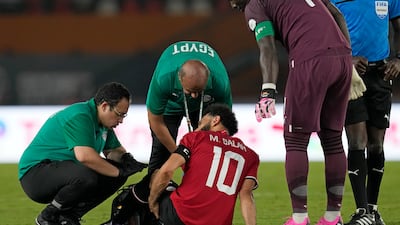
Egypt's Mohamed Salah receives medical treatment during the Africa Cup of Nations Group B match against Ghana in Abidjan, Ivory Coast, Thursday, January 18, 2024. AP -
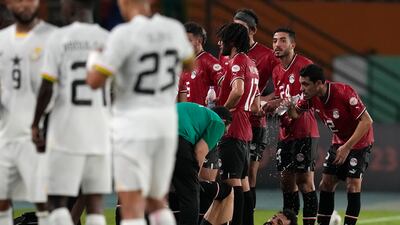
Egypt's Mohamed Salah suffered the injury setback just before half time and received lengthy medical treatment. AP -
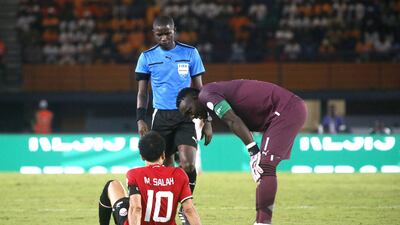
Mohamed Salah of Egypt signaled to the bench he was unable to continue. AP -
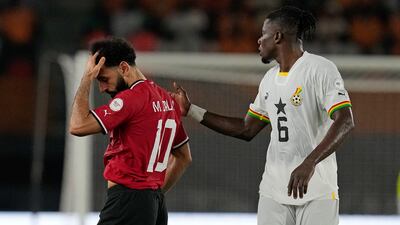
Egypt's Mohamed Salah, left, leaves the field. AP -
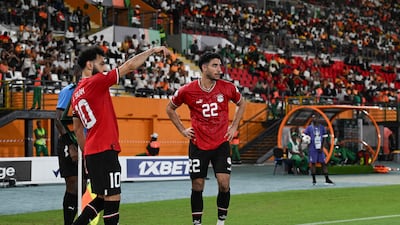
Egypt's Mohamed Salah prepares to take a corner. AFP -
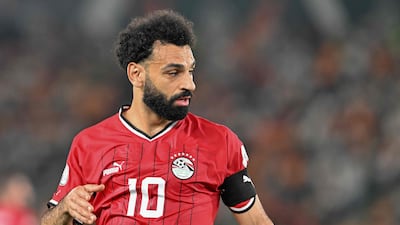
Egypt's forward #10 Mohamed Salah reacts during the Africa Cup of Nations (CAN) 2024 group B football match between Egypt and Ghana at the Felix Houphouet-Boigny Stadium in Abidjan on January 18, 2024. (Photo by Issouf SANOGO / AFP) -
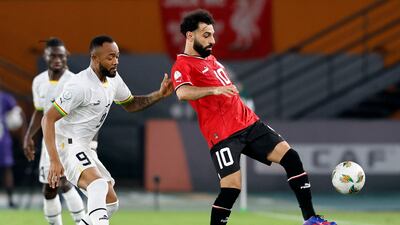
Egypt were held to a 2-2 draw by Ghana. AFP -
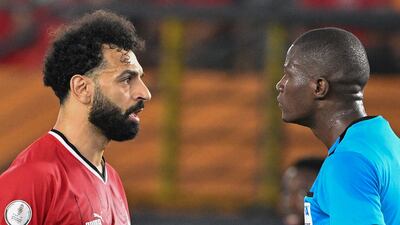
Mohamed Salah speaks with Gabonese referee Pierre Atcho. AFP -

Egypt's Mohamed Salah fights for the ball with Ghana's Gideon Mensah and Jordan Ayew, right. AFP -
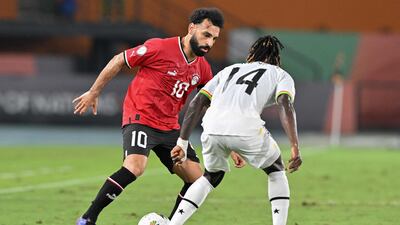
Egypt's Mohamed Salah up against Ghana's Gideon Mensah. AFP


And those questions are resurfacing after the confusion over when Salah's trip back to the UK should be announced.
Salah’s agent, Ramy Abbas Issa, posted on social media on Monday, just before the Pharaohs' crucial final group match against Cape Verde, that he could be sidelined for longer than the original 10-14-day prognosis.
“We didn't want to alarm anyone. I didn't think it was right for Liverpool, via any intermediary, to speak about this, because we had a tremendously important game,” said Egypt manager Rui Vitoria after the game.
This only added to the debate over whether Salah should be leaving the squad at all. “He has no leadership qualities,” declared prominent football commentator Sabry Sirag. “But he insisted on taking the captain’s armband and it’s evident now that he’s not capable of shouldering the responsibilities that go with it.”
Egypt's poor form at Afcon so far – the Pharaohs reached the last 16 but finished second in Group B behind Cape Verde after three consecutive 2-2 draws – has only added to the angst against Salah and the team.
The record seven-time African champions have not won an Afcon title for 14 years and have been beaten in two of the last three finals.
But Salah – who has lifted the Fifa Club World Cup, Uefa Super Cup, Uefa Champions League, Premier League, FA Cup and League Cup during his seven-year spell with Liverpool – insisted that his determination to help Egypt win a major trophy remains as strong as ever.
“I have won everything possible but not this one yet,” Salah said Sunday when asked about Egypt's title drought. “It will happen somehow, that is what I believe, and whatever I believe I achieve, so sooner or later it will happen.
“Everybody knows what it means to any player to win an Africa Cup.”
And there are some who have come out in defence of Salah insisting he is always made a scapegoat for the team's struggles. Hassan El Mistikawi, arguably Egypt’s top football commentator, said: “From the viewpoint of his critics, he’s to blame every time the squad stumbles.
“Salah is the best player in the history of Egyptian football … the most talented among Egypt’s professionals and one of the world’s top 10 players, and I will not be exaggerating if I say he is one of the world’s best five players,” adding a sentiment that is probably shared by every football fan in Egypt: “Salah, get well!”

