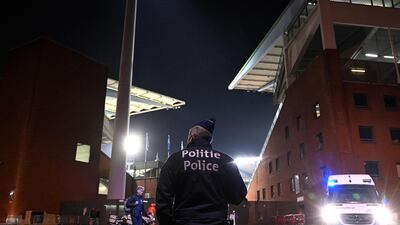
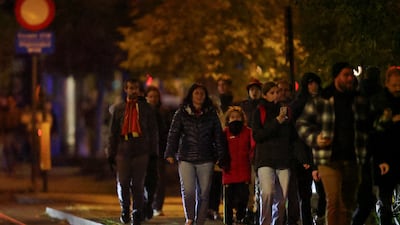
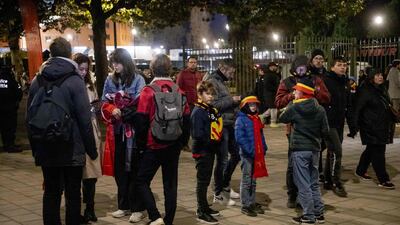
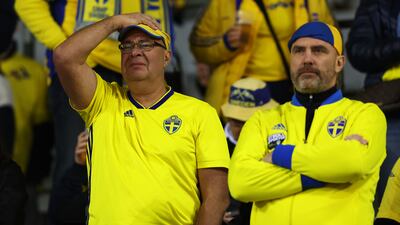
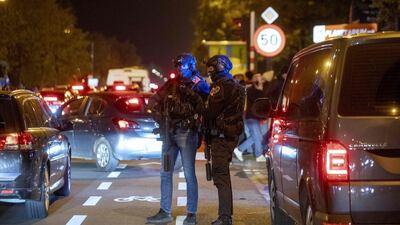
By half-time, the news had reached a majority of those inside the Stade Roi Baudouin. They learnt that two of the spectators who had been making their way to Brussels’s main stadium for Monday night’s Euro 2024 qualifier between Belgium and Sweden never made it to their seats.
They had been shot, fatally, some 90 minutes before the scheduled kick-off. It is believed they were targeted for being Swedish.
The gunman, killed by police bullets the following morning, knew their nationality by their clothes, Sweden colours, worn with enthusiasm to a fixture that should have been about shared, patriotic pride – and only about that.
The Sweden national team was already very unlikely to reach next summer’s Euros. At 1-1 after 45 minutes in Brussels, their hopes were hanging on the sliver of a slim chance of somehow making it into the March play-offs.
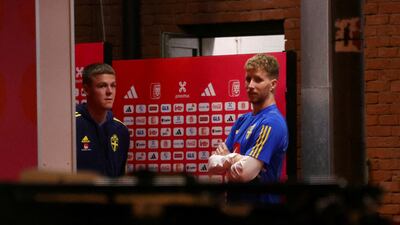
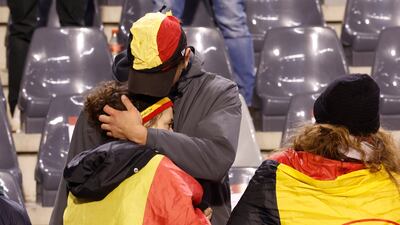
It was during half-time that the Swedish players learnt of the deaths of their compatriots. In the grandstands, meanwhile, spectators scrolled phones for updates on the breaking story.
A loud bang from a firework caused unusual, jittery alarm because of the circumstances, memories being stirred of similar incidents, where terrorism has impacted on a sporting event.
Eight years ago, three bombs were detonated outside the Stade de France, just north of Paris, while France were playing Germany in a friendly designed as preparation for the following summer’s European championships.
Then, the reaction from some of the crowd to the noise of the first bomb, exploding 16 minutes into the first half, was to assume it was just a firework. The next explosion was louder. By the time the third bomb went off, four people in the area outside the stadium, including the three bombers, had died.
Police investigators later came to the conclusion the intention had been to detonate the bombs inside the Stade de France, where the attendance was more than 60,000.
That night in and around Paris, the bombings at the football were just one episode among several and the death toll, after co-ordinated shootings and bombings at restaurants and cafés and at the Bataclan theatre, where there was a packed crowd for a concert, would reach 130.
As central Paris reeled, the Stade de France turned from vulnerable target to place of refuge. The decision was taken not to abandon the France-Germany match for fear of panic as the crowd left the stadium. The German and French players slept overnight in the arena, deeming it safer than being outside.
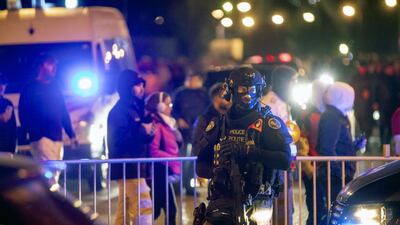
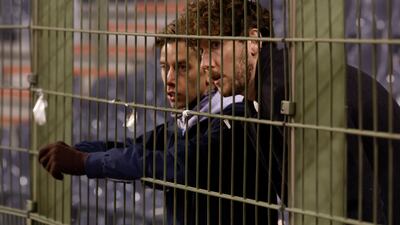
Some of the same instinct informed Monday’s security operation at the Roi-Baudouin. The gunman – later identified as a Tunisian living in Belgium, linked to Islamic State and, the Swedish authorities believe, targeting Swedes because of the Quran-burning incidents in Sweden this year – was still at large long into the night.
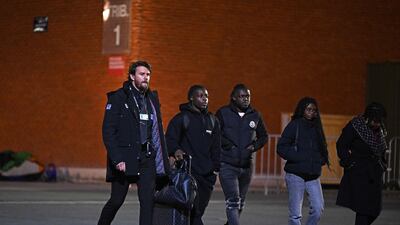
It was thought safer for the crowd to be inside the stadium than on the streets of Brussels. The gates were eventually opened to let the 30,000 fans out at 15 minutes to midnight. Belgian fans passed some of the time cheering for Sweden, a gesture of solidarity in grief.
They filed out two hours after the last ball was kicked. Sweden’s players, told of the horrific shootings during half-time, had decided they would not continue with the match.
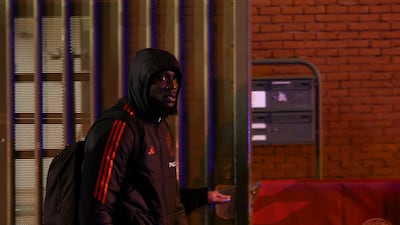
The captain, Victor Lindelof of Manchester United, canvassed opinion around his dressing-room and then consulted with the Belgium team.
“I tried to talk to all the players about how they felt,” he said. “Then I felt I needed to speak to Belgian players. I explained we felt very clearly we didn’t want to carry on. They understood.
“We wanted to look after our fans. There are players who had family and friends present and they wanted to make contact to see if they were okay. People were worried.”
Lindelof is against replaying or finishing the game at a later date. “I don’t think there is any point,” he said.
The repercussions will be felt most of all by the families of the dead, and by the taxi driver who sustained injuries during the shootings.
As with the Paris attacks of November 2015, the security of major sporting events, of fans from different nations travelling together in conspicuous groups and big numbers comes under urgent focus.
France stepped up its police and military presence around stadiums during its hosting of Euro 2016, staged seven months after the Paris attacks.
Just over Belgium’s borders, there are major, mass-attendance events taking place over the next nine days – the conclusion of the Rugby World Cup in France – and in eight months time, the Euro 2024 tournament in Germany.
In July, the Olympic Games go to Paris.
“Europe has been shaken,” said French president, Emmanuel Macron, of the shootings in Brussels.

PROFILE OF SWVL
Started: April 2017
Founders: Mostafa Kandil, Ahmed Sabbah and Mahmoud Nouh
Based: Cairo, Egypt
Sector: transport
Size: 450 employees
Investment: approximately $80 million
Investors include: Dubai’s Beco Capital, US’s Endeavor Catalyst, China’s MSA, Egypt’s Sawari Ventures, Sweden’s Vostok New Ventures, Property Finder CEO Michael Lahyani
THE BIO: Martin Van Almsick
Hometown: Cologne, Germany
Family: Wife Hanan Ahmed and their three children, Marrah (23), Tibijan (19), Amon (13)
Favourite dessert: Umm Ali with dark camel milk chocolate flakes
Favourite hobby: Football
Breakfast routine: a tall glass of camel milk
Gothia Cup 2025
4,872 matches
1,942 teams
116 pitches
76 nations
26 UAE teams
15 Lebanese teams
2 Kuwaiti teams
AIR
%3Cp%3E%3Cstrong%3EDirector%3A%20%3C%2Fstrong%3EBen%20Affleck%3Cbr%3E%3Cbr%3E%3Cstrong%3EStars%3A%20%3C%2Fstrong%3EMatt%20Damon%2C%20Jason%20Bateman%2C%20Ben%20Affleck%2C%20Viola%20Davis%3Cbr%3E%3Cbr%3E%3Cstrong%3ERating%3A%3C%2Fstrong%3E%204%2F5%3C%2Fp%3E%0A
Countries recognising Palestine
France, UK, Canada, Australia, Portugal, Belgium, Malta, Luxembourg, San Marino and Andorra
In numbers: China in Dubai
The number of Chinese people living in Dubai: An estimated 200,000
Number of Chinese people in International City: Almost 50,000
Daily visitors to Dragon Mart in 2018/19: 120,000
Daily visitors to Dragon Mart in 2010: 20,000
Percentage increase in visitors in eight years: 500 per cent
Results
5pm: Al Falah – Maiden (PA) Dh80,000 (Turf) 1,200m; Winner: Bshara, Richard Mullen (jockey), Salem Al Ketbi (trainer)
5.30pm: Wathba Stallions Cup – Handicap (PA) Dh70,000 (T) 1,400m; Winner: AF Musannef, Tadhg O’Shea, Ernst Oertel
6pm: Al Dhafra – Maiden (PA) Dh80,000 (T) 1,600m; Winner: AF Mualami, Antonio Fresu, Abubakar Daud
6.30pm: Al Khaleej Al Arabi – Handicap (PA) Dh80,000 (T) 1,600m; Winner: Hawafez, Adrie de Vries, Abubakar Daud
7pm: Al Mafraq – Handicap (PA) Dh80,000 (T) 1,600m; Winner: JAP Almahfuz, Royston Ffrench, Irfan Ellahi
7.30pm: Al Samha – Handicap (TB) Dh80,000 (T) 1,600m; Winner: Celestial Spheres, Patrick Cosgrave, Ismail Mohammed
Most sought after workplace benefits in the UAE
- Flexible work arrangements
- Pension support
- Mental well-being assistance
- Insurance coverage for optical, dental, alternative medicine, cancer screening
- Financial well-being incentives
COMPANY%20PROFILE
%3Cp%3E%3Cstrong%3ECompany%3A%20%3C%2Fstrong%3EMascotte%20Health%3C%2Fp%3E%0A%3Cp%3E%3Cstrong%3EStarted%3A%20%3C%2Fstrong%3E2023%3C%2Fp%3E%0A%3Cp%3E%3Cstrong%3EBased%3A%20%3C%2Fstrong%3EMiami%2C%20US%3C%2Fp%3E%0A%3Cp%3E%3Cstrong%3EFounder%3A%3C%2Fstrong%3E%20Bora%20Hamamcioglu%3C%2Fp%3E%0A%3Cp%3E%3Cstrong%3ESector%3A%20%3C%2Fstrong%3EOnline%20veterinary%20service%20provider%3C%2Fp%3E%0A%3Cp%3E%3Cstrong%3EInvestment%20stage%3A%3C%2Fstrong%3E%20%241.2%20million%20raised%20in%20seed%20funding%3C%2Fp%3E%0A
Earth under attack: Cosmic impacts throughout history
- 4.5 billion years ago: Mars-sized object smashes into the newly-formed Earth, creating debris that coalesces to form the Moon
- 66 million years ago: 10km-wide asteroid crashes into the Gulf of Mexico, wiping out over 70 per cent of living species – including the dinosaurs.
- 50,000 years ago: 50m-wide iron meteor crashes in Arizona with the violence of 10 megatonne hydrogen bomb, creating the famous 1.2km-wide Barringer Crater
- 1490: Meteor storm over Shansi Province, north-east China when large stones “fell like rain”, reportedly leading to thousands of deaths.
- 1908: 100-metre meteor from the Taurid Complex explodes near the Tunguska river in Siberia with the force of 1,000 Hiroshima-type bombs, devastating 2,000 square kilometres of forest.
- 1998: Comet Shoemaker-Levy 9 breaks apart and crashes into Jupiter in series of impacts that would have annihilated life on Earth.
-2013: 10,000-tonne meteor burns up over the southern Urals region of Russia, releasing a pressure blast and flash that left over 1600 people injured.
Sarfira
Director: Sudha Kongara Prasad
Starring: Akshay Kumar, Radhika Madan, Paresh Rawal
Rating: 2/5
Mercer, the investment consulting arm of US services company Marsh & McLennan, expects its wealth division to at least double its assets under management (AUM) in the Middle East as wealth in the region continues to grow despite economic headwinds, a company official said.
Mercer Wealth, which globally has $160 billion in AUM, plans to boost its AUM in the region to $2-$3bn in the next 2-3 years from the present $1bn, said Yasir AbuShaban, a Dubai-based principal with Mercer Wealth.
“Within the next two to three years, we are looking at reaching $2 to $3 billion as a conservative estimate and we do see an opportunity to do so,” said Mr AbuShaban.
Mercer does not directly make investments, but allocates clients’ money they have discretion to, to professional asset managers. They also provide advice to clients.
“We have buying power. We can negotiate on their (client’s) behalf with asset managers to provide them lower fees than they otherwise would have to get on their own,” he added.
Mercer Wealth’s clients include sovereign wealth funds, family offices, and insurance companies among others.
From its office in Dubai, Mercer also looks after Africa, India and Turkey, where they also see opportunity for growth.
Wealth creation in Middle East and Africa (MEA) grew 8.5 per cent to $8.1 trillion last year from $7.5tn in 2015, higher than last year’s global average of 6 per cent and the second-highest growth in a region after Asia-Pacific which grew 9.9 per cent, according to consultancy Boston Consulting Group (BCG). In the region, where wealth grew just 1.9 per cent in 2015 compared with 2014, a pickup in oil prices has helped in wealth generation.
BCG is forecasting MEA wealth will rise to $12tn by 2021, growing at an annual average of 8 per cent.
Drivers of wealth generation in the region will be split evenly between new wealth creation and growth of performance of existing assets, according to BCG.
Another general trend in the region is clients’ looking for a comprehensive approach to investing, according to Mr AbuShaban.
“Institutional investors or some of the families are seeing a slowdown in the available capital they have to invest and in that sense they are looking at optimizing the way they manage their portfolios and making sure they are not investing haphazardly and different parts of their investment are working together,” said Mr AbuShaban.
Some clients also have a higher appetite for risk, given the low interest-rate environment that does not provide enough yield for some institutional investors. These clients are keen to invest in illiquid assets, such as private equity and infrastructure.
“What we have seen is a desire for higher returns in what has been a low-return environment specifically in various fixed income or bonds,” he said.
“In this environment, we have seen a de facto increase in the risk that clients are taking in things like illiquid investments, private equity investments, infrastructure and private debt, those kind of investments were higher illiquidity results in incrementally higher returns.”
The Abu Dhabi Investment Authority, one of the largest sovereign wealth funds, said in its 2016 report that has gradually increased its exposure in direct private equity and private credit transactions, mainly in Asian markets and especially in China and India. The authority’s private equity department focused on structured equities owing to “their defensive characteristics.”
COMPANY PROFILE
Founders: Alhaan Ahmed, Alyina Ahmed and Maximo Tettamanzi
Total funding: Self funded
EPL's youngest
- Ethan Nwaneri (Arsenal)
15 years, 181 days old
- Max Dowman (Arsenal)
15 years, 235 days old
- Jeremy Monga (Leicester)
15 years, 271 days old
- Harvey Elliott (Fulham)
16 years, 30 days old
- Matthew Briggs (Fulham)
16 years, 68 days old