



Ole Gunnar Solskjaer will always be defined by a game with two injury-time goals, and it won’t be one where Watford got them both. The last-gasp strike that springs to mind when Solskjaer is mentioned will remain his own strike in the Nou Camp in 1999, not Emmanuel Dennis’ 96th-minute effort at Vicarage Road.
Manchester United recognised as much with a statement that acknowledged their sacked manager remains a legend. “His place in the club’s history will always be secure,” they said. So much of the Solskjaer project revolved around history that it was the constant; he sought to remember it and re-enact it but, dismissed after a 4-1 defeat, he emulated Ron Atkinson, not Sir Alex Ferguson.
United’s recent spell has been reminiscent of Ferguson’s awful autumn of 1989, but without its Mark Robins moment and subsequent surge to glory. The winner as player was the nearly man as a manager, the serial semi-finalist. United were seventh in the table when Solskjaer came sixth in the sack race.
His shortcomings were cruelly exposed by their inability to act. Realistically, the 5-0 evisceration by Liverpool signalled the need for change; so, too, the Manchester derby defeat. Solskjaer limped on to Watford by a board who placed too much faith in the likeable legend, ignoring a host of better-qualified managers as, one by one, they took jobs.
United are left with an interim for the rest of the season. They have hamstrung themselves by overlooking Mauricio Pochettino and Antonio Conte until it was too late. United believed in their own hype, in Solskjaer’s doctrine of United exceptionalism meaning it did not matter if he wasn’t a world-class manager because he loved the club. They gave him a new three-year contract in the summer. They did not see a crisis coming and did not react in time when it did.
Maybe Solskjaer should always have been an interim. Instead, his reign lasted three years. He was a brilliant caretaker, an antidote to the toxicity of Jose Mourinho, his enthusiasm propelling United to 14 wins in 17 games.
Yet the nature of Solskjaer’s reign meant they could veer between boom and bust, between counter-attacking triumphs over supposedly superior managers to embarrassing defeats. Long before the run of five losses in seven league games that finished him off were Cardiff and Astana and Sheffield United. Before the 5-0 to Liverpool was the 6-1 to Mourinho’s Tottenham.
Watford 4 Manchester United 1: player ratings
-

WATFORD RATINGS: Ben Foster: 6 - The 38-year-old was a spectator at times, but made a crucial save in the first-half to deny Rashford’s volley. Had an important ten minutes in the second-half , tipping Ronaldo’s chance over the bar when he was through on goal. Getty -

Kiko Femenia: 7 - The full-back was often involved in an attacking sense, cutting the ball back from wide to set-up Sarr’s finish. He also scored a rebound from the first Sarr penalty, but was deemed to have encroached and forced a retake of the kick. Getty -

Craig Cathcart: 6 - The Northern Irish defender made some vital interceptions, throwing himself in front of a shot to stop the away side scoring. However, he made a mistake for the goal, leaving Ronaldo free to head back across the box. Getty -

Nicolas N’Koulou: 6 - Struggled after the break. The pace behind meant he found life difficult, with Ronaldo finding space twice, but he was denied by Foster and blasted over for the other. Taken off midway through the half. Getty -

Adam Masina: 5 - The full-back struggled to deal with Sancho and Van de Beek at times in the second half, drifting between both and leaving the former free to put a cross in to pull a goal back. Getty -

Moussa Sissoko: 7 - The Watford captain had a solid display, often dropping into the defensive line to create a back five. Made a key interception to deny Wan-Bissaka a cut-back to the edge of the box. Reuters -
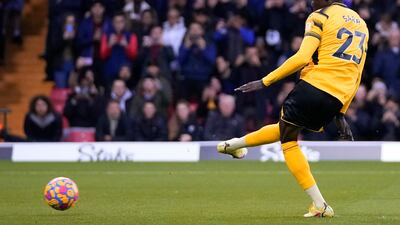
Ismaila Sarr: 6 - Misplaced passes, missed a penalty but also scored. Missed from the spot before it was retaken due to encroachment. The second penalty was poor and saved by De Gea. The forward made up for it with a finish across goal. AP -

Imran Louza: 7 - In his first start for Watford since September, the midfielder had a great all-round game. He won the majority of his duels, making one great challenge to deny United breaking on the counter attack. AP -

Tom Cleverley: 6 - Played King through on goal with a long kick downfield in the second-half. Also forced United to go down to ten, pressing Maguire and dispossessing him, before receiving a challenge that resulted in a second yellow. Reuters -

Joshua King: 8 - The forward had a great game, linking with Dennis throughout to cause chaos for the United backline. This was only emphasised when the Norwegian international was played in by his teammate to score the opener. AP -

Emmanuel Dennis: 10 - His link-up with King was crucial, setting the striker up with a cut-back on the left for the opener. He grabbed a second assist, playing in Pedro late on. Rounded out the performance with a goal of his own, hammering the ball in from the right. Getty -

SUBS: William Troost-Ekong (On for Nkoulou 63’): 6 - The defender did a good job of helping keep Ronaldo quiet, denying the Portuguese forward any chances behind like he enjoyed with Nkoulou. Getty -

Joao Pedro (On for Louza 77’): 8 - Played a neat dummy to lay in Femenia for a chance. He then secured the victory late on with a finish in the six-yard box for his first Premier League goal. Cucho Hernandez (On for Sarr 68’): 6 - The 22-year-old came on for the injured Sarr, but saw little of the ball as his side looked to see out the game. Getty -

MANCHESTER UNITED RATINGS: David de Gea - 6 Saved the first poor penalty. And the second! Conceded four goals yet wasn’t the worst United player - yet again. Went down too slowly for Watford’s third. Looked resigned after Watford’s fourth and said the result was embarrassing after the match. Getty -

Aaron Wan-Bissaka - 3. Headed the ball high into the air – and watched it go to an opponent to set up Watford’s first. He’s been bad for a long time, but he was really bad at Watford. Getty -

Harry Maguire - 5. Struggled with direct runs but blocked a shot from King and was United’s best defender in the wretched first half. Booked, then booked again and sent off after being indecisive before clattering into Cleverley. Reuters -

Victor Lindelof - 5. Not at the races in a United defence which looked so shambolically bad, so short of confidence, in the first half. Came too slowly towards Pedro for Watford’s third. AFP -

Luke Shaw - 4. Peripheral. Such a good player last season. Nowhere near good this. It’s baffling how his levels have dropped off so much. United have conceded 15 league goals in their last five games. It’s dreadful. Getty -

Nemanja Matic - 4. A rare start. Won four aerials but gave the ball away too often. Asleep for Watford’s fourth. Too slow on the most wretched afternoon as even Watford fans sang ‘Ole’s at the wheel’, laughing at the fortunes – or lack of them - of the manager. AFP -

Scott McTominay - 4. Gave away the first penalty and was lucky to stay on the pitch since he stopped a direct attempt on goal. Booked for a foul too many after only 18 minutes. Touched the ball 39 times. Matic next to him had 98 touches. AP -

Jadon Sancho - 5. Another who did next to nothing in the first half, but much better in the second. He made a super cross as part of United's goal for Ronaldo, then picked out Fernandes who shot wide after 55. Set up Ronaldo again on 76. AP -
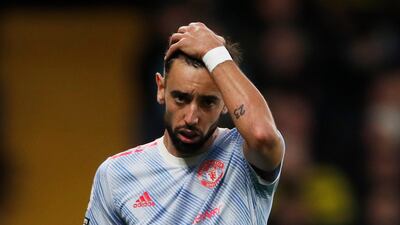
Bruno Fernandes - 3. Terrible ball high towards his own area which led to a penalty and the opening goal. His goals have stopped and his performances have dropped off. Pulled a shot far over the bar after 75 when he should have hit the target. Gave the ball away on 87. Reuters -

Marcus Rashford - 4. Had United’s first attempt on goal after 30 minutes. Came off at half time after the worst half that Manchester United have played in recent memory. Getty -

Cristiano Ronaldo - 4. Nothing in the first half, then unselfishly cushioned a header to set up Van de Beek for United’s first. Drew a save from Ben Foster on 57. AP -

SUBS: Donny van de Beek (On for McTominay 46') - 7: He’d had only 15 minutes of league football so far this season. Headed United’s first, looked full of confidence as he set up Ronaldo. Then Maguire was sent off and United fell apart again. AP -

Anthony Martial - On for Rashford 46') - 4: Did little. Done little for far too long for United. Getty -

Diogo Dalot (On for Shaw 85') N/A. United conceded two late goals from his side of defence. Jesse Lingard - (On for Sancho 90 +1'). N/A. PA


Despite a couple of notable wins over Paris Saint-Germain, Solskjaer’s Champions League record was undistinguished. Yet he could point to Premier League finishes of sixth, third and second as evidence of progress.
Had he gone before May’s Europa League final, it could have been with the sense he had steered the club in the right direction, resetting the culture, promoting youth, adding an upbeat air. But his passivity in Gdansk was a sign he had run out of ideas. He was simply relying on his premier players to do something. It was an illustration United lacked the capacity to create courtesy of training-ground moves implemented by better managers. Solskjaer was the throwback, the great ex-player in a managerial world of tactics nerds.
And this season descended into farce, unravelling to a startlingly degree. The signing of Cristiano Ronaldo unbalanced everything. Jadon Sancho became the new Donny van de Beek, a player Solskjaer did not know what to do with. United’s defending was shambolic, their side lacking in shape or spirit.
Nostalgia was no answer to their failures in the modern world. Solskjaer leaves United with a better squad than he inherited, even if that underlines their underachievement this season, but in a similar position: miles from recreating the glory days he enjoyed as a player.

