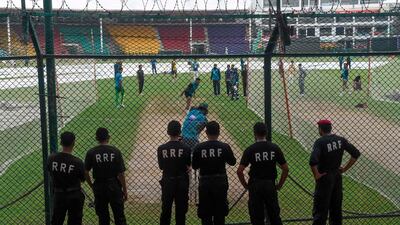
Pakistan team training in Karachi last year. Image for representation. AFP

Pakistan board warns of expulsion after breach of Covid-19 protocols


  • English
  • Arabic

The Pakistan Cricket Board (PCB) has warned players and officials of possible expulsion if they breach health and safety protocols after 12 people compromised the bio-secure bubble at the ongoing National Twenty20 Cup in Rawalpindi.

Nine players and three officials tested negative for coronavirus after they were found to have spent time outside the bubble area near their hotel.

The people, identified only as senior players and officials, received warnings and were made to pay for the tests, the board said in a statement.

"They have put at risk the integrity of the tournament and, health and safety of their colleagues," PCB director of high performance Nadeem Khan said in the statement, adding that the board was "disturbed and disappointed."

"This is completely unacceptable to the PCB and following meetings with the concerned players and their team officials, it has been agreed there will be zero-tolerance for future breaches, and those violating the protocols will be expelled from the ongoing and future tournaments."

Pakistan is scheduled to host Zimbabwe for three one-day internationals and as many Twenty20 matches in Rawalpindi and Lahore in a limited-overs series starting on October 30.

"I expect the players and officials to show responsibility as the world is watching and international cricket is standing at our doorsteps," Nadeem said.

"Their irresponsible actions can put into jeopardy all the efforts of the PCB in organising and inviting sides during these challenging times."


Ten tax points to be aware of in 2026

1. Domestic VAT refund amendments: request your refund within five years

If a business does not apply for the refund on time, they lose their credit.

2. E-invoicing in the UAE

Businesses should continue preparing for the implementation of e-invoicing in the UAE, with 2026 a preparation and transition period ahead of phased mandatory adoption. 

3. More tax audits

Tax authorities are increasingly using data already available across multiple filings to identify audit risks. 

4. More beneficial VAT and excise tax penalty regime

Tax disputes are expected to become more frequent and more structured, with clearer administrative objection and appeal processes. The UAE has adopted a new penalty regime for VAT and excise disputes, which now mirrors the penalty regime for corporate tax.

5. Greater emphasis on statutory audit

There is a greater need for the accuracy of financial statements. The International Financial Reporting Standards standards need to be strictly adhered to and, as a result, the quality of the audits will need to increase.

6. Further transfer pricing enforcement

Transfer pricing enforcement, which refers to the practice of establishing prices for internal transactions between related entities, is expected to broaden in scope. The UAE will shortly open the possibility to negotiate advance pricing agreements, or essentially rulings for transfer pricing purposes. 

7. Limited time periods for audits

Recent amendments also introduce a default five-year limitation period for tax audits and assessments, subject to specific statutory exceptions. While the standard audit and assessment period is five years, this may be extended to up to 15 years in cases involving fraud or tax evasion. 

8. Pillar 2 implementation 

Many multinational groups will begin to feel the practical effect of the Domestic Minimum Top-Up Tax (DMTT), the UAE's implementation of the OECD’s global minimum tax under Pillar 2. While the rules apply for financial years starting on or after January 1, 2025, it is 2026 that marks the transition to an operational phase.

9. Reduced compliance obligations for imported goods and services

Businesses that apply the reverse-charge mechanism for VAT purposes in the UAE may benefit from reduced compliance obligations. 

10. Substance and CbC reporting focus

Tax authorities are expected to continue strengthening the enforcement of economic substance and Country-by-Country (CbC) reporting frameworks. In the UAE, these regimes are increasingly being used as risk-assessment tools, providing tax authorities with a comprehensive view of multinational groups’ global footprints and enabling them to assess whether profits are aligned with real economic activity. 

Contributed by Thomas Vanhee and Hend Rashwan, Aurifer

If you go

Flight connections to Ulaanbaatar are available through a variety of hubs, including Seoul and Beijing, with airlines including Mongolian Airlines and Korean Air. While some nationalities, such as Americans, don’t need a tourist visa for Mongolia, others, including UAE citizens, can obtain a visa on arrival, while others including UK citizens, need to obtain a visa in advance. Contact the Mongolian Embassy in the UAE for more information.

Nomadic Road offers expedition-style trips to Mongolia in January and August, and other destinations during most other months. Its nine-day August 2020 Mongolia trip will cost from $5,250 per person based on two sharing, including airport transfers, two nights’ hotel accommodation in Ulaanbaatar, vehicle rental, fuel, third party vehicle liability insurance, the services of a guide and support team, accommodation, food and entrance fees; nomadicroad.com

A fully guided three-day, two-night itinerary at Three Camel Lodge costs from $2,420 per person based on two sharing, including airport transfers, accommodation, meals and excursions including the Yol Valley and Flaming Cliffs. A return internal flight from Ulaanbaatar to Dalanzadgad costs $300 per person and the flight takes 90 minutes each way; threecamellodge.com

'Peninsula'

Stars: Gang Dong-won, Lee Jung-hyun, Lee Ra

Director: ​Yeon Sang-ho

Rating: 2/5