


When the UAE first went to a cricket World Cup, in 1996, all but two of the players – the Emiratis Sultan Zarawani and Saeed Al Saffer – had come to the country as adults for work.
That stood to reason. Cricket was not much more than a Friday morning pursuit back then.
It was a well-known game, thanks to more than 10 years of the leading teams in the world frequenting the Asia Cup. But it was a spectator sport rather than a formalised, mass-participation one, even within the expanding subcontinental workforce.
Facilities were sparse – Sharjah Cricket Stadium and a couple of rudimentary grounds in Dubai and Abu Dhabi being the only places with turf wickets to play on. And the provision for junior coaching was minimal, at best.
But Zarawani’s pioneers started something. From then on, there was something to aim for: participation in a UAE national cricket team. And, if you succeeded, that could even mean playing at a World Cup.
That is 30 years ago now, and the landscape of the UAE has changed immeasurably since. The population has boomed. Urban expansion has been exponential. There is provision for everything imaginable – indoor ski slopes, football team-themed parks, gold-dispensing ATMs.
And, cricket. The UAE has a set of high-spec facilities the envy of almost any country in the world.
The ICC Academy first broke ground in the late 2000s, and has become one of the best facilities of its type anywhere in the world in the nearly two decades since.
The Zayed Cricket Academy in Abu Dhabi is outstanding. The cricket facilities at The Sevens, Dubai are immaculate. And Sharjah has a long history of producing fine players, too.
Given all that, the composition of the national team had been tracking the way that might be expected. When the UAE played at the 2014 T20 World Cup, in Bangladesh, six of the 15 players were home-produced.

When they made it back to the same event eight years later, in Australia, that number had grown to more than half of the squad: eight of the 15 had done their schooling in the UAE.
And yet now, it has regressed alarmingly. Of the 15-man squad initially named for the 2026 T20 World Cup in India, only three were UAE-raised. This became four when Syed Haider replaced Mohammed Zohaib on the eve of the tournament.
The quality of players being delivered to senior cricket is better than it ever has been. So why the disconnect now? Where is the glitch in the system that has meant only three were deemed worthy of selection for the travel to India?
If the academy systems of the UAE are not the main supply line for the national team, then what is the point of them?
It is not as though the junior game in the country is not producing talent. It is thriving, as shown by the national age-group teams.
In 2022, the UAE won the plate competition at the Under-19 World Cup in the Caribbean, beating Test nations West Indies and Ireland in doing so.
That cohort of players later went on to reach the U19 Asia Cup final against Bangladesh, beating Sri Lanka and Pakistan along the way.
-
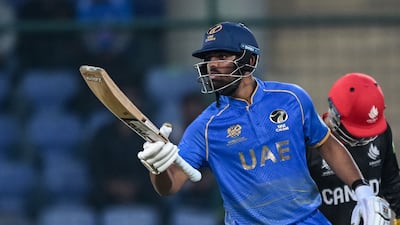
UAE's Aryansh Sharma scored a match-winning fifty against Canada in their T20 World Cup clash at the Arun Jaitley Stadium in New Delhi. AFP -
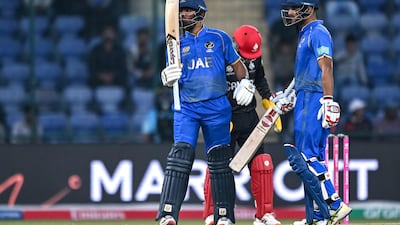
Aryansh Sharma, left, and Sohaib Khan hit sparkling fifties to guide the UAE to victory. AFP -
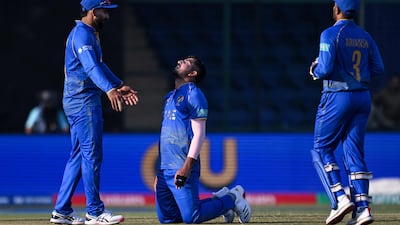
UAE's Junaid Siddique celebrates taking the wicket of Canada's Saad Bin Zafar. AFP -
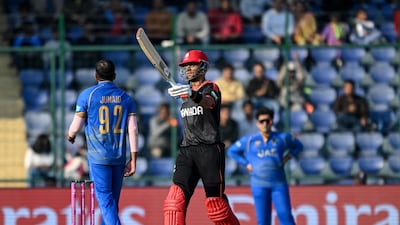
Canada's Harsh Thaker after reaching fifty. AFP -
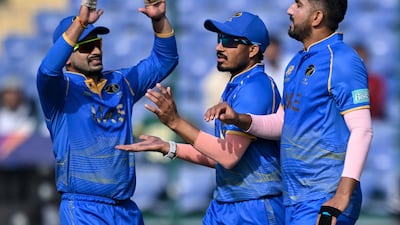
UAE's Junaid Siddique, right, finished with five wickets on Friday. AFP -
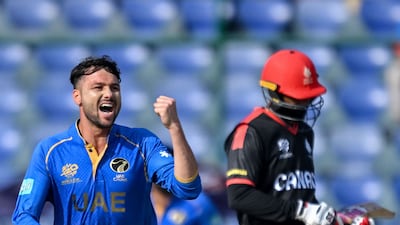
UAE's Muhammad Jawadullah celebrates taking the wicket of Canada's Nicholas Kirton. AFP


Lots of those players have graduated to the senior team, and played plenty of international cricket since. And yet they are not deemed worthy of selection, in a side whose results have been ever declining.
In the current setup, there seems to be a wariness about homegrown players. There appears to be a perception that, if they have grown up in the UAE, they are not as battle-hardened as those who had to fight to make their way in more mature cricket environments elsewhere.
Yasir Arafat, the short-term appointment as bowling consultant for the World Cup, intimated as much. After the final game against South Africa, he suggested that expat players are, by their nature, “slightly immature”.
“Many of them are expats,” Arafat said. “They are slightly immature. I am there, Lalu-sir [head coach Lalchand Rajput] is also. We will try to share whatever experience that we can in this little time that we have.”
And yet the side’s leading run scorer was one of the few home-produced players, Alishan Sharafu, the player who was also their leading run-scorer in qualifying.
Sharafu has an agreeable, laid-back demeanour. But do not mistake that for a lack of hardness or maturity.
He showed just how tough he is in the final game the UAE played at the World Cup, against South Africa. Worryingly so. He was hit on the head twice by bouncers against South Africa’s fast bowlers, yet battled on regardless.
That brought to mind Zarawani, the UAE cricket trailblazer, whose helmetless head was famously hit by another South African, Allan Donald, back in 1996.
In both his output and his attitude, Sharafu shows that UAE-raised players are every bit as worthy as those who have come from abroad as adults. Players who have their lives invested in UAE cricket are in many ways even more vital. They give the team its identity.
Players like Harshit Kaushik, Mayank Kumar and Mohammed Arfan took places in the World Cup squad which could easily have been filled by young, home-produced players like Aayan Khan, Ethan D’Souza, Vriitya Aravind or Ali Naseer.
It is important to point out that this is not in any way to undermine the commitment of the players who arrived from overseas. For example, no one was more thrilled or emotional when the UAE qualified for the World Cup than Haider Ali.
After qualification was sealed at a tournament in Muscat last year, the left-arm spin-bowler repeatedly broke down in tears. He was thinking about what his late father, from whom he was estranged for much of his life, would have thought of it.
Everyone has their own motivation. Just because a player only arrived in the UAE as an adult, it does not mean they feel for the cause any less.
There was also the case of Sohaib Khan. He was a breakout star at the World Cup after playing successive thrilling knocks in the city he once called home.
He left Delhi shortly after completing a sociology degree as he needed to provide for his wife and baby daughter.
He ended up in Dubai, went for months unemployed, and yet has now found himself a way to make a living, thanks to cricket. He is a player of great quality, with a desire to succeed that matches anyone’s.
There are many such players the national team cannot be without, like Muhammad Waseem and Junaid Siddique.
But any national team should reflect the cricket infrastructure of the country it represents. The misfiring national team – who are also the lowest-ranked One-Day International side in the world – need to find an identity. The only way it can do that is if the nucleus of the side is homegrown.

