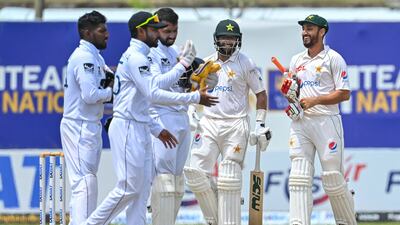
Pakistan's Imam-ul-Haq, left, and Agha Salman walk back to the pavilion after winning the first Test against Sri Lanka in Galle. AFP

Imam-ul-Haq and Saud Shakeel guide Pakistan to win in first Sri Lanka Test


  • English
  • Arabic

Pakistan made heavy weather of a modest chase before eventually getting over the finish line in a four-wicket win in the first Test against Sri Lanka in Galle on Thursday.

Pakistan kept losing wickets at regular intervals but opening batsman Imam-ul-Haq scored an unbeaten half-century – his eighth in Test cricket – to see the tourists home before lunch on the fifth day.

Imam's 50 helped the visitors chase down a tricky target of 131.

Pakistan started the final day on 48-3 and lost three more wickets, including skipper Babar Azam for 24 off Prabath Jayasuriya, before they achieved their target in the first session.

Imam started the day on 25 and remained calm with Azam and then left-handed partner Saud Shakeel, who made a brisk 30 after his unbeaten 208 in Pakistan's first innings.

Left-arm spinner Jayasuriya took four wickets including two on the evening of Day 4 to give the hosts a glimmer of hope.

When play resumed on the final day, Pakistan needed 83 runs and there were memories of the 2009 Test at Galle. That's when the visitors needed 97 runs with eight wickets in hand chasing a target of 168 but collapsed and were bowled out for 117.

  • Pakistan's Saud Shakeel scored a brisk 30 to help secure victory in the first Test against Sri Lanka in Galle. AP
    Pakistan's Saud Shakeel scored a brisk 30 to help secure victory in the first Test against Sri Lanka in Galle. AP
  • Pakistan's Imam-ul-Haq, second right, and Agha Salman after completing a four-wicket win in the Galle Test. AFP
    Pakistan's Imam-ul-Haq, second right, and Agha Salman after completing a four-wicket win in the Galle Test. AFP
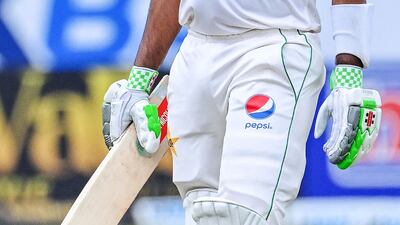
  • Pakistan's Imam-ul-Haq after reaching his fifty. AFP
    Pakistan's Imam-ul-Haq after reaching his fifty. AFP
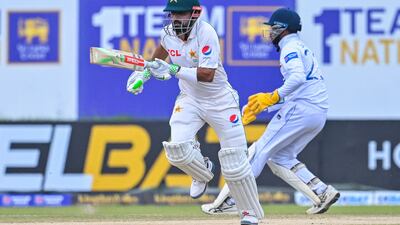
  • Pakistan captain Babar Azam takes off for a run. AFP
    Pakistan captain Babar Azam takes off for a run. AFP
  • Babar Azam was dismissed for 24. AFP
    Babar Azam was dismissed for 24. AFP
  • Sri Lanka's Prabath Jayasuriya, left, picked up four wickets. AP
    Sri Lanka's Prabath Jayasuriya, left, picked up four wickets. AP

Azam added 41 runs for the fourth wicket with Imam and the run chase looked a mere formality, but Jayasuriya trapped the Pakistan captain to give the tourists jitters.

Shakeel and Imam then added 43 runs for the fifth wicket with the former being the more dominant partner with his clever footwork against the spinners. He had come down the track and executed an elegant cover drive off Ramesh Mendis but was caught behind the next ball to give Mendis his first wicket in the innings.

Jayasuriya claimed his fourth wicket when Sarfraz Ahmed, attempting to sweep, was caught at backward square leg by Kusal Mendis.

Agha Salman walked in at the fall of the sixth wicket with Pakistan needing four runs and he completed the victory by depositing Jayasuriya over long-off for six.

Shakeel, whose maiden Test double hundred fetched Pakistan a decisive first-innings lead of 149, was named player of the match.

"The way Saud and Agha played, it totally changed the game," Azam said referring to their 177-run partnership, which helped Pakistan post 461 in the first innings.

"It's not easy to bat in Galle, but the way Saud's playing is outstanding."

While you're here
if you go

The flights

Etihad, Emirates and Singapore Airlines fly direct from the UAE to Singapore from Dh2,265 return including taxes. The flight takes about 7 hours.

The hotel

Rooms at the M Social Singapore cost from SG $179 (Dh488) per night including taxes.

The tour

Makan Makan Walking group tours costs from SG $90 (Dh245) per person for about three hours. Tailor-made tours can be arranged. For details go to www.woknstroll.com.sg

Ten tax points to be aware of in 2026

1. Domestic VAT refund amendments: request your refund within five years

If a business does not apply for the refund on time, they lose their credit.

2. E-invoicing in the UAE

Businesses should continue preparing for the implementation of e-invoicing in the UAE, with 2026 a preparation and transition period ahead of phased mandatory adoption. 

3. More tax audits

Tax authorities are increasingly using data already available across multiple filings to identify audit risks. 

4. More beneficial VAT and excise tax penalty regime

Tax disputes are expected to become more frequent and more structured, with clearer administrative objection and appeal processes. The UAE has adopted a new penalty regime for VAT and excise disputes, which now mirrors the penalty regime for corporate tax.

5. Greater emphasis on statutory audit

There is a greater need for the accuracy of financial statements. The International Financial Reporting Standards standards need to be strictly adhered to and, as a result, the quality of the audits will need to increase.

6. Further transfer pricing enforcement

Transfer pricing enforcement, which refers to the practice of establishing prices for internal transactions between related entities, is expected to broaden in scope. The UAE will shortly open the possibility to negotiate advance pricing agreements, or essentially rulings for transfer pricing purposes. 

7. Limited time periods for audits

Recent amendments also introduce a default five-year limitation period for tax audits and assessments, subject to specific statutory exceptions. While the standard audit and assessment period is five years, this may be extended to up to 15 years in cases involving fraud or tax evasion. 

8. Pillar 2 implementation 

Many multinational groups will begin to feel the practical effect of the Domestic Minimum Top-Up Tax (DMTT), the UAE's implementation of the OECD’s global minimum tax under Pillar 2. While the rules apply for financial years starting on or after January 1, 2025, it is 2026 that marks the transition to an operational phase.

9. Reduced compliance obligations for imported goods and services

Businesses that apply the reverse-charge mechanism for VAT purposes in the UAE may benefit from reduced compliance obligations. 

10. Substance and CbC reporting focus

Tax authorities are expected to continue strengthening the enforcement of economic substance and Country-by-Country (CbC) reporting frameworks. In the UAE, these regimes are increasingly being used as risk-assessment tools, providing tax authorities with a comprehensive view of multinational groups’ global footprints and enabling them to assess whether profits are aligned with real economic activity. 

Contributed by Thomas Vanhee and Hend Rashwan, Aurifer

Star%20Wars%3A%20Ahsoka%20
%3Cp%3E%3Cstrong%3EDirector%3A%3C%2Fstrong%3E%20Various%20%3Cbr%3E%3Cstrong%3EStarring%3A%3C%2Fstrong%3E%20Rosario%20Dawson%2C%20Natasha%20Liu%20Bordizzo%2C%20Lars%20Mikkelsen%20%3Cbr%3E%3Cstrong%3ERating%3A%3C%2Fstrong%3E%204%2F5%0D%3Cbr%3E%3C%2Fp%3E%0A
Updated: July 20, 2023, 7:14 AM