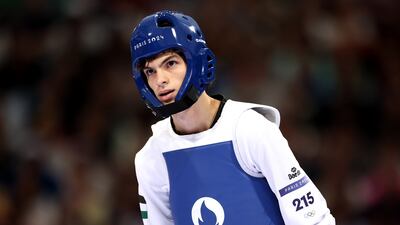
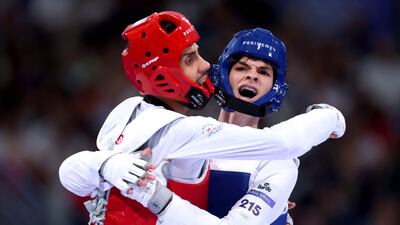
Mohamed Khalil Jendoubi celebrates with his coaches after claiming a bronze medal. Getty Images

Tunisia's Mohamed Khalil Jendoubi wins bronze in taekwondo at Paris 2024


  • English
  • Arabic

Follow the latest news on the 2024 Paris Olympics

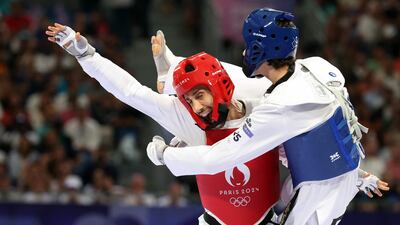
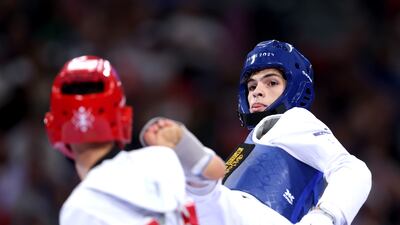
Tunisia's Mohamed Khalil Jendoubi went through his full repertoire of tricks to seal bronze in the men's taekwondo -58kg category at Paris 2024 on Wednesday.

Remarkably, Jendoubi, the silver medallist at the same weight from the Tokyo Games, now has two Olympic medals in his collection at just 22 years old. He also won bronze at the 2022 World Championships and is the reigning African champion.

He was denied a shot at gold – or another silver – by defeat to Park Tae-joon of South Korea in the semi-finals.

Instead, he found himself in the bronze medal match against the second seed Adrian Vicente of Spain, who had earlier beaten Palestine's Omar Ismail in the Round of 16.

Vicente edged in front with a punch to lead 1-0, but Jendoubi responded in emphatic fashion and led for the remainder of the contest.

Two scoring head kicks, one awarded after review, along with two body kicks and a penalty saw him take the first round 11-3.

The second round was initially closer but Jendoubi edged 2-0 in front with a scoring kick to the trunk.

A head kick, followed by another scoring shot to the trunk, stretched his advantage to 7-0 and all but sealed the win.

At that point he showcased all his skills as he put on a show in the closing stages to seal a 12-1 victory in the round – and with it a bronze medal.

It was Tunisia's second medal of these Games following fencer Fares Ferjani's superb silver in the men's individual sabre.

Meanwhile, Saudi Arabia's Dunya Abutaleb narrowly missed out on a historic bronze in the women's -49kg category.

Iran's Mobina Nematzadeh, left, and Saudi Arabia's Dunya Abutaleb compete in the taekwondo women's -49kg bronze medal bout. AFP

Abutaleb, who was bidding to become the Kingdom’s first ever female Olympic medallist, lost 2-0 in the bronze medal contest against Iran's Mobina Nematzadeh.

The Iranian sneaked the first round 3-0 with a head kick with just seconds left on the clock.

Abutaleb, 27, thought she was on course to level the match but her appeal for a head kick of her own wasn't upheld in the second round.

Nematzadeh then contorted impressively to land a scorpion kick and seal her bronze medal in style.

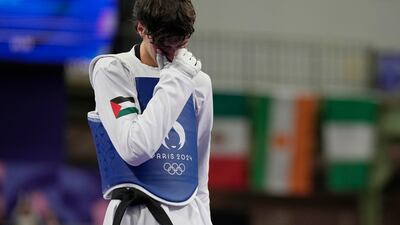
Earlier in the day, Palestine's Ismail was defeated in the men's -58kg Round of 16 – but not before pushing the experienced Vicente close.

UAE-based Ismail, who lives in Sharjah, was seconds away from taking the match into a deciding round.

After losing the first round 8-3, Ismail led the second 6-3 with 10 seconds remaining, but a head kick from Vicente in the final exchanges turned the contest back in the Spaniard's favour.

Considering the pedigree of his opponent – Vicente won bronze at last year's World Championships – Ismail, 18, proved he can challenge the best in the sport.

Ismail had earlier made a winning start to his campaign with a 2-0 victory over Hadi Tiranvalipour of the Refugee Olympic Team.

Ismail won the first round 4-3 to take an early lead and followed it up with a 5-0 second-round victory to book his place in the Round of 16.


Timeline

2012-2015

The company offers payments/bribes to win key contracts in the Middle East

May 2017

The UK SFO officially opens investigation into Petrofac’s use of agents, corruption, and potential bribery to secure contracts

September 2021

Petrofac pleads guilty to seven counts of failing to prevent bribery under the UK Bribery Act

October 2021

Court fines Petrofac £77 million for bribery. Former executive receives a two-year suspended sentence 

December 2024

Petrofac enters into comprehensive restructuring to strengthen the financial position of the group

May 2025

The High Court of England and Wales approves the company’s restructuring plan

July 2025

The Court of Appeal issues a judgment challenging parts of the restructuring plan

August 2025

Petrofac issues a business update to execute the restructuring and confirms it will appeal the Court of Appeal decision

October 2025

Petrofac loses a major TenneT offshore wind contract worth €13 billion. Holding company files for administration in the UK. Petrofac delisted from the London Stock Exchange

November 2025

180 Petrofac employees laid off in the UAE

Who's who in Yemen conflict

Houthis: Iran-backed rebels who occupy Sanaa and run unrecognised government

Yemeni government: Exiled government in Aden led by eight-member Presidential Leadership Council

Southern Transitional Council: Faction in Yemeni government that seeks autonomy for the south

Habrish 'rebels': Tribal-backed forces feuding with STC over control of oil in government territory

Mercer, the investment consulting arm of US services company Marsh & McLennan, expects its wealth division to at least double its assets under management (AUM) in the Middle East as wealth in the region continues to grow despite economic headwinds, a company official said.

Mercer Wealth, which globally has $160 billion in AUM, plans to boost its AUM in the region to $2-$3bn in the next 2-3 years from the present $1bn, said Yasir AbuShaban, a Dubai-based principal with Mercer Wealth.

Within the next two to three years, we are looking at reaching $2 to $3 billion as a conservative estimate and we do see an opportunity to do so,” said Mr AbuShaban.

Mercer does not directly make investments, but allocates clients’ money they have discretion to, to professional asset managers. They also provide advice to clients.

“We have buying power. We can negotiate on their (client’s) behalf with asset managers to provide them lower fees than they otherwise would have to get on their own,” he added.

Mercer Wealth’s clients include sovereign wealth funds, family offices, and insurance companies among others.

From its office in Dubai, Mercer also looks after Africa, India and Turkey, where they also see opportunity for growth.

Wealth creation in Middle East and Africa (MEA) grew 8.5 per cent to $8.1 trillion last year from $7.5tn in 2015, higher than last year’s global average of 6 per cent and the second-highest growth in a region after Asia-Pacific which grew 9.9 per cent, according to consultancy Boston Consulting Group (BCG). In the region, where wealth grew just 1.9 per cent in 2015 compared with 2014, a pickup in oil prices has helped in wealth generation.

BCG is forecasting MEA wealth will rise to $12tn by 2021, growing at an annual average of 8 per cent.

Drivers of wealth generation in the region will be split evenly between new wealth creation and growth of performance of existing assets, according to BCG.

Another general trend in the region is clients’ looking for a comprehensive approach to investing, according to Mr AbuShaban.

“Institutional investors or some of the families are seeing a slowdown in the available capital they have to invest and in that sense they are looking at optimizing the way they manage their portfolios and making sure they are not investing haphazardly and different parts of their investment are working together,” said Mr AbuShaban.

Some clients also have a higher appetite for risk, given the low interest-rate environment that does not provide enough yield for some institutional investors. These clients are keen to invest in illiquid assets, such as private equity and infrastructure.

“What we have seen is a desire for higher returns in what has been a low-return environment specifically in various fixed income or bonds,” he said.

“In this environment, we have seen a de facto increase in the risk that clients are taking in things like illiquid investments, private equity investments, infrastructure and private debt, those kind of investments were higher illiquidity results in incrementally higher returns.”

The Abu Dhabi Investment Authority, one of the largest sovereign wealth funds, said in its 2016 report that has gradually increased its exposure in direct private equity and private credit transactions, mainly in Asian markets and especially in China and India. The authority’s private equity department focused on structured equities owing to “their defensive characteristics.”

Pharaoh's curse

British aristocrat Lord Carnarvon, who funded the expedition to find the Tutankhamun tomb, died in a Cairo hotel four months after the crypt was opened.
He had been in poor health for many years after a car crash, and a mosquito bite made worse by a shaving cut led to blood poisoning and pneumonia.
Reports at the time said Lord Carnarvon suffered from “pain as the inflammation affected the nasal passages and eyes”.
Decades later, scientists contended he had died of aspergillosis after inhaling spores of the fungus aspergillus in the tomb, which can lie dormant for months. The fact several others who entered were also found dead withiin a short time led to the myth of the curse.

'The Coddling of the American Mind: How Good Intentions and Bad Ideas are Setting up a Generation for Failure' ​​​​
Greg Lukianoff and Jonathan Haidt, Penguin Randomhouse

UAE currency: the story behind the money in your pockets
Updated: August 09, 2024, 9:11 AM