

Sir Mo Farah has revealed the moment he found his mother was still alive, years after he was trafficked from Somalia to the UK to work as a domestic slave at 9 years old.
"When I was 4 my dad was killed in the civil war," Farah said. "You know, as a family we were torn apart.
"I was separated from my mother and I was brought into the UK illegally under the name of another child called Mohamed Farah."
The four-time Olympic champion long-distance runner said "the truth is I'm not who you think I am," and that he needed to tell his real story "whatever the cost" in the BBC documentary The Real Mo Farah.
"Most people know me as Mo Farah but it's not my name or it's not the reality," said the father of four, 39.
"The real story is I was born in Somaliland, north of Somalia, as Hussein Abdi Kahin. Despite what I've said in the past, my parents never lived in the UK."
Farah described working in a Somalian restaurant cleaning tables in west London when a woman came in and asked if he was Mohamed Farah.
When he confirmed he was, she asked him: "Now what's your real name?"
The mystery woman then told him his mother Aisha had been looking for him and that she had seen her recently in Somaliland.
“I was like, 'Saw my mum? She's alive?' And she's like, 'Yeah, she's alive. Here's a photo, if you don't believe me'. And then she said, 'Look this is a cassette tape for you'.
“It wasn't just a tape, it was more of a voice and then it was singing sad songs for me like poems or like traditional song, you know. And I would listen to it for days, weeks.
“The side of the tape had a number on it and then on it, it said, 'If this is a bother or causing you trouble, just leave it. You don't have to contact me'.
"And I'm going, 'Of course I want to contact you.' That's when I first called my mum.”
-
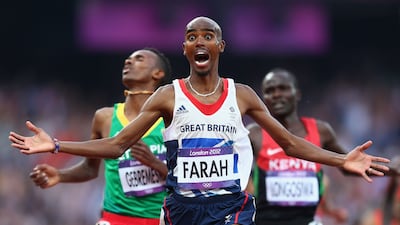
Mo Farah is a four-time Olympic champion and one of the greatest British athletes of all time. Here 'The National' looks back at his career. Getty Images -
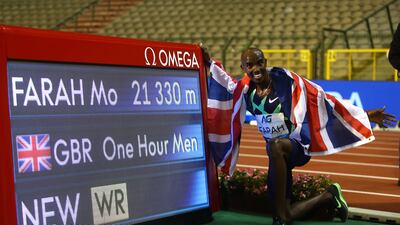
Farah celebrates winning the One Hour Race with a new World Record time in September 2020 in Brussels. Getty Images -
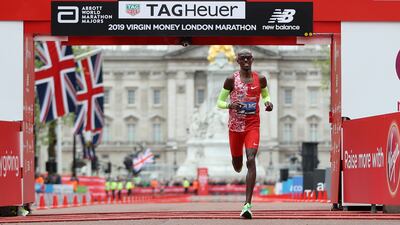
Farah crosses the finish line at the London Marathon in 2019. Getty Images -

Farah on the red carpet ahead of receiving a 'Lifetime Achievement' award at the BT Sports Awards in 2018 in London. Getty Images -
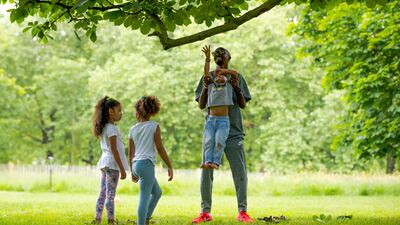
Farah lifts his son Hussein as his twin daughters Aisha and Amani look on during a family day out in St James' Park, London, in 2018. Getty Images -

Farah reflects in between training sessions in 2018 in St Moritz, Switzerland. Getty Images -
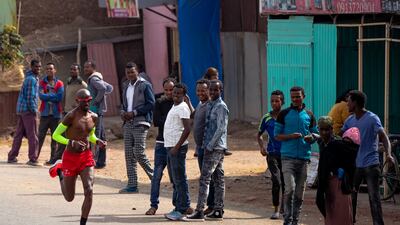
Farah has the support of locals during a 42km training run in February 2018 in Addis Ababa, Ethiopia. Getty Images -
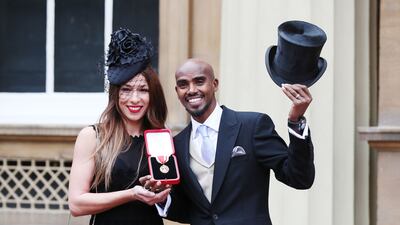
Farah with wife Tania after he was awarded a Knighthood by Queen Elizabeth II at Buckingham Palace, in 2017. PA -
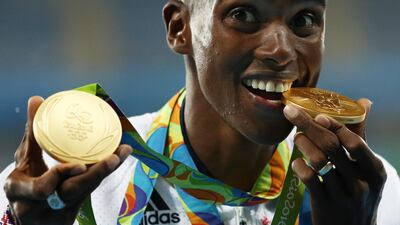
Farah holds both his 5,000m and 10,000m gold medals on the podium at the Rio 2016 Olympic Games in Brazil. Getty Images -
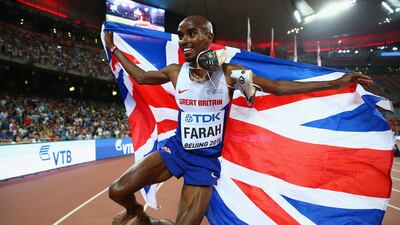
Farah celebrates after crossing the finish line to win gold in the Men's 5,000 metres at IAAF World Athletics Championships in Beijing, China, in 2015. Getty Images -
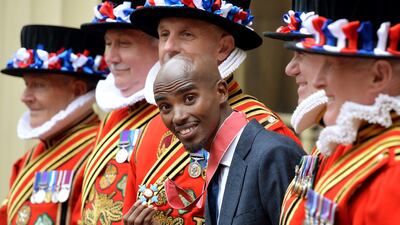
Farah holds his CBE medal at Buckingham Palace, after he received the award in 2013. PA -
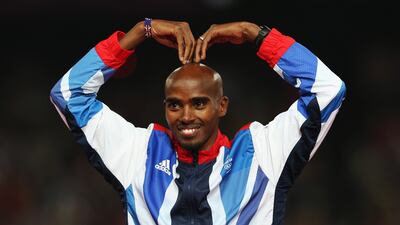
Farah shows off his famous 'Mobot' celebration on the podium after winning the gold medal in the men's 5,000m at the London 2012 Olympic Games. Getty Images -
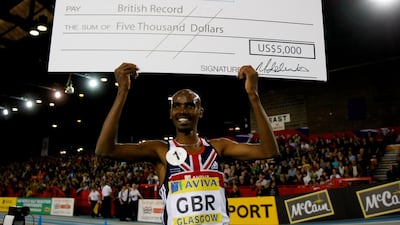
Farah celebrates with a cheque after winning a 3,000m race in Glasgow, Scotland, in 2009. Getty Images -
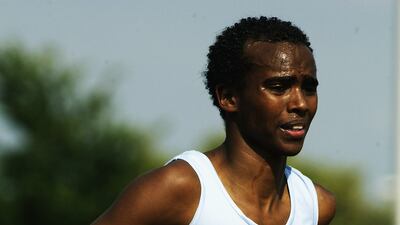
Farah in action in Bedford, England, in 2002. Getty Images


Farah, who became the first British track and field athlete to win four Olympic gold medals, said his children motivated him to be truthful about his past.
"Family means everything to me and you know, as a parent, you always teach your kids to be honest," he said.
"But I feel like I've always had that private thing where I could never be me and tell what's really happened.
"I've been keeping it for so long, its been difficult because you don't want to face it, and often my kids ask questions: 'Dad, how come this?'
"And you've always got an answer for everything but you haven't got an answer for that.
"That's the main reason in telling my story because I want to feel normal and … don't feel like you're holding on to something."
Farah's wife Tania Nell said in the year leading up to their 2010 wedding that she realised "there was lots of missing pieces to his story", but she eventually "wore him down with the questioning" and he told the truth.
During the documentary, he said he thought he was going to Europe to live with relatives and recalled going through a UK passport check under the guise of Mohamed at the age of 9.
"I had all the contact details for my relative and once we got to her house, the lady took it off me and right in front of me ripped them up and put it in the bin, and at that moment I knew I was in trouble," he said.
The athlete travelled back to his childhood home in Hounslow recalling "not great memories", where he was not treated as part of the family.
"If I wanted food in my mouth my job was to look after those kids, shower them, cook for them, clean for them.
"And she said, 'If you ever want to see your family again, don't say anything. If you say anything, they will take you away.'
"So she told you don't talk about anything, otherwise I was in big trouble and I guess for me the only things that I could do in my control was to run away from this, was to get out and run."

Farah eventually told his PE teacher Alan Watkinson the truth and moved to live with his friend's mum, Kinsi, who "really took great care" of him. He ended up staying for seven years.
It was Mr Watkinson who applied for Farah's British citizenship, which he described as a "long process". On July 25, 2000, Farah was recognised as a British citizen.
"I often think about the other Mohamed Farah, the boy whose place I took on that plane, and I really hope he's OK," said Farah, who named his son Hussein after his real identity.
"Wherever he is, I carry his name and that could cause problems now for me and my family.
"The important thing is for me to just be able to look and say this is what's happened, and just being honest, really."
In the documentary, a barrister tells him that although he was trafficked into the country as a small child and he told the relevant authorities the truth, there is still a "real risk" his British nationality could be taken away as it was obtained by misrepresentations.
The UK Home Office has the power to legally strip people of their British citizenship if it is found to have been obtained illegally.
But the department has since said it would be taking no action “whatsoever” against the athlete.
“He is a sporting hero, he is an inspiration to people across the country," a Downing Street spokesman said.
“It is a shocking reminder of the horrors that people face when they are trafficked.
"And we must continue to clamp down on these criminals who take advantage of vulnerable people.”
Asked if the Home Office would be taking any action against Farah, he said: “Absolutely not.
“I think the Home Office has been very clear that no action whatsoever will be taken against Sir Mo and that is in line with the guidance.”

Mr Watkinson told filmmakers he knew the truth but was unrepentant that he did not disclose it to authorities as it meant he could help Farah find a new home.
“When you went through the process of social services, you stayed as Mohamed Farah," he said.
"To my mind, at that point, the state has recognised you as Mohamed Farah. I don’t think either I or the school did anything wrong."
The husband and wife at the heart of the storm are believed still to be living in the UK.
Asked during a BBC interview how he felt about the government’s response, Farah said: “I feel relieved.
“This is my country. If it wasn’t for Alan [Watkinson] and the people who supported me throughout my childhood then maybe I wouldn’t even have the courage to be doing this.
“There’s a lot of people that have been very supportive, particularly my wife, throughout my career and gave me the strength to come and talk about it and telling me it’s OK to do this.”
The Metropolitan Police said it was “assessing” Farah's allegations that he was trafficked into the UK as a child and forced to work as a domestic servant.
“We are aware of reports in the media concerning Sir Mo Farah," the Met Police said.
“No reports have been made to the MPS at this time. Specialist officers are currently assessing the available information.”
Farah said he was “really proud” of the documentary, which enabled him to “address and learn more” about his past and his journey to Britain.
"I don't think I was ever ready to say anything — not because you want to lie, but because you're protecting yourself," he told his wife.
"I think you only realise later on down the line it's OK to let things out and say how it happened.
"But in this, I think you know I was trafficked and that's what it feels like."
The documentary ends with Farah speaking to the real Mohamed Farah before saying he will continue to go by the name he was given when he entered the UK.
The Real Mo Farah will air at 6am on BBC iPlayer and 9pm on BBC One on July 13.

