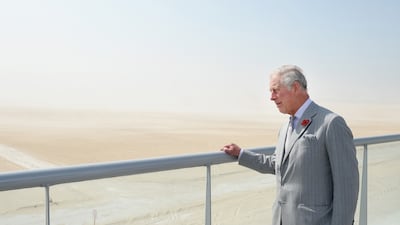
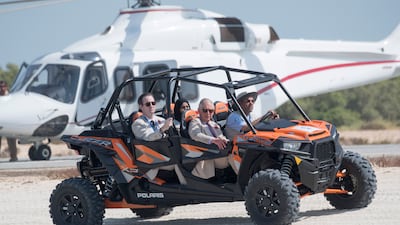
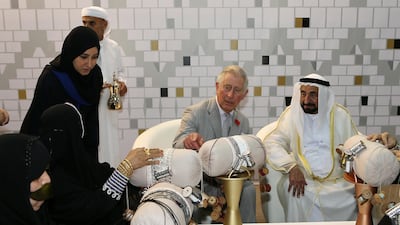
King Charles at Sheikh Zayed Mosque in Abu Dhabi in 2007. The monarch has made religious tolerance and understanding a cornerstone of his personal philosophy. Reuters


UAE and UK celebrate shared beliefs at King Charles's coronation


  • English
  • Arabic

May 04, 2023

When King Charles III receives the orb, sceptre and ring at his coronation in Westminster Abbey on Saturday, millions around the world will relish the pageantry of the occasion.

The coronation offers a moment for us to reflect on how mutual interests and shared values bind the ruling generations of our countries.

For decades, the new British king has championed interfaith relations and worked hard to set the world on a path of hope for a sustainable future.

In fact, King Charles has been a visionary for more than half a century.

He made his first speech on the environment in 1968, years before the world had heard of the term “global warming”.

Then, in 1970 at the age of 21, he spoke of the dangers that mankind faced.

“At this moment, with the horrifying effects of pollution in all its cancerous forms … there is air pollution from smoke and fumes discharged by factories and from gases pumped out by endless cars and aeroplanes.”

Today, King Charles is widely regarded as the godfather of Cop, the UN Conference of the Parties, after he hosted an environmental conference aboard the Royal Yacht Britannia in the Amazon delta in 1991.

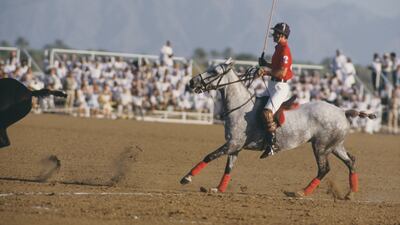
  • The UK's Prince Charles, now King Charles III, plays polo near Muscat, Oman, in 1986. Getty
    The UK's Prince Charles, now King Charles III, plays polo near Muscat, Oman, in 1986. Getty
  • Prince Charles and Princess Diana at a picnic near Riyadh, Saudi Arabia, in 1986. Getty
    Prince Charles and Princess Diana at a picnic near Riyadh, Saudi Arabia, in 1986. Getty
  • Sheikh Nahyan bin Mubarak with Prince Charles during a visit to the UAE in 1988. Photo: Al Ittihad
    Sheikh Nahyan bin Mubarak with Prince Charles during a visit to the UAE in 1988. Photo: Al Ittihad
  • Prince Charles and Diana, Princess of Wales, attend a camel race in Al Ain in March 1989. Getty
    Prince Charles and Diana, Princess of Wales, attend a camel race in Al Ain in March 1989. Getty
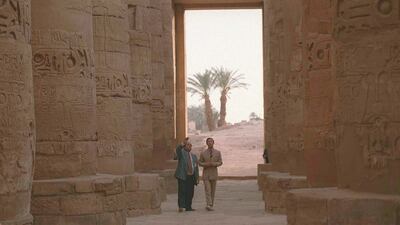
  • Prince Charles visits the Karnak Temple Complex during a visit to Egypt in 1995. Getty
    Prince Charles visits the Karnak Temple Complex during a visit to Egypt in 1995. Getty
  • Prince Charles tours the Hassan II Mosque in Casablanca during a three-day official visit to Morocco in 1995. Reuters
    Prince Charles tours the Hassan II Mosque in Casablanca during a three-day official visit to Morocco in 1995. Reuters
  • The British royal is served Arabic coffee during a visit to Bait Al Zubair in Muscat in 2003. Reuters
    The British royal is served Arabic coffee during a visit to Bait Al Zubair in Muscat in 2003. Reuters
  • Prince Charles with Maj Gen Andrew Stewart, right, at a British military base in Basra, Iraq, in 2004. Reuters
    Prince Charles with Maj Gen Andrew Stewart, right, at a British military base in Basra, Iraq, in 2004. Reuters
  • The UK royal is shown a map of Arg-e-Bam during a 2004 visit to the ruins in Bam, southern Iran. Reuters
    The UK royal is shown a map of Arg-e-Bam during a 2004 visit to the ruins in Bam, southern Iran. Reuters
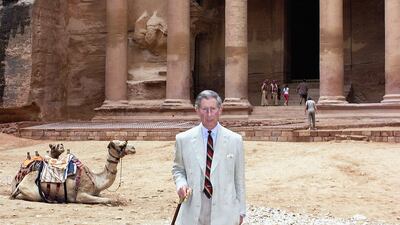
  • Prince Charles in Petra, Jordan, in 2004. Getty
    Prince Charles in Petra, Jordan, in 2004. Getty
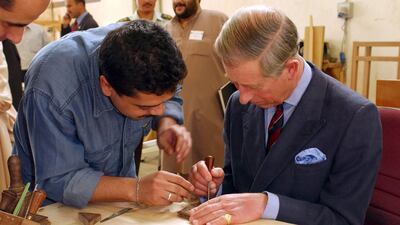
  • Charles, Prince of Wales at the time, visits the College of Islamic Art at Salt University in Amman, Jordan, in 2004. Getty
    Charles, Prince of Wales at the time, visits the College of Islamic Art at Salt University in Amman, Jordan, in 2004. Getty
  • Prince Charles wears a bisht during a 2007 visit to a traditional handicraft centre in Kuwait with Camilla, now Queen Consort. Reuters
    Prince Charles wears a bisht during a 2007 visit to a traditional handicraft centre in Kuwait with Camilla, now Queen Consort. Reuters
  • The royal visits Al Safwa farm in Doha in 2013. Reuters
    The royal visits Al Safwa farm in Doha in 2013. Reuters
  • Prince Charles with former Saudi tourism minister Prince Sultan bin Salman at Al Diriyah in 2014. Reuters
    Prince Charles with former Saudi tourism minister Prince Sultan bin Salman at Al Diriyah in 2014. Reuters
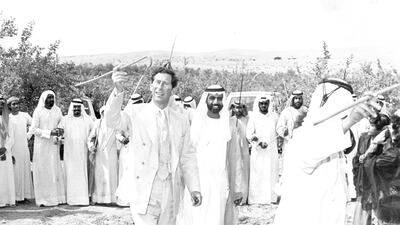
  • Prince Charles wears a traditional Saudi uniform to perform a sword dance, known as ardah, in Riyadh in 2014. Reuters
    Prince Charles wears a traditional Saudi uniform to perform a sword dance, known as ardah, in Riyadh in 2014. Reuters
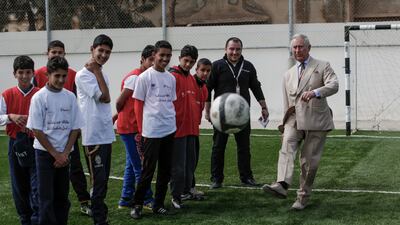
  • Prince Charles visits Jordanian children and Syrian refugees at a sports ground in Zaatari, Jordan, in 2015. Getty
    Prince Charles visits Jordanian children and Syrian refugees at a sports ground in Zaatari, Jordan, in 2015. Getty
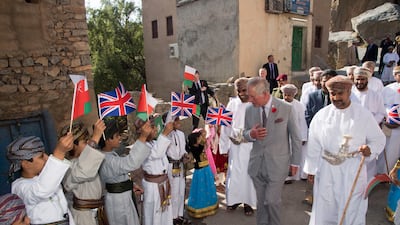
  • The royal is greeted by children during a walking tour in Muscat in 2016. Getty
    The royal is greeted by children during a walking tour in Muscat in 2016. Getty
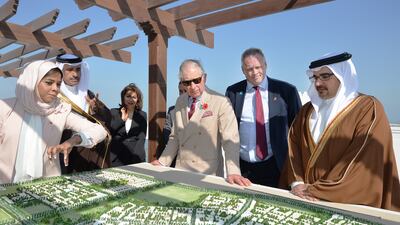
  • Prince Charles during a visit to the Tubil Bay regeneration project in Bahrain, in 2016. Getty
    Prince Charles during a visit to the Tubil Bay regeneration project in Bahrain, in 2016. Getty
  • Prince Charles visits Manama Souq, Bahrain, in 2016. Getty
    Prince Charles visits Manama Souq, Bahrain, in 2016. Getty
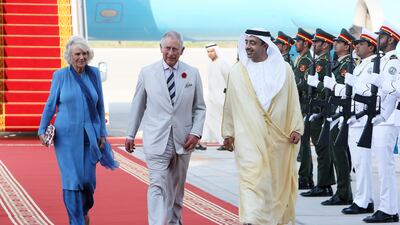
  • Sheikh Abdullah bin Zayed, Minister of Foreign Affairs and International Co-operation, receives Prince Charles and Camilla in Abu Dhabi in 2016. Photo: Abu Dhabi Crown Prince Court
    Sheikh Abdullah bin Zayed, Minister of Foreign Affairs and International Co-operation, receives Prince Charles and Camilla in Abu Dhabi in 2016. Photo: Abu Dhabi Crown Prince Court
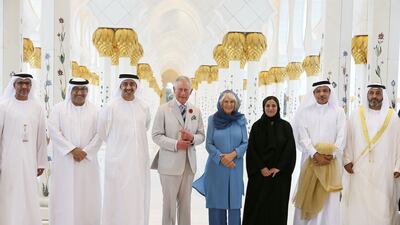
  • Sheikh Abdullah with Prince Charles and Camilla after a meeting at the Sheikh Zayed Grand Mosque in 2016. Photo: Abu Dhabi Crown Prince Court
    Sheikh Abdullah with Prince Charles and Camilla after a meeting at the Sheikh Zayed Grand Mosque in 2016. Photo: Abu Dhabi Crown Prince Court
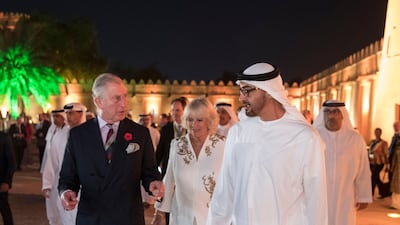
  • President Sheikh Mohamed, who at the time was Crown Prince of Abu Dhabi and Deputy Supreme Commander of the Armed Forces, receives Charles and Camilla, at Al Jahili Fort in Al Ain in 2016. Photo: Abu Dhabi Crown Prince Court
    President Sheikh Mohamed, who at the time was Crown Prince of Abu Dhabi and Deputy Supreme Commander of the Armed Forces, receives Charles and Camilla, at Al Jahili Fort in Al Ain in 2016. Photo: Abu Dhabi Crown Prince Court
  • Prince Charles visits the site of Expo 2020 Dubai in 2016. Getty
    Prince Charles visits the site of Expo 2020 Dubai in 2016. Getty
  • Prince Charles visits Bu Tinah island on the second day of his tour of the UAE, in November 2016. Getty
    Prince Charles visits Bu Tinah island on the second day of his tour of the UAE, in November 2016. Getty
  • Sheikh Dr Sultan bin Muhammad Al Qasimi, Ruler of Sharjah, with Prince Charles during his visit to the Regional Conservation Centre in Sharjah, in November 2016. Photo: Ab Dhabi Crown Prince Court
    Sheikh Dr Sultan bin Muhammad Al Qasimi, Ruler of Sharjah, with Prince Charles during his visit to the Regional Conservation Centre in Sharjah, in November 2016. Photo: Ab Dhabi Crown Prince Court
  • Prince Charles lays a wreath during the Fifth World Holocaust Forum in Jerusalem in 2020. Reuters
    Prince Charles lays a wreath during the Fifth World Holocaust Forum in Jerusalem in 2020. Reuters
  • Prince Charles with Roman Krassovsky, right, Archimandrite of the Russian Orthodox Church Outside Russia and chief of its Russian Ecclesiastical Mission in Jerusalem, during a visit in Russian Orthodox Church of Mary Magdalene in 2020. Reuters
    Prince Charles with Roman Krassovsky, right, Archimandrite of the Russian Orthodox Church Outside Russia and chief of its Russian Ecclesiastical Mission in Jerusalem, during a visit in Russian Orthodox Church of Mary Magdalene in 2020. Reuters
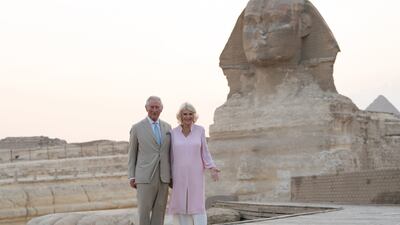
  • Prince Charles and Camilla visit the Great Sphinx of Giza during a regional tour in 2021. Getty
    Prince Charles and Camilla visit the Great Sphinx of Giza during a regional tour in 2021. Getty
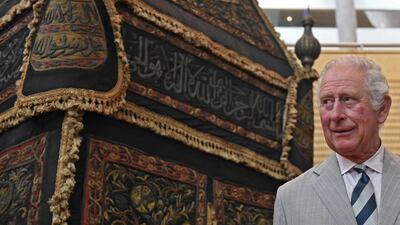
  • Prince Charles stands next to the mahmal, the palanquin used to transport the kiswah that covers the Kaaba in Makkah, during a visit to Alexandria, Egypt, in 2021. AFP
    Prince Charles stands next to the mahmal, the palanquin used to transport the kiswah that covers the Kaaba in Makkah, during a visit to Alexandria, Egypt, in 2021. AFP

His appeal to the Brazilian president at the time was passionate. “We are literally the last generation which can save the rainforest from total destruction,” he said.

That meeting paved the way for the first Earth Summit the following year, where the first Cop was born.

And today, 32 years later, the United Arab Emirates has the honour of the presidency of Cop28, where the world will once again assess the measures it has taken to combat climate change and renew its ambitions.

As conveners, our nation has the highest duty of leadership, for it has never been more important to foster a spirit of international collaboration and enterprise through our shared values.

We are meeting that challenge. Our country is already adopting innovative strategies for economic diversification away from oil and will support those countries most vulnerable to climate change and least able to protect themselves.

The late Queen Elizabeth II served as monarch during a formative period of our country’s history and met our Founding Father, the late Sheikh Zayed bin Sultan Al Nahyan, on her first visit to the UAE in 1979.

During her second visit in 2010, Queen Elizabeth emphasised to the world again our mutual interest in dialogue and tolerance by visiting the Sheikh Zayed Grand Mosque in Abu Dhabi.

It was a hugely significant event. As Supreme Governor of the Church of England, Queen Elizabeth was the first leader of another religion to visit the mosque.

As Supreme Governor of the Church of England, Queen Elizabeth II was the first leader of another religion to visit the Sheikh Zayed Grand Mosque in Abu Dhabi. Andrew Henderson/The National

Six years later, King Charles followed his mother’s example, accompanied by his wife, Queen Consort Camilla, then the Duchess of Cornwall.

Today, in the spirit of fraternity which has been passed down through the generations, and led by President Sheikh Mohamed, we have opened our monument to religious tolerance and friendship, the Abrahamic Family House.

For King Charles, spirituality and the promotion of interfaith relations have long been abiding passions.

At his accession ceremony, two days after his mother’s death, King Charles committed to become Defender of the Faith, a title bestowed on every English monarch since Henry VIII. But he has always been open about his wider intent.

“I mind about the inclusion of other people’s faiths and their freedom to worship in this country. And it’s always seemed to me that, while at the same time being Defender of the Faith, you can also be protector of faiths,” he once said.

King Charles has always had a passionate curiosity about Islam, particularly because he sees the faith complementing his own view of the environment.

He is comfortable citing the Quran for explicitly identifying that the natural world and mankind are entwined, he said, “precisely because there is no separation between the natural world and God”.

King Charles has gone so far as to suggest that many more people might benefit from “an appreciation of the Islamic tradition's deep respect for the timeless traditions of the natural order … and help us in the West to rethink, and for the better, our practical stewardship of man and his environment”.

Throughout, he has always admired the UAE and the example set by its leadership.

On his last visit, King Charles paid a special tribute to the nation’s pioneering humanitarian efforts.

“The UAE is second to none in its generosity. This is one facet of Sheikh Zayed’s remarkable legacy.”

Such deep family respect binds our countries.

Today, the dream is indeed a reality and our ties with the UK grow stronger as King Charles begins a new Carolean era in Britain, and Sheikh Mohamed sets an inspiring vision for the Emirates in the 21st century and beyond.

The UK and the UAE have always been close allies and partners through practical, shared interests in security, defence, trade, education and the environment.

Together, we stand for diplomacy over conflict, partnerships over unilateralism, and dialogue over confrontation.

The strength and vitality of our relationship has grown immeasurably since the signing of the original Treaty of Friendship in 1971.

Today, more than 100,000 Britons live in the Emirates and more than half a million visit each year. At the same time, we feel at home in the UK, where thousands of Emiratis study at British universities and hundreds of thousands of Emiratis choose to visit every year.

The total trade between our countries amounts to £18.9 billion a year and the future looks brighter with agreements to develop life sciences, hydrogen energy, space and other industrial sectors, which will mean jobs and investment for all.

But let us pause to celebrate that we are tied by something more intimate in this important year of renewal — our leaders' histories, our personal friendships and our deepest shared values.

Mansoor Abulhoul is UAE ambassador to the United Kingdom

Ten tax points to be aware of in 2026

1. Domestic VAT refund amendments: request your refund within five years

If a business does not apply for the refund on time, they lose their credit.

2. E-invoicing in the UAE

Businesses should continue preparing for the implementation of e-invoicing in the UAE, with 2026 a preparation and transition period ahead of phased mandatory adoption. 

3. More tax audits

Tax authorities are increasingly using data already available across multiple filings to identify audit risks. 

4. More beneficial VAT and excise tax penalty regime

Tax disputes are expected to become more frequent and more structured, with clearer administrative objection and appeal processes. The UAE has adopted a new penalty regime for VAT and excise disputes, which now mirrors the penalty regime for corporate tax.

5. Greater emphasis on statutory audit

There is a greater need for the accuracy of financial statements. The International Financial Reporting Standards standards need to be strictly adhered to and, as a result, the quality of the audits will need to increase.

6. Further transfer pricing enforcement

Transfer pricing enforcement, which refers to the practice of establishing prices for internal transactions between related entities, is expected to broaden in scope. The UAE will shortly open the possibility to negotiate advance pricing agreements, or essentially rulings for transfer pricing purposes. 

7. Limited time periods for audits

Recent amendments also introduce a default five-year limitation period for tax audits and assessments, subject to specific statutory exceptions. While the standard audit and assessment period is five years, this may be extended to up to 15 years in cases involving fraud or tax evasion. 

8. Pillar 2 implementation 

Many multinational groups will begin to feel the practical effect of the Domestic Minimum Top-Up Tax (DMTT), the UAE's implementation of the OECD’s global minimum tax under Pillar 2. While the rules apply for financial years starting on or after January 1, 2025, it is 2026 that marks the transition to an operational phase.

9. Reduced compliance obligations for imported goods and services

Businesses that apply the reverse-charge mechanism for VAT purposes in the UAE may benefit from reduced compliance obligations. 

10. Substance and CbC reporting focus

Tax authorities are expected to continue strengthening the enforcement of economic substance and Country-by-Country (CbC) reporting frameworks. In the UAE, these regimes are increasingly being used as risk-assessment tools, providing tax authorities with a comprehensive view of multinational groups’ global footprints and enabling them to assess whether profits are aligned with real economic activity. 

Contributed by Thomas Vanhee and Hend Rashwan, Aurifer

The National Archives, Abu Dhabi

Founded over 50 years ago, the National Archives collects valuable historical material relating to the UAE, and is the oldest and richest archive relating to the Arabian Gulf.

Much of the material can be viewed on line at the Arabian Gulf Digital Archive - https://www.agda.ae/en

THE BIO

Bio Box

Role Model: Sheikh Zayed, God bless his soul

Favorite book: Zayed Biography of the leader

Favorite quote: To be or not to be, that is the question, from William Shakespeare's Hamlet

Favorite food: seafood

Favorite place to travel: Lebanon

Favorite movie: Braveheart

Gifts exchanged
  • King Charles - replica of President Eisenhower Sword
  • Queen Camilla -  Tiffany & Co vintage 18-carat gold, diamond and ruby flower brooch
  • Donald Trump - hand-bound leather book with Declaration of Independence
  • Melania Trump - personalised Anya Hindmarch handbag
Gender pay parity on track in the UAE

The UAE has a good record on gender pay parity, according to Mercer's Total Remuneration Study.

"In some of the lower levels of jobs women tend to be paid more than men, primarily because men are employed in blue collar jobs and women tend to be employed in white collar jobs which pay better," said Ted Raffoul, career products leader, Mena at Mercer. "I am yet to see a company in the UAE – particularly when you are looking at a blue chip multinationals or some of the bigger local companies – that actively discriminates when it comes to gender on pay."

Mr Raffoul said most gender issues are actually due to the cultural class, as the population is dominated by Asian and Arab cultures where men are generally expected to work and earn whereas women are meant to start a family.

"For that reason, we see a different gender gap. There are less women in senior roles because women tend to focus less on this but that’s not due to any companies having a policy penalising women for any reasons – it’s a cultural thing," he said.

As a result, Mr Raffoul said many companies in the UAE are coming up with benefit package programmes to help working mothers and the career development of women in general. 

Updated: May 06, 2023, 4:21 AM