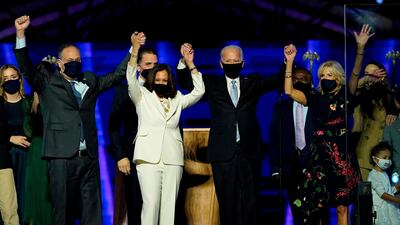
Husband of Vice President-elect Kamala Harris, Douglas Emhoff, Vice President-elect Kamala Harris, US President-elect Joe Biden and wife Jill Biden salute the crowd after being declared the winners of the presidential election. AFP
Husband of Vice President-elect Kamala Harris, Douglas Emhoff, Vice President-elect Kamala Harris, US President-elect Joe Biden and wife Jill Biden salute the crowd after being declared the winners of
For five days, the world’s attention was occupied almost entirely by one of the most fraught US elections in years. A record number of ballots were cast, and many are still being counted.
But the result is clear. Joe Biden, the Democratic challenger, has won. The contest is over, though the story, perhaps, is not. Donald Trump, the incumbent, continues to insist upon his own victory and the existence of a vast conspiracy against him.
The story will continue as Mr Trump’s claim moves through various states’ administrative and judicial organs. For now, however, the most pressing questions lie not in the validity of the President-elect Biden’s victory (most believe his position to be secure) but rather in his opening moves and statements.
Mr Biden has already begun penning a new story. In his first speech as President-elect on Saturday, he stressed the need to “heal America” after a divisive presidential race. Mr Trump is a polarising figure. At home and abroad, he is either loved or loathed. There is hardly a middle ground, neither in his own opinions nor in opinions of him. Restoring the middle ground’s place in American politics will be among Mr Biden’s most important tasks.
Mr Biden’s running mate, Kamala Harris, reflects his desire to represent a wider group of Americans. Women proved to be one of the most difficult demographic groups for Mr Trump to win over. Ms Harris will now be the first female vice president in American history. “Every little girl watching tonight,” she pointed out yesterday, “sees that this is a country of possibilities.
America will need to heal from more than its partisan divisions. Yesterday, the country’s tally of officially recorded coronavirus cases reached nearly 10.2 million. Daily infections continue to break the previous day’s records. Images from the campaign trail demonstrate how differently both contenders for the presidency viewed the pandemic. Mr Biden’s team were hardly ever seen without masks and sanitiser. Mr Trump’s endeavoured, for as long as possible, to project a bygone sense of normality.
That desperation for a more care-free time is understandable, given the harsh economic toll pandemic-related measures have wrought on America’s workers. Mr Trump’s economic record was, in voters’ eyes, one of his great strengths. Mr Biden will have to balance the difficult work of bringing his country in line with new international public health standards, while shielding the economy from further deterioration. He will also have to appreciate that so much of his constituency of more are suspicious of his party’s economic agenda; fears of a wild swing to the left were a key reason Democrats failed to win over Latino Americans whose families had fled dysfunctional, socialist regimes in Cuba and Venezuela.
Mr Trump was successful in projecting to the 71 million Americans who voted for him a concern for law and order
Mr Biden’s economic plan, above all, will need to navigate ideological divisions while maintaining its reach for ambitious environmental targets. He has pledged to invest $1.7 trillion in renewables and to make the US a carbon-neutral country by 2050.
Most immediately, however, Mr Biden will need to turn his attention to racial inequality. The waves of protests that hit American streets in the aftermath of the police killing of an unarmed African American George Floyd subsided, for the most part, as voters were going to the polls. But the issues driving them are not yet resolved and the protest movement will not be over. Mr Trump was successful in projecting to the 71 million Americans who voted for him a concern for law and order. It will now be on Mr Biden to imbue that desire for stability with a sense of deep compassion.
“I pledge to be a president who seeks not to divide, but unify.. who doesn’t see red states and blue states, only sees the United States”, Mr Biden promised. What, one wonders, will the United States see in President Biden?

Key products and UAE prices
iPhone XS
With a 5.8-inch screen, it will be an advance version of the iPhone X. It will be dual sim and comes with better battery life, a faster processor and better camera. A new gold colour will be available. Price: Dh4,229
iPhone XS Max
It is expected to be a grander version of the iPhone X with a 6.5-inch screen; an inch bigger than the screen of the iPhone 8 Plus. Price: Dh4,649
iPhone XR
A low-cost version of the iPhone X with a 6.1-inch screen, it is expected to attract mass attention. According to industry experts, it is likely to have aluminium edges instead of stainless steel. Price: Dh3,179
Apple Watch Series 4
More comprehensive health device with edge-to-edge displays that are more than 30 per cent bigger than displays on current models.
Mercer, the investment consulting arm of US services company Marsh & McLennan, expects its wealth division to at least double its assets under management (AUM) in the Middle East as wealth in the region continues to grow despite economic headwinds, a company official said.
Mercer Wealth, which globally has $160 billion in AUM, plans to boost its AUM in the region to $2-$3bn in the next 2-3 years from the present $1bn, said Yasir AbuShaban, a Dubai-based principal with Mercer Wealth.
“Within the next two to three years, we are looking at reaching $2 to $3 billion as a conservative estimate and we do see an opportunity to do so,” said Mr AbuShaban.
Mercer does not directly make investments, but allocates clients’ money they have discretion to, to professional asset managers. They also provide advice to clients.
“We have buying power. We can negotiate on their (client’s) behalf with asset managers to provide them lower fees than they otherwise would have to get on their own,” he added.
Mercer Wealth’s clients include sovereign wealth funds, family offices, and insurance companies among others.
From its office in Dubai, Mercer also looks after Africa, India and Turkey, where they also see opportunity for growth.
Wealth creation in Middle East and Africa (MEA) grew 8.5 per cent to $8.1 trillion last year from $7.5tn in 2015, higher than last year’s global average of 6 per cent and the second-highest growth in a region after Asia-Pacific which grew 9.9 per cent, according to consultancy Boston Consulting Group (BCG). In the region, where wealth grew just 1.9 per cent in 2015 compared with 2014, a pickup in oil prices has helped in wealth generation.
BCG is forecasting MEA wealth will rise to $12tn by 2021, growing at an annual average of 8 per cent.
Drivers of wealth generation in the region will be split evenly between new wealth creation and growth of performance of existing assets, according to BCG.
Another general trend in the region is clients’ looking for a comprehensive approach to investing, according to Mr AbuShaban.
“Institutional investors or some of the families are seeing a slowdown in the available capital they have to invest and in that sense they are looking at optimizing the way they manage their portfolios and making sure they are not investing haphazardly and different parts of their investment are working together,” said Mr AbuShaban.
Some clients also have a higher appetite for risk, given the low interest-rate environment that does not provide enough yield for some institutional investors. These clients are keen to invest in illiquid assets, such as private equity and infrastructure.
“What we have seen is a desire for higher returns in what has been a low-return environment specifically in various fixed income or bonds,” he said.
“In this environment, we have seen a de facto increase in the risk that clients are taking in things like illiquid investments, private equity investments, infrastructure and private debt, those kind of investments were higher illiquidity results in incrementally higher returns.”
The Abu Dhabi Investment Authority, one of the largest sovereign wealth funds, said in its 2016 report that has gradually increased its exposure in direct private equity and private credit transactions, mainly in Asian markets and especially in China and India. The authority’s private equity department focused on structured equities owing to “their defensive characteristics.”
MATCH INFO
Barcelona 4 (Suarez 27', Vidal 32', Dembele 35', Messi 78')
Sevilla 0
Red cards: Ronald Araujo, Ousmane Dembele (Barcelona)
Ammar 808:
Maghreb United Sofyann Ben Youssef
Glitterbeat
Profile of Hala Insurance
Date Started: September 2018
Founders: Walid and Karim Dib
Based: Abu Dhabi
Employees: Nine
Amount raised: $1.2 million
Funders: Oman Technology Fund, AB Accelerator, 500 Startups, private backers
Key findings of Jenkins report
Founder of the Muslim Brotherhood, Hassan al Banna, "accepted the political utility of violence"
Views of key Muslim Brotherhood ideologue, Sayyid Qutb, have “consistently been understood” as permitting “the use of extreme violence in the pursuit of the perfect Islamic society” and “never been institutionally disowned” by the movement.
Muslim Brotherhood at all levels has repeatedly defended Hamas attacks against Israel, including the use of suicide bombers and the killing of civilians.
Laying out the report in the House of Commons, David Cameron told MPs: "The main findings of the review support the conclusion that membership of, association with, or influence by the Muslim Brotherhood should be considered as a possible indicator of extremism."
*NOTE: Haaland's goals for Salzburg count for 1.5 points per goal. Goals for Dortmund count for two points per goal.
GIANT REVIEW
Starring: Amir El-Masry, Pierce Brosnan
Director: Athale
Rating: 4/5
Sole survivors
Cecelia Crocker was on board Northwest Airlines Flight 255 in 1987 when it crashed in Detroit, killing 154 people, including her parents and brother. The plane had hit a light pole on take off
George Lamson Jr, from Minnesota, was on a Galaxy Airlines flight that crashed in Reno in 1985, killing 68 people. His entire seat was launched out of the plane
Bahia Bakari, then 12, survived when a Yemenia Airways flight crashed near the Comoros in 2009, killing 152. She was found clinging to wreckage after floating in the ocean for 13 hours.
Jim Polehinke was the co-pilot and sole survivor of a 2006 Comair flight that crashed in Lexington, Kentucky, killing 49.
