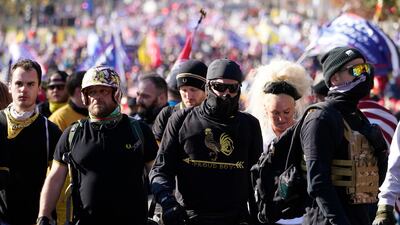
The Institute of Economics and Peace, an Australian think tank, published its Global Terror Index for 2020 on Wednesday. It observes a worrying rise in far-right extremism.
Between 2014 and 2019, the number of far-right terrorist attacks rose by 250 per cent and the number of deaths as a consequence by 709 per cent.
Right-wing terrorism still constitutes a relatively small share of attacks worldwide. It is the rate at which it is rising that is concerning.
Certain features make right-wing extremism difficult to prevent. Sixty per cent of far-right terrorists are not affiliated with an organisation, far more than in leftist or Islamist terrorism.
Last year, there were 53 terrorist attacks in the US. It is perhaps unsurprising. American politics today are deeply divided, increasingly unmoderated by a centrist consensus.
A greater number of reasonable conservative positions are now taboo, as a more censorious left labels those with different beliefs to their own as enemies, rather than opponents in debate.
This risks pushing some conservatives into online echo chambers, where there is less challenge and dogma thrives. And anonymous, often encrypted forums with their parallel vocabularies of hate, are hard for authorities to monitor.
Politics has been tense this year, particularly in the US. AFP
With a lack of direction in life, a small but significant minority will fill a void in their identity with the psychosis of extremism
Those with limited opportunity, particularly young men, are vulnerable to this cycle. In regions where jobs are already scarce, the pandemic risks making the situation worse. With a lack of direction in life, a small but significant minority will fill a void in their identity with the psychosis of extremism.
Considering the causes of terrorism by no means excuses it. Instead, it treats extremism as a problem that should be tackled. The Middle East has been making progress in this regard. Eighteen nations in the region have a reduced level of terrorism this year. The UAE was described as having a "perfect record", with no attacks in the past five years.
The Middle East’s deradicalisation programmes have mostly proven to be more effective than those in the West. From the efforts of Saudi Arabia’s internal deradicalisation program, to the joint partnership between the UAE, UNESCO and Iraq in restoring Mosul’s Al Nouri mosque, reviving a symbol of traditional Islamic values, serious efforts are being exerted to negate the mantra of hate extremists want to promote.
In the West, however, the challenge is growing. Deradicalisation programmes there have unimpressive records. This month, when a terrorist in Austria killed four people, authorities subsequently revealed he had been taken off such a programme because he was deemed no longer a threat.
While the West improves on these areas, it should in parallel address the social causes of terrorism.
Not all extremists can be rehabilitated, but those newly possessed by radical ideology might not necessarily be lost to it irrevocably. A 15-year-old girl, groomed by adults to join ISIS, or a young boy with learning difficulties who is given a bomb, is not the same person as someone who premeditates a rampage in a New Zealand mosque while livestreaming the attack. They are not the same as members of the infamous ISIS Beatles cell, who are criminals turned executioners.
Long-time terrorist leaders are also more likely driven by nihilistic political agendas, than ideological ones. Osama bin Laden or ISIS's top brass all had, as their core purpose, the attainment of political notoriety.
For the moderate majority, the aim of ending terrorism often feels hopeless. Most cannot comprehend the process by which someone becomes inspired by nihilism and death. Regardless, countries need to define their values robustly. All must feel included, especially those at risk of radicalisation. Without doing so, extremism in its many forms risks rising further.

- At 9.16pm, three suicide attackers killed one person outside the Atade de France during a foootball match between France and Germany - At 9.25pm, three attackers opened fire on restaurants and cafes over 20 minutes, killing 39 people - Shortly after 9.40pm, three other attackers launched a three-hour raid on the Bataclan, in which 1,500 people had gathered to watch a rock concert. In total, 90 people were killed - Salah Abdeslam, the only survivor of the terrorists, did not directly participate in the attacks, thought to be due to a technical glitch in his suicide vest - He fled to Belgium and was involved in attacks on Brussels in March 2016. He is serving a life sentence in France
Friday Celta Vigo v Villarreal (midnight kick-off UAE)
Saturday Sevilla v Real Sociedad (4pm), Atletico Madrid v Athletic Bilbao (7.15pm), Granada v Barcelona (9.30pm), Osasuna v Real Madrid (midnight)
Sunday Levante v Eibar (4pm), Cadiz v Alaves (7.15pm), Elche v Getafe (9.30pm), Real Valladolid v Valencia (midnight)
Monday Huesca v Real Betis (midnight)
Mercer, the investment consulting arm of US services company Marsh & McLennan, expects its wealth division to at least double its assets under management (AUM) in the Middle East as wealth in the region continues to grow despite economic headwinds, a company official said.
Mercer Wealth, which globally has $160 billion in AUM, plans to boost its AUM in the region to $2-$3bn in the next 2-3 years from the present $1bn, said Yasir AbuShaban, a Dubai-based principal with Mercer Wealth.
“Within the next two to three years, we are looking at reaching $2 to $3 billion as a conservative estimate and we do see an opportunity to do so,” said Mr AbuShaban.
Mercer does not directly make investments, but allocates clients’ money they have discretion to, to professional asset managers. They also provide advice to clients.
“We have buying power. We can negotiate on their (client’s) behalf with asset managers to provide them lower fees than they otherwise would have to get on their own,” he added.
Mercer Wealth’s clients include sovereign wealth funds, family offices, and insurance companies among others.
From its office in Dubai, Mercer also looks after Africa, India and Turkey, where they also see opportunity for growth.
Wealth creation in Middle East and Africa (MEA) grew 8.5 per cent to $8.1 trillion last year from $7.5tn in 2015, higher than last year’s global average of 6 per cent and the second-highest growth in a region after Asia-Pacific which grew 9.9 per cent, according to consultancy Boston Consulting Group (BCG). In the region, where wealth grew just 1.9 per cent in 2015 compared with 2014, a pickup in oil prices has helped in wealth generation.
BCG is forecasting MEA wealth will rise to $12tn by 2021, growing at an annual average of 8 per cent.
Drivers of wealth generation in the region will be split evenly between new wealth creation and growth of performance of existing assets, according to BCG.
Another general trend in the region is clients’ looking for a comprehensive approach to investing, according to Mr AbuShaban.
“Institutional investors or some of the families are seeing a slowdown in the available capital they have to invest and in that sense they are looking at optimizing the way they manage their portfolios and making sure they are not investing haphazardly and different parts of their investment are working together,” said Mr AbuShaban.
Some clients also have a higher appetite for risk, given the low interest-rate environment that does not provide enough yield for some institutional investors. These clients are keen to invest in illiquid assets, such as private equity and infrastructure.
“What we have seen is a desire for higher returns in what has been a low-return environment specifically in various fixed income or bonds,” he said.
“In this environment, we have seen a de facto increase in the risk that clients are taking in things like illiquid investments, private equity investments, infrastructure and private debt, those kind of investments were higher illiquidity results in incrementally higher returns.”
The Abu Dhabi Investment Authority, one of the largest sovereign wealth funds, said in its 2016 report that has gradually increased its exposure in direct private equity and private credit transactions, mainly in Asian markets and especially in China and India. The authority’s private equity department focused on structured equities owing to “their defensive characteristics.”
• Supports military aid for Ukraine, unlike other eurosceptic leaders, but he will oppose its membership in western alliances.
• A nationalist, his campaign slogan was Poland First. "Let's help others, but let's take care of our own citizens first," he said on social media in April.
• Cultivates tough-guy image, posting videos of himself at shooting ranges and in boxing rings.
• Met Donald Trump at the White House and received his backing.
2002: "Hezbollah supporters feared becoming a target of security services because of the effects of [9/11] ... discussions on Hezbollah policy moved from mosques into smaller circles in private homes." Supporters in Germany: 800
2013: "Financial and logistical support from Germany for Hezbollah in Lebanon supports the armed struggle against Israel ... Hezbollah supporters in Germany hold back from actions that would gain publicity." Supporters in Germany: 950
2023: "It must be reckoned with that Hezbollah will continue to plan terrorist actions outside the Middle East against Israel or Israeli interests." Supporters in Germany: 1,250
Source: Federal Office for the Protection of the Constitution
