Palestinian refugees amid the ruins of Tel al-Zaatar camp on August 13, 1976 after an attack by right-wing Christian forces. More than 150,000 deaths in 15 years of bitter armed conflict that ended in 1990. AFP
Palestinian refugees amid the ruins of Tel al-Zaatar camp on August 13, 1976 after an attack by right-wing Christian forces. More than 150,000 deaths in 15 years of bitter armed conflict that ended in


Learning the lessons of Lebanon's civil war


  • English
  • Arabic

April 13, 2025

Fifty years ago today, Lebanon and its people were plunged into the abyss of civil war. Partly as a reaction to the horror of more than 150,000 deaths in 15 years of bitter armed conflict, there has been a tendency to somewhat romanticise the country’s pre-war history – yet Lebanon’s sectarian tensions and social inequalities left the state brittle and prone to collapse.

The war brought a special period in Lebanon’s history to a shuddering halt. Its position as a vibrant cultural and intellectual bridge between East and West became another victim of the conflict. Before the war, cosmopolitan Beirut was a luxury tourism destination, a hub for Arab commerce and home to a flourishing and stable banking sector. The conflict that erupted on April 13, 1975 was manipulated by an array of countries including Israel, Syria and Iran. The early 1980s saw the rise of Hezbollah after Israel invaded Lebanon in 1982, leaving successive Lebanese governments struggling to cope with an Iranian-backed state within a state.

However, despite this dark history – or, in some ways, because of it – Lebanon has much to teach the world about resilience. In spite of facing some very long odds and amid repeated predictions that the state would not survive, Lebanon is still standing. It is a country that has worked hard to manage its diversity, and has not given up on the goal of creating a civic society and multi-confessional republic that all Lebanese can call home. That various Lebanese governments have often fallen short of these ideals does not invalidate them.

Lebanon has been through more than its fair share of hardships: occupation; sectarian violence; repeated governmental collapse; financial crises; corruption; the destabilising assassination of former prime minister Rafic Hariri in 2005; the 2020 Beirut port blast and last year’s Israeli invasion to name but a few. Although the civil war ended in 1990, there has been little accountability or justice for the many families who lost loved ones in the fighting.

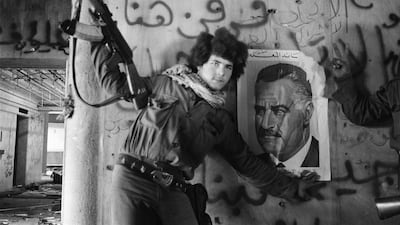
  • A pro-Palestinian fighter poses by a poster of late Egyptian President Gamal Abdel Nasser on the wall of the Holiday Inn in Beirut on March 24, 1976, days after pro-Palestinian militias dislodged Lebanese Christian forces from the 27-storey hotel. All photos: AFP
    A pro-Palestinian fighter poses by a poster of late Egyptian President Gamal Abdel Nasser on the wall of the Holiday Inn in Beirut on March 24, 1976, days after pro-Palestinian militias dislodged Lebanese Christian forces from the 27-storey hotel. All photos: AFP
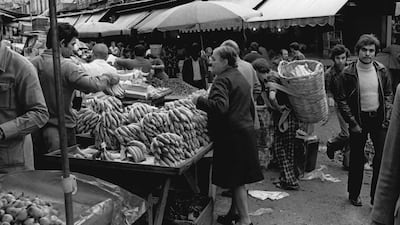
  • This picture taken in Beirut in the early 1970s shows people shopping in the old vegetable market that was destroyed in the 1975-90 civil war, when the city was split into two warring sectors.
    This picture taken in Beirut in the early 1970s shows people shopping in the old vegetable market that was destroyed in the 1975-90 civil war, when the city was split into two warring sectors.
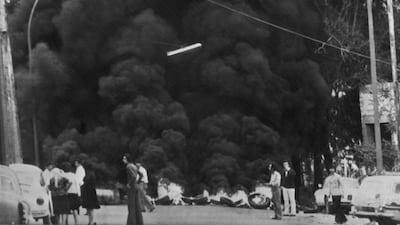
  • Smoke rises during clashes between Palestinian fighters and members of a Lebanese Christian militia in Beirut, on April 15, 1975.
    Smoke rises during clashes between Palestinian fighters and members of a Lebanese Christian militia in Beirut, on April 15, 1975.
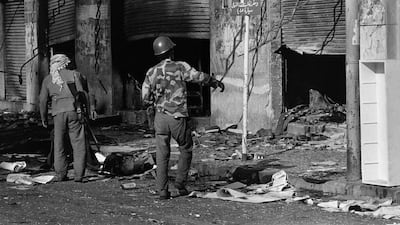
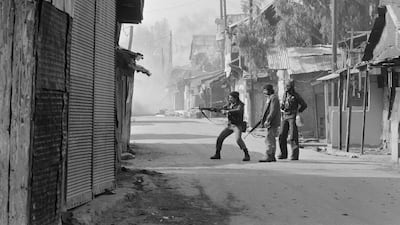
  • An armed man stands in a street in Lebanon's northern city of Tripoli, on October 21, 1975. The military had taken up positions in the buffer zone between Sunni-majority Tripoli and Zgharta, with orders to keep fighters from the cities apart.
    An armed man stands in a street in Lebanon's northern city of Tripoli, on October 21, 1975. The military had taken up positions in the buffer zone between Sunni-majority Tripoli and Zgharta, with orders to keep fighters from the cities apart.
  • Fighters from Lebanon's Christian Kataeb or Phalangist militia patrol the Christian Palestinian camp of Dbayeh, north of Beirut, on January 28, 1976.
    Fighters from Lebanon's Christian Kataeb or Phalangist militia patrol the Christian Palestinian camp of Dbayeh, north of Beirut, on January 28, 1976.
  • Children play among the ruins of a destroyed building in Beirut on January 28, 1976, as the blockade of the two main Palestinian camps was lifted.
    Children play among the ruins of a destroyed building in Beirut on January 28, 1976, as the blockade of the two main Palestinian camps was lifted.
  • Palestinian fighters unfurl a Lebanese flag in Beirut's Holiday Inn on March 24, 1976, after Palestinian commando units dislodged Lebanese Christian forces from the hotel.
    Palestinian fighters unfurl a Lebanese flag in Beirut's Holiday Inn on March 24, 1976, after Palestinian commando units dislodged Lebanese Christian forces from the hotel.
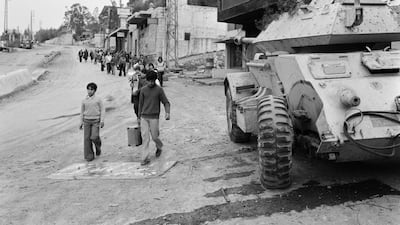
  • Students leave the Lebanese village of Kahaleh on April 3, 1976, the day after a 10-day truce began. This followed a blockade imposed by Palestinian and Lebanese left-wing fighters on the Christian stronghold in Mount Lebanon.
    Students leave the Lebanese village of Kahaleh on April 3, 1976, the day after a 10-day truce began. This followed a blockade imposed by Palestinian and Lebanese left-wing fighters on the Christian stronghold in Mount Lebanon.
  • Members of the Beirut-based Sunni-majority Nasserist militia al-Murabitoun – Sentinels – take position in the capital, on April 12, 1976.
    Members of the Beirut-based Sunni-majority Nasserist militia al-Murabitoun – Sentinels – take position in the capital, on April 12, 1976.
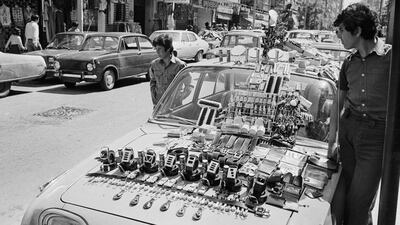
  • A Beirut street vendor selling goods on April 21, 1976, as some semblance of normal life resumed following a truce.
    A Beirut street vendor selling goods on April 21, 1976, as some semblance of normal life resumed following a truce.
  • A Phalangist militiaman in the village of Kahaleh, a Christian stronghold in Mount Lebanon, near Beirut, on April 4, 1976, after an assault at the end of March by Palestinian and allied Lebanese fighters.
    A Phalangist militiaman in the village of Kahaleh, a Christian stronghold in Mount Lebanon, near Beirut, on April 4, 1976, after an assault at the end of March by Palestinian and allied Lebanese fighters.
  • Loading flour on to vehicles in a food convoy travelling from the eastern neighbourhoods of Beirut, controlled by Christian conservatives, to western areas controlled by progressive and Palestinian forces, after the lifting of the food blockade.
    Loading flour on to vehicles in a food convoy travelling from the eastern neighbourhoods of Beirut, controlled by Christian conservatives, to western areas controlled by progressive and Palestinian forces, after the lifting of the food blockade.
  • The food convoy – laden with 35 tonnes of flour – enters western neighbourhoods of Beirut, after the lifting of the food blockade.
    The food convoy – laden with 35 tonnes of flour – enters western neighbourhoods of Beirut, after the lifting of the food blockade.
  • A Christian militia member poses amid the ruins of the Palestinian refugee camp of Tel Al Zaatar, on August 13, 1976, after right-wing forces launched an attack the previous day, following a 52-day siege.
    A Christian militia member poses amid the ruins of the Palestinian refugee camp of Tel Al Zaatar, on August 13, 1976, after right-wing forces launched an attack the previous day, following a 52-day siege.
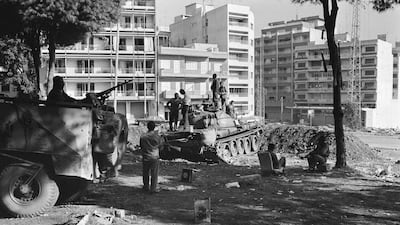
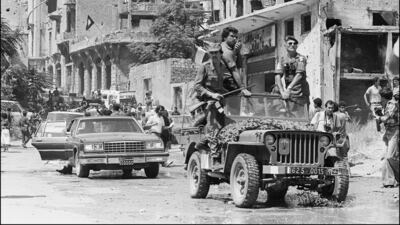
  • Soldiers from the Syrian contingent of the Arab deterrent force in Lebanon – known as the Green Helmets – take position in Beirut, on November 15, 1976.
    Soldiers from the Syrian contingent of the Arab deterrent force in Lebanon – known as the Green Helmets – take position in Beirut, on November 15, 1976.
  • Soldiers from the Syrian contingent of the Green Helmets Arab deterrent force arrive in Beirut, on November 15, 1976.
    Soldiers from the Syrian contingent of the Green Helmets Arab deterrent force arrive in Beirut, on November 15, 1976.
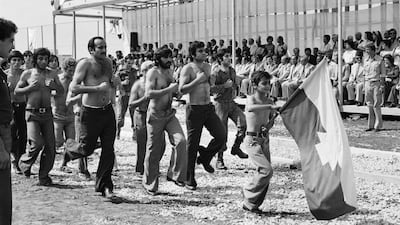
  • A parade at the swearing-in ceremony of young supporters of Camille Chamoun, leader of the right-wing Christian NLP, at Hadath, in the Beirut suburbs, close to Baabda presidential palace, on October 14, 1977.
    A parade at the swearing-in ceremony of young supporters of Camille Chamoun, leader of the right-wing Christian NLP, at Hadath, in the Beirut suburbs, close to Baabda presidential palace, on October 14, 1977.
  • Palestinian fighters travel ahead of the motorcade of Palestine Liberation Organisation chairman Yasser Arafat, as he leaves Israeli-occupied Beirut for Tunis, on August 30 1982.
    Palestinian fighters travel ahead of the motorcade of Palestine Liberation Organisation chairman Yasser Arafat, as he leaves Israeli-occupied Beirut for Tunis, on August 30 1982.
  • Lebanese army soldiers patrol the streets of the mountain village of Souk Al Gharb, south-east of Beirut, on September 26, 1983, after a ceasefire was established throughout Lebanon.
    Lebanese army soldiers patrol the streets of the mountain village of Souk Al Gharb, south-east of Beirut, on September 26, 1983, after a ceasefire was established throughout Lebanon.

It is worth considering however, that in early 2025, Lebanon is in a better position to build a brighter future that it has been for several years. A new President, Prime Minister and government are in place, there is international support for the state’s institutions, and a weakened Hezbollah has lost much of its ability to act as a spoiler. Added to these are the energy and spirit of the Lebanese people, who are among the most educated, entrepreneurial and dynamic in the Middle East.

Lebanon has not given up on the goal of creating a republic that all citizens can call home. That various Lebanese governments have often fallen short of these ideals does not invalidate them

If the country wants to harness this energy and stem the brain drain of young talent, there is much work to be done. Lebanon’s sovereignty must be re-established by building up institutions such as its armed forces and removing occupying Israeli troops in the south. The Lebanese authorities must also work to curtail corruption, provide essential services, maintain law and order, and ensure opportunity for all.

Friends of Lebanon must step up and ensure its government has the tools to maintain a real path of reform. The ultimate goal should include restoring the Lebanese people’s confidence in their institutions and leaders, and reinstating the country’s place as a regional and international hub, therefore ensuring that the kind of deadly divisions seen 50 years ago are never allowed to return.


What are the influencer academy modules?
  1. Mastery of audio-visual content creation. 
  2. Cinematography, shots and movement.
  3. All aspects of post-production.
  4. Emerging technologies and VFX with AI and CGI.
  5. Understanding of marketing objectives and audience engagement.
  6. Tourism industry knowledge.
  7. Professional ethics.
India squads

T20: Rohit Sharma (c), Shikhar Dhawan, KL Rahul, Sanju Samson, Shreyas Iyer, Manish Pandey, Rishabh Pant, Washington Sundar, Krunal Pandya, Yuzvendra Chahal, Rahul Chahar, Deepak Chahar, Khaleel Ahmed, Shivam Dube, Shardul Thakur

Test: Virat Kohli (c), Rohit Sharma, Mayank Agarwal, Cheteshwar Pujara, Ajinkya Rahane, Hanuma Vihari, Wriddhiman Saha (wk), Ravindra Jadeja, Ravichandran Ashwin, Kuldeep Yadav, Mohammed Shami, Umesh Yadav, Ishant Sharma, Shubman Gill, Rishabh Pant

Paris%20Agreement
%3Cp%3EArticle%2014%3C%2Fp%3E%0A%3Cp%3E1.%20%5BThe%20Cop%5D%20shall%20periodically%20take%20stock%20of%20the%20implementation%20of%20this%20Agreement%20to%20assess%20the%20collective%20progress%20towards%20achieving%20the%20purpose%20of%20this%20Agreement%20and%20its%20long-term%20goals%20(referred%20to%20as%20the%20%22global%20stocktake%22)%3C%2Fp%3E%0A%3Cp%3E2.%20%5BThe%20Cop%5D%20shall%20undertake%20its%20first%20global%20stocktake%20in%202023%20and%20every%20five%20years%20thereafter%C2%A0%3C%2Fp%3E%0A
Masters%20of%20the%20Air
%3Cp%3E%3Cstrong%3EDirectors%3A%3C%2Fstrong%3E%20Cary%20Joji%20Fukunaga%2C%20Dee%20Rees%2C%20Anna%20Boden%2C%20Ryan%20Fleck%2C%20Tim%20Van%20Patten%3C%2Fp%3E%0A%3Cp%3E%3Cstrong%3EStarring%3A%3C%2Fstrong%3E%20Austin%20Butler%2C%20Callum%20Turner%2C%20Anthony%20Boyle%2C%20Barry%20Keoghan%2C%20Sawyer%20Spielberg%3C%2Fp%3E%0A%3Cp%3E%3Cstrong%3ERating%3A%3C%2Fstrong%3E%202%2F5%3C%2Fp%3E%0A

Armies of Sand

By Kenneth Pollack (Oxford University Press)
 

SPEC%20SHEET%3A%20SAMSUNG%20GALAXY%20S23%20ULTRA
%3Cp%3E%3Cstrong%3EDisplay%3A%3C%2Fstrong%3E%206.8%22%20edge%20quad-HD%2B%20dynamic%20Amoled%202X%2C%20Infinity-O%2C%203088%20x%201440%2C%20500ppi%2C%20HDR10%2B%2C%20120Hz%3C%2Fp%3E%0A%3Cp%3E%3Cstrong%3EProcessor%3A%3C%2Fstrong%3E%204nm%20Qualcomm%20Snapdragon%208%20Gen%202%2C%2064-bit%20octa-core%3C%2Fp%3E%0A%3Cp%3E%3Cstrong%3EMemory%3A%3C%2Fstrong%3E%208%2F12GB%20RAM%3C%2Fp%3E%0A%3Cp%3E%3Cstrong%3EStorage%3A%3C%2Fstrong%3E%20128%2F256%2F512GB%2F1TB%20(only%20128GB%20has%20an%208GB%20RAM%20option)%3C%2Fp%3E%0A%3Cp%3E%3Cstrong%3EPlatform%3A%3C%2Fstrong%3E%20Android%2013%3C%2Fp%3E%0A%3Cp%3E%3Cstrong%3EMain%20camera%3A%3C%2Fstrong%3E%20quad%2012MP%20ultra-wide%20f%2F2.2%20%2B%20200MP%20wide%20f%2F1.7%20%2B%2010MP%20telephoto%20f%2F4.9%20%2B%2010MP%20telephoto%202.4%3B%203x%2F10x%20optical%20zoom%2C%20Space%20Zoom%20up%20to%20100x%3B%20auto%20HDR%2C%20expert%20RAW%3C%2Fp%3E%0A%3Cp%3E%3Cstrong%3EVideo%3A%3C%2Fstrong%3E%208K%4024%2F30fps%2C%204K%4060fps%2C%20full-HD%4060fps%2C%20HD%4030fps%2C%20full-HD%20super%20slo-mo%40960fps%3C%2Fp%3E%0A%3Cp%3E%3Cstrong%3EFront%20camera%3A%3C%2Fstrong%3E%2012MP%20f%2F2.2%3C%2Fp%3E%0A%3Cp%3E%3Cstrong%3EBattery%3A%3C%2Fstrong%3E%205000mAh%2C%20fast%20wireless%20charging%202.0%2C%20Wireless%20PowerShare%3C%2Fp%3E%0A%3Cp%3E%3Cstrong%3EConnectivity%3A%3C%2Fstrong%3E%205G%2C%20Wi-Fi%2C%20Bluetooth%205.2%2C%20NFC%3C%2Fp%3E%0A%3Cp%3E%3Cstrong%3EI%2FO%3A%3C%2Fstrong%3E%20USB-C%3B%20built-in%20Galaxy%20S%20Pen%3C%2Fp%3E%0A%3Cp%3E%3Cstrong%3ESIM%3A%3C%2Fstrong%3E%20single%20nano%20%2F%20nano%20%2B%20eSIM%20%2F%20nano%20%2B%20nano%20%2B%20eSIM%20%2F%20nano%20%2B%20nano%3C%2Fp%3E%0A%3Cp%3E%3Cstrong%3EColours%3A%3C%2Fstrong%3E%20cream%2C%20green%2C%20lavender%2C%20phantom%20black%3B%20online%20exclusives%3A%20graphite%2C%20lime%2C%20red%2C%20sky%20blue%3C%2Fp%3E%0A%3Cp%3E%3Cstrong%3EPrice%3A%3C%2Fstrong%3E%20Dh4%2C949%20for%20256GB%2C%20Dh5%2C449%20for%20512GB%2C%20Dh6%2C449%20for%201TB%3B%20128GB%20unavailable%20in%20the%20UAE%3C%2Fp%3E%0A

The Baghdad Clock

Shahad Al Rawi, Oneworld

The biog

Name: Timothy Husband

Nationality: New Zealand

Education: Degree in zoology at The University of Sydney

Favourite book: Lemurs of Madagascar by Russell A Mittermeier

Favourite music: Billy Joel

Weekends and holidays: Talking about animals or visiting his farm in Australia

Avatar: Fire and Ash

Director: James Cameron

Starring: Sam Worthington, Sigourney Weaver, Zoe Saldana

Rating: 4.5/5

england euro squad

Goalkeepers: Dean Henderson (Man Utd), Sam Johnstone (West Brom), Jordan Pickford (Everton)

Defenders: John Stones (Man City), Luke Shaw (Man Utd), Harry Maguire (Man Utd), Trent Alexander-Arnold (Liverpool), Kyle Walker (Man City), Tyrone Mings (Aston Villa), Reece James (Chelsea), Conor Coady (Wolves), Ben Chilwell (Chelsea), Kieran Trippier (Atletico Madrid)

Midfielders: Mason Mount (Chelsea), Declan Rice (West Ham), Jordan Henderson (Liverpool), Jude Bellingham (Borussia Dortmund), Kalvin Phillips (Leeds)

Forwards: Harry Kane (Tottenham), Marcus Rashford (Man Utd), Raheem Sterling (Man City), Dominic Calvert-Lewin (Everton), Phil Foden (Man City), Jack Grealish (Aston Villa), Jadon Sancho (Borussia Dortmund), Bukayo Saka (Arsenal)

Bharat

Director: Ali Abbas Zafar

Starring: Salman Khan, Katrina Kaif, Sunil Grover

Rating: 2.5 out of 5 stars

Updated: April 14, 2025, 4:28 AM