

For most governments, a national emergency is a time for urgent prioritisation. Non-critical functions take a back seat in favour of a laser-like focus on resolving the immediate crisis – getting aid to the disaster zone or winning the war, for example.
Israel is experiencing such a national crisis, yet some members of its current government seem to regard settlement building on occupied Palestinian land as the real priority. This is despite the country reeling from the killing and kidnappings of October 7 and the growing international isolation it faces over the government’s continuing collective punishment of Palestinians in Gaza.
A few days ago, Israeli Finance Minister Bezalel Smotrich, a hardline nationalist ally of Prime Minister Benjamin Netanyahu, revealed plans to build on 800 hectares of occupied Palestinian land in the West Bank. This has been described by Israeli watchdog Peace Now as the largest area of land seized since the 1993 Oslo Accords. The move has also drawn the ire of the EU, which described the settlements as “a grave breach of international humanitarian law” and was criticised by Jordan, which denounced "the Israeli government’s ongoing violations of all international law norms".
-

A Palestinian man picks olives during harvest season near Nablus, in the Israeli-occupied West Bank. Reuters -

Olive trees are considered both a revered cultural emblem and an economic necessity for Palestinians. Reuters -
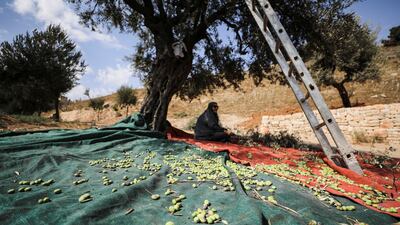
A Palestinian woman sits under an olive tree as others pick its olives in Jerusalem. Reuters -

Palestinian farmer Ibrahim Amar, 64, stands by the Seam Zone in Qaffin, in the occupied West Bank. Seam zones are sections of Palestinian land that have been designated by Israel as closed military areas. Tanya Habjouqa / Noor for The National -
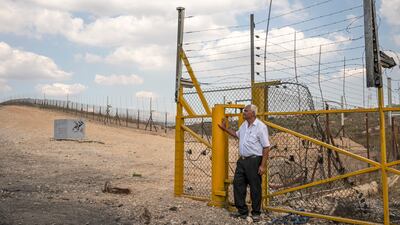
Palestinian farmer Mohammed Khasib, 65, by the Seam Zone in Qaffin. Tanya Habjouqa / Noor for The National -
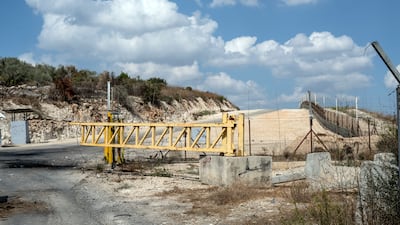
Israel has erected walls and gates to separate Palestinian farmers from their land. Tanya Habjouqa / Noor for The National -
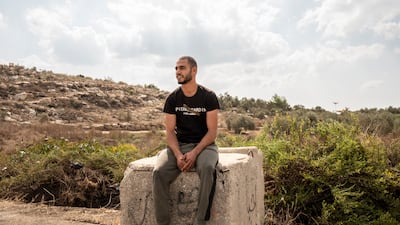
A Palestinian man outside a seam zone. Access to these Palestinian areas is controlled by an Israeli permit system. Tanya Habjouqa / Noor for The National -
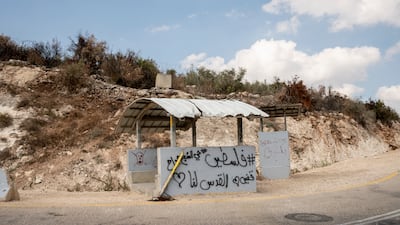
Palestinian graffiti on a stand used by Israeli soldiers in the seam zone in Qaffin. It reads in Arabic: 'Palestine, Sheikh Jarrah, Jerusalem is ours'. Tanya Habjouqa / Noor for The National -
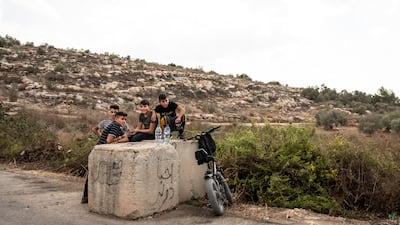
Young men and children hang around the seam zone to see if they will be allowed to help their family members, who have permits to access their farms in Qaffin, harvest their olives. Tanya Habjouqa / Noor for The National -
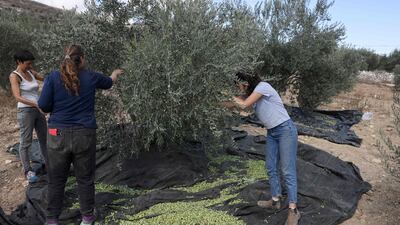
Activists from the Rabbis for Human Rights organisation help Palestinian farmers to harvest their olive trees near Nablus. AFP -

Palestinians walk alongside Israel's separation barrier after receiving special permission to harvest their olive trees, near Bait A'wa village, on the outskirts of the West Bank city of Hebron. AFP -
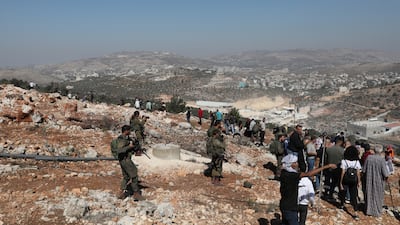
Israeli soldiers stand guard as volunteers and demonstrators help Palestinian farmers to pick their olives next to the Israeli outpost of Evitar, near Nablus. The volunteers picked the olives in solidarity with Palestinians, whose land was confiscated by Israeli settlers. EPA -
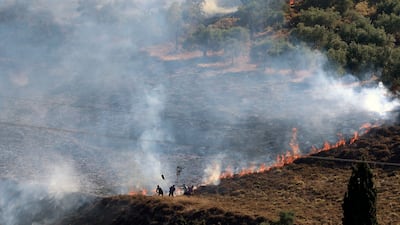
Palestinians extinguish a fire in a field around the village of Burin, south of Nablus, on June 29, 2021. AFP -

The field was set ablaze by Israelis from the settlement of Yitzhar, according to witnesses from the village council. AFP


As if the seizure of Palestinian land was not bad enough, efforts to find Jewish residents to populate it continue unabated. In the past week, The National has reported from the US on an Israeli real estate company that is advising Jewish Americans on how to quickly and easily buy up West Bank land and property. Those who avail themselves of this offer should be clear about what they’re buying in to; settling the West Bank means benefiting from a discriminatory, militarised and lawless occupation. In addition, the settlements suffer from many problems. One example of this was laid out in a report published last week by the Norwegian Refugee Council that described the “devastating environmental and economic consequences” from the unlawful discharge of untreated wastewater from settlements into Palestinian lands.
It seems remarkable that cabinet members of a country at war think that now is the time to redouble their efforts to completing a project that leaves Israel more isolated and less secure. In earlier years, hardline settlers were a tool of Israel’s political and military establishment to be championed, tolerated or uprooted as needs dictated. Since then, the radical settlers and other religious nationalists have embedded themselves and their agenda in the heart of government. This has had some clear consequences – Israeli soldiers are posted in large numbers to protect settlers in the West Bank, even during wartime, and controversial draft legislation currently being championed by Mr Netanyahu would extend exemption from army conscription for ultra-Orthodox Jews, a divisive issue for many Israelis.
Emboldened and enabled, the settler movement and their political champions at home and abroad have also noted how little real international pressure has been brought to bear for their activities. Although the US, France, Britain and the EU have recently imposed some sanctions on individual settlers, this response fails to appreciate how the project is not solely the work of a few radicals – it is a process enabled by Israel’s legal and security institutions.
The settlements are almost universally deemed illegal, therefore they are a potential pressure point for influential countries. Extending and deepening sanctions would send a clear message that the days of dispossessing Palestinians is at an end. Such a message would be timely, as some Israelis – as well as former US president Donald Trump’s son-in-law Jared Kushner – openly contemplate a re-occupation of the Gaza Strip, as if the ruined territory was a piece of prime real estate to be bought and sold.
The US refuses to take stringent measures against Israel, for example, refusing to review its arms exports – the two countries’ security relationship runs too deep. But the settlement issue is one where a line can more easily be drawn, and a message sent that kicking people off their land or forcing them to live under military law to the benefit of Israeli settlers is wrong.
Decades of inaction have led us to a point where not only the Palestinians but much of Israeli society are confronted by intransigent settlers who insist that everyone from their own government to the international community bend to their will. They want to make their priority everyone’s priority. Everyone who desires an end to this conflict must insist that peace and justice take priority instead.

