


A terrible fact of climate change is that so many of the places set to be affected the most and the quickest have the least capacity to prepare. Several countries in the Middle East are prime examples, as are the states in the Horn of Africa.
The region is home to roughly 11 per cent of Africans, and some of the continent’s most volatile states. The UN Population Fund estimates that more than 36 million people there have been affected by one of the longest and most severe droughts in recent history. It is expected to continue well into next year. Millions more are facing crisis levels of hunger.
Even the most stable governments around the world are scrambling to mitigate the dangers of climate change. The situation is made far harder when politics is unstable. A civil war began in Ethiopia in November 2020. And while a ceasefire was struck last month, hundreds of thousands of civilians died or were injured in the violence. The fighting also threatened Ethiopia’s territorial integrity, and its diverse, ancient culture. It came as the country was battling Covid-19, drought, locust swarms and a food crisis.
Sudan, meanwhile, has been in political turmoil since the ousting of its former president Omar Al Bashir in 2019, despite his departure being a hugely important and positive development for the future of the country. His problematic rule might be gone, but economic turmoil and mass protests are not.
-
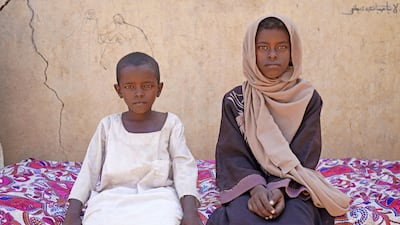
Zahra Hussein (R), a nine-year-old Sudanese girl who dropped out of school for financial reasons, poses for a picture with her brother at their home in the village of Ed Moussa in Sudan's eastern state of Kassala, on September 27, 2022. - There are nearly seven million children in Sudan who no longer go to school, a victim of what aid agencies have warned is a "generational catastrophe". Children in the country have for years faced mounting difficulties gaining access to proper education, especially in rural areas. Sudan is already one of the world's poorest countries, plagued by political instability, droughts, hunger and conflict, with an adult literacy rate of only around 60 percent according to the World Bank. AFP -
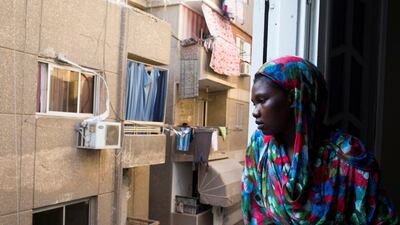
Abukk Sebit, 25, looks from her balcony after working to help financially her family in Sudan, at Ain Shams district area in Cairo, Egypt September 13, 2022. Reuters -
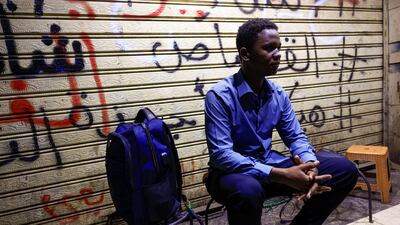
Mostafa waits for the bus before leaving for Egypt in Khartoum, Sudan September 24, 2022. Reuters -
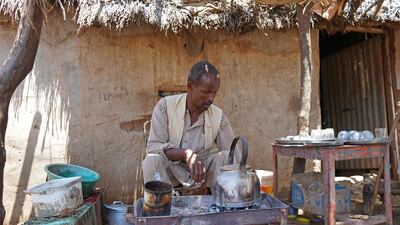
Abdalla Ibrahim, the Sudanese owner of a coffee shop and father of seven, looks on as he sits behind a pot on a fire in the village of Gosla in Sudan's eastern state of Kassala, on September 27, 2022. There are nearly seven million children in Sudan who no longer go to school, a victim of what aid agencies have warned is a "generational catastrophe". Children in the country have for years faced mounting difficulties gaining access to proper education, especially in rural areas. Sudan is already one of the world's poorest countries, plagued by political instability, droughts, hunger and conflict, with an adult literacy rate of only around 60 percent according to the World Bank. AFP -
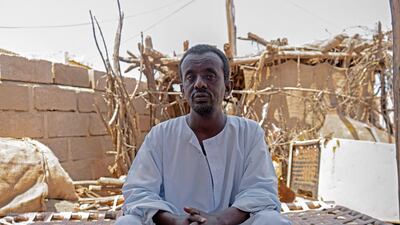
Othman Abubakr, a Sudanese day labourer who has nine children, poses for a picture in the village of Wad Sharifai in Sudan's eastern state of Kassala on September 27, 2022. There are nearly seven million children in Sudan who no longer go to school, a victim of what aid agencies have warned is a "generational catastrophe". Children in the country have for years faced mounting difficulties gaining access to proper education, especially in rural areas. Sudan is already one of the world's poorest countries, plagued by political instability, droughts, hunger and conflict, with an adult literacy rate of only around 60 percent according to the World Bank. AFP -
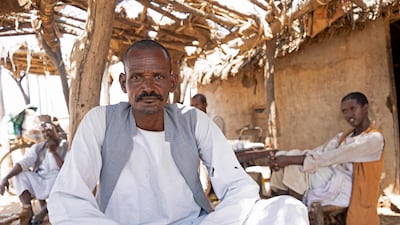
Ohaj Soliman, a 43-year-old Sudanese day labourer who put his children to work, poses for a picture during an interview with AFP in the village of Gosla in Sudan's eastern state of Kassala, on September 27, 2022. There are nearly seven million children in Sudan who no longer go to school, a victim of what aid agencies have warned is a "generational catastrophe". Children in the country have for years faced mounting difficulties gaining access to proper education, especially in rural areas. Sudan is already one of the world's poorest countries, plagued by political instability, droughts, hunger and conflict, with an adult literacy rate of only around 60 percent according to the World Bank. AFP -
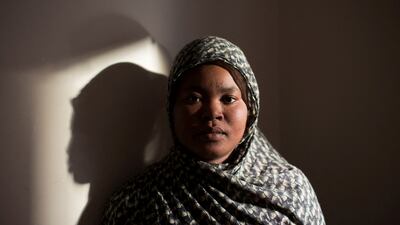
Malaz Al-Bakr Ibrahim, 23, who has worked as a babysitter in Egypt since 2020 because of the economic and political situation in Sudan, poses for a photograph at Ain Shams district area in Cairo, Egypt September 13, 2022. Reuters -
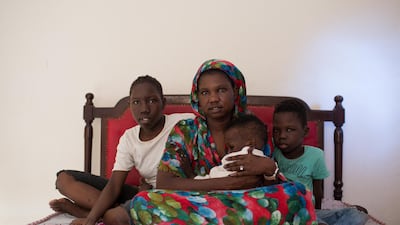
Abukk Sebit, 25 years old, poses with her children after working to help her family in Sudan financially at Ain Shams district area in Cairo, Egypt September 13, 2022. Reuters -
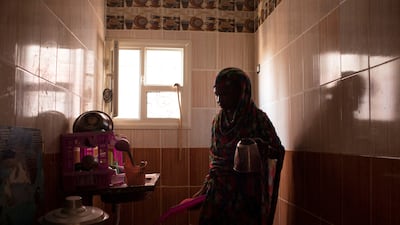
Abukk Sebit, 25 years old, prepares food before going to work to help her family in Sudan financially at Ain Shams district area in Cairo, Egypt September 13, 2022. Reuters -
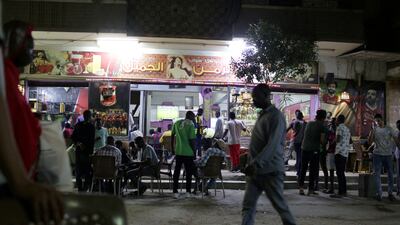
General view of a Sudanese coffee shop, where the number of Sudanese clients has increased in recent years after the economic and political conditions in their country deteriorated, at Ain Shams district area in Cairo, Egypt September 13, 2022. Reuters -

Sudanese protesters rally against the October 2021 military coup which has led to deaths and scores of arrests of demonstrators, in Khartoum, Sudan, Monday, February 28, 2022. Since the coup, more than 80 people, mostly young men, have been killed and over 2,600 others injured in the protests, according to a Sudanese medical group. AP Photo -
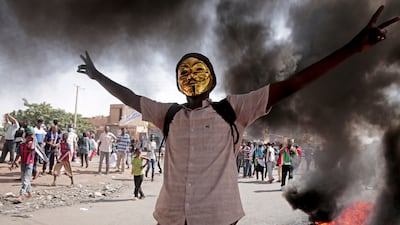
A man flashes the victory sign during a protest to denounce the October 2021 military coup, in Khartoum, Sudan, Jan. 9, 2022. Since the coup, security forces launched a deadly crackdown on protesters. Many activists were taken from their homes or snatched from the streets, according to documents he provided to The Associated Press. Around 80 people, mostly young men, were killed and over 2,200 others were wounded in the protests since the coup, according to a Sundanese medical group. AP Photo -
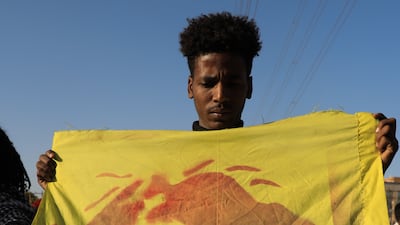
A Sudanese protester holds a painting of a person who reportedly died in a previous rally during a protest, in Khartoum, Sudan, 20 January 2022. Sudanese protesters rallied against the killing of at least 70 protests in crackdown against pro-democracy since the beginning of the military coup on 25 October 2021. The protest was organized as the US Assistant Secretary of State Molly Phee and US special envoy for the Horn of Africa David Satterfield visit Khartoum to meet separately with pro-democracy activists and military leaders to put an end to the crisis in the country. EPA -
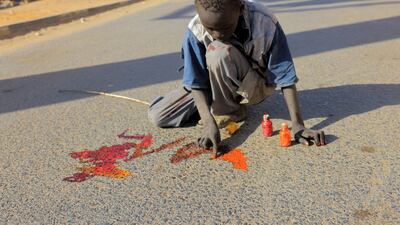
A boy draws on the street in front of a barricade during a two-day general strike and civil disobedience campaign in response to demonstrators' deaths against military takeover on October 25, 2021, in Khartoum, Sudan January 18, 2022. Reuters -

A Sudanese demonstrator waves a national flag during a protest against the October 2021 military coup, in the capital Khartoum, on January 13, 2022. The demonstrations which converged from several parts of Khartoum came only days after the United Nations launched a bid to facilitate talks between Sudanese factions. AFP -
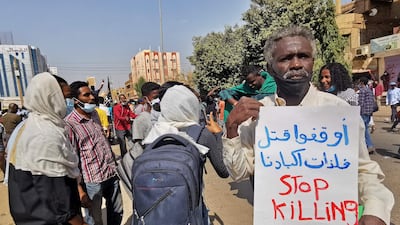
Sudanese protesters take to the streets of the capital Khartoum as they rally against the October 2021 military coup, on January 13, 2022. The demonstrations which converged from several parts of Khartoum came only days after the United Nations launched a bid to facilitate talks between Sudanese factions. AFP -
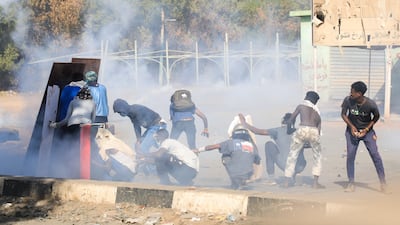
Sudanese protesters take cover as security forces fire tear gas during clashes with security forces at an anti-coup protest, in Khartoum, Sudan, 09 January 2022. Security forces fired tear gas to disperse protesters gathering in Khartoum and attempting to march towards the presidential palace, as part of the continuing protesting movement against a military coup in October 2021. The protest was organized a day after the UN envoy for Sudan said the international group will invite different parties for talks in Sudan to end the crisis. EPA -
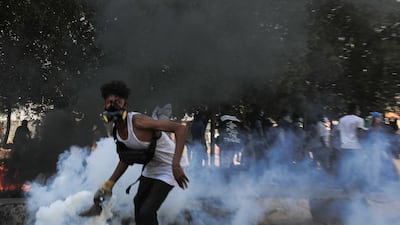
A Sudanese protester attempts to throw back a tear gas canister during clashes with security forces at an anti-coup protest, in Khartoum, Sudan, 09 January 2022. Security forces fired tear gas to disperse protesters gathering in Khartoum and attempting to march towards the presidential palace, as part of the continuing protesting movement against a military coup in October 2021. The protest was organized a day after the UN envoy for Sudan said the international group will invite different parties for talks in Sudan to end the crisis. EPA -
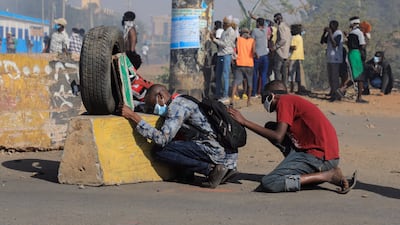
Sudanese protesters take cover during clashes with security forces at an anti-coup protest, in Khartoum, Sudan, 09 January 2022. Security forces fired tear gas to disperse protesters gathering in Khartoum and attempting to march towards the presidential palace, as part of the continuing protesting movement against a military coup in October 2021. The protest was organized a day after the UN envoy for Sudan said the international group will invite different parties for talks in Sudan to end the crisis. EPA -
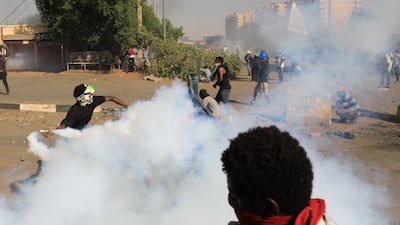
Sudanese protesters take cover as security forces fire tear gas during clashes with security forces at an anti-coup protest, in Khartoum, Sudan, 09 January 2022. Security forces fired tear gas to disperse protesters gathering in Khartoum and attempting to march towards the presidential palace, as part of the continuing protesting movement against a military coup in October 2021. The protest was organized a day after the UN envoy for Sudan said the international group will invite different parties for talks in Sudan to end the crisis. EPA


And Somalia, one of the most impoverished countries in the world, is also one of the most vulnerable to terrorism. At the end of November, 14 people were killed in a hotel siege carried out by the Al Shabab terrorist group that once controlled the capital Mogadishu and continues to aspire to establish an extremist state in the country.
Tensions remain high in Ethiopia, a number of high-profile experts have consistently said that the conflict does not get as much attention as other wars and more than 5 million people face starvation because of fighting, according to the World Food Programme.
Terrorism has blighted Somalia for years and will be hard to root out, particularly as the government struggles with high levels of internally displaced people and ongoing political infighting.
But there are signs of hope in the region.
Ethiopia’s ceasefire, a result of mediation by the African Union, has a greater chance of lasting following reports on Sunday that most Tigrayan forces, who were fighting government troops, have withdrawn from front-line positions.
Sudan’s ruling military-civilian coalition, too, have signed an agreement. Many in the international community hope it will restore the country’s peaceful transition to civilian rule. The UAE, for one, welcomed the agreement of an initial political framework reached by Sudanese parties to complete the transitional period, with Afra Al Hameli, the director of strategic communications at the Ministry of Foreign Affairs and International Co-operation, expressing "aspirations for a peaceful and successful political transition in a way that enhances stability and brings prosperity and development to [Sudan's] people".
But much effort is needed to win the peace and secure a stable and prosperous future for Sudan’s people. Today, almost a million more people are in need of humanitarian assistance than last year. The overall number is at least, 14.3 million, according to Acaps, an NGO. This is the time to support the Sudanese people.
The leaders of the Horn of Africa should pursue the urgent priority of building political stability as soon as possible. Only then will the region be able to put its best foot forward in an uncertain, tough future. For now, all those who can should support the positive momentum witnessed in recent weeks.

