


Yesterday, as Iran’s Islamic Republic prepared to mark the second anniversary of the death of Qassem Suleimani, one of the most powerful military figures in its young history, the country’s Supreme Leader, Ayatollah Ali Khamenei, addressed Iranians with characteristic bluster.
Former US president Donald Trump, he said, would soon “pay for his crimes”. Suleimani, who before his death was the head of the Quds Force, a branch of the Islamic Revolutionary Guard Corps, was killed in Baghdad by the Trump administration, using a drone strike, on January 3, 2020.
The two years since have seen Iranian officials issue all manner of threats of direct and indirect retaliation against the US, but little has materialised beyond Tehran’s usual pattern of regional agitation using its proxies in other countries, and continued obstinacy in negotiations over its nuclear programme. For all the damage Iran has been able to inflict on its neighbours in recent decades, the country’s conventional military forces are widely understood to be too weak to engage in any direct conflict with a powerful rival.
This was something Suleimani himself knew very well. It was the primary motivation for his shaping of the Quds Force, which he turned into a premier tool of unconventional and psychological warfare. It has outclassed the IRGC’s other branches, which include ground forces and a navy, in terms of both domestic prominence and effectiveness overseas.
The throngs of mourners for Suleimani, and the deputy leader of Iraq’s Popular Mobilisation Units, Abu Mahdi AlMuhandis, seen in the streets of multiple Iraqi cities this week are a testament to this. The IRGC’s psychological operations in Iraq have been effective at churning up sympathy for Iran’s cause among some and support for its interference in Iraqi affairs that many politicians in Baghdad, even two years after Suleimani’s death, remain in fear of provoking Tehran’s local proxies.
-
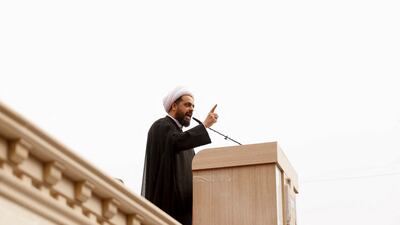
Qais Al Khazali, leader of the political party and militia Asaib Ahl Al Haq, speaks on January 1, 2022, almost two years after Iranian military commander Qassem Suleimani and Iraqi militia leader Abu Mahdi Al Muhandis were assassinated in a US drone attack in Baghdad. Reuters -
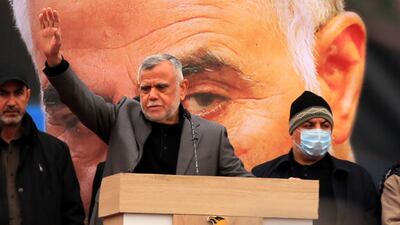
Hadi Al Amiri, centre, head of Badr Organisation, waves to his supporters during the rally, held in the Iraqi capital. Members and supporters the Popular Mobilisation Forces, a group of Shiite militias in Iraq, attended a rally to commemorate Suleimani and Al Muhandis, who died on January 3, 2020. EPA -
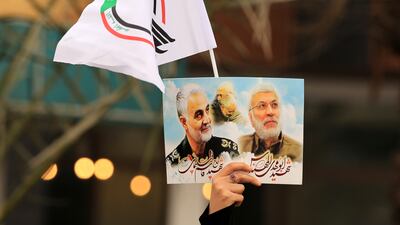
A PMF follower carries a picture of Suleimani and Al Muhandis. EPA -
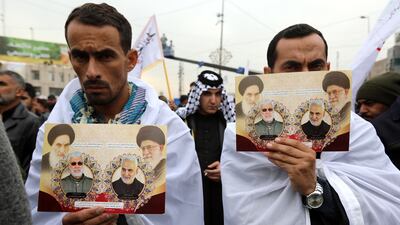
PMF followers at the rally carry pictures featuring Iran’s supreme leader Ayatollah Ali Khamenei, his predecessor Ayatollah Khomeini, Al Muhandis and Suleimani. EPA -
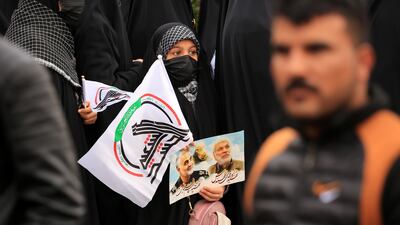
A PMF follower carries the organisation’s flag and portraits of Al Muhandis and Suleimani. EPA -
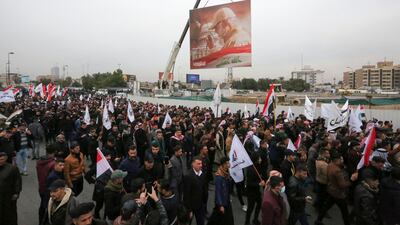
Members and supporters of the PMF, also known as Hashed Al Shaabi, take part in a demonstration and a symbolic funeral for Suleimani and Al Muhandis. AFP -

PMF members carry a symbolic coffin for Suleimani during the rally. EPA -
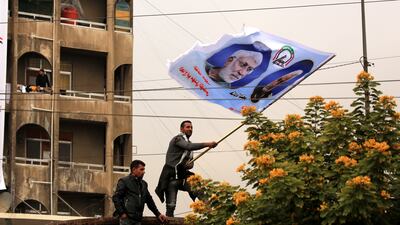
A PMF follower waves a flag depicting Suleimani and Al Muhandis. EPA


In the year ahead, psychological warfare, along with cyber warfare, guerrilla warfare and other unconventional methods for waging conflict, will only become more valuable. Paradoxically, however, the more these advanced tactics continue to undermine the stability of the Middle East, the less developed the region will be and the more older, more familiar problems will persist. The IRGC will not be spared the fallout. This week, at least three of its soldiers died fighting criminal gangs in Sistan and Baluchistan province, which borders Pakistan and Afghanistan.
That tri-border area has, in fact, witnessed a string of such clashes in the past two months, which have often been deadly for Iranian security forces. The violence is fuelled by deeply entrenched poverty and instability in Afghanistan, where the IRGC recently played a role in bringing the Taliban militant group to power, and has recruited thousands of young, able-bodied Afghan men to fight on its behalf in Syria.
Iran’s eastern frontier is an old stomping ground for the IRGC. It was the file run by Suleimani’s successor, Esmail Qaani, before he assumed his new role, and it is where the most prominent IRGC commanders, including Suleimani himself, often develop their careers before deploying to the Arab world. So it is surprising that the sorry state of Iran’s eastern borderlands, which remain the same today as they were when Suleimani’s career began, has provided so few lessons to Tehran’s leaders. The IRGC may have innovated the methods to fit a modern, more complicated world, but unless the doctrine itself – its continued pattern of destruction – is rectified, Iran will continue to suffer the consequences.

