


The world would be a less healthy place over the course of history were it not for Middle Eastern doctors and scientists. Avicenna, arguably the region's most famous polymath, wrote The Canon of Medicine in the 10th century, one of the most famous medical books in history, and the 13th century Arab physician Ibn Al Nafis outlined pulmonary circulation more than 300 years before William Harvey did so in the West. Today, Egypt still trains 15 per cent more medics per capita than the US.
But nowadays the region is not an easy place to practise. War and economic crises have devastated a number of its centres of excellence, and the strain of Covid-19 has made things worse. In Lebanon, more than 400 medics left the country in 2020. While the situation might not be as bad in other parts, there is still a trend towards young doctors leaving for better prospects outside the Middle East.
There are a few countries in the region that buck the trend. The UAE is fortunate to be one of them, the result of the country's planning, prosperity and government efforts over the years to strengthen the sector.
-
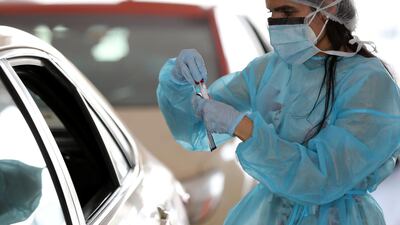
People get tested for coronavirus at the Mina Rashid screening centre in Dubai. Chris Whiteoak / The National -
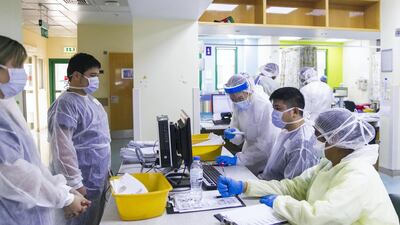
Since the beginning of the coronavirus pandemic, health authorities have called upon citizens and residents to join with the efforts of health care professionals. Health workers, such as these Sheikh Khalifa Medical City, have led the way. Reem Mohammed / The National -
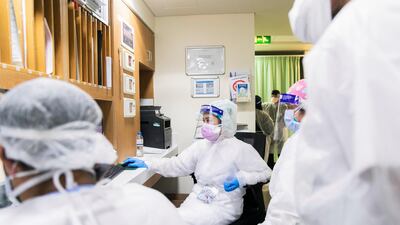
Healthcare workers at the emergency ward in Sheikh Khalifa Medical City. The President, Sheikh Khalifa, has paid tribute to the frontline workers who helped to curb Covid-19. Reem Mohammed / The National -
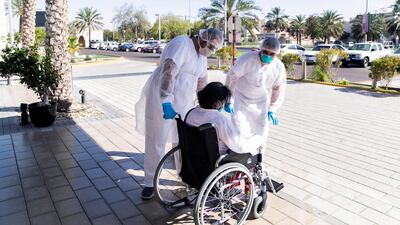
Healthcare workers at Sheikh Khalifa Medical City receive a patient outside the emergency department. Reem Mohammed / The National -
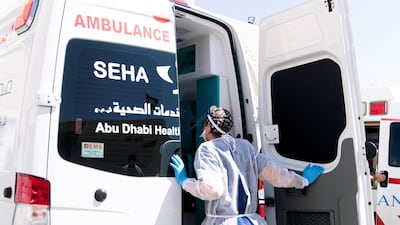
A consultant physician at the emergency department in Sheikh Khalifa Medical City, receives a Covid-19 patient. Reem Mohammed / The National -
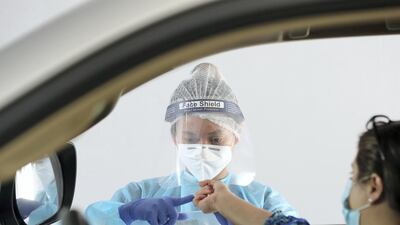
People get the laser blood test tests at the Mina Rashid screening centre in Dubai. Chris Whiteoak / The National -
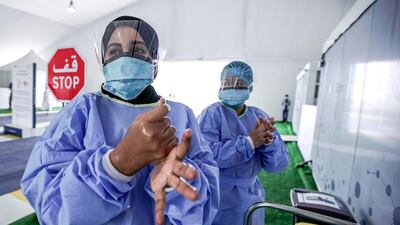
A nurse sanitises her hands after conducting a swab test at one of the UAE's screening drive-through centres in Mina Rashid, Dubai. Victor Besa / The National -
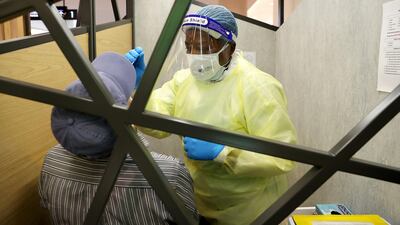
A health worker taking the Covid-19 nasal swab test at a testing station in thet Mall of the Emirates in Dubai. Pawan Singh / The National -
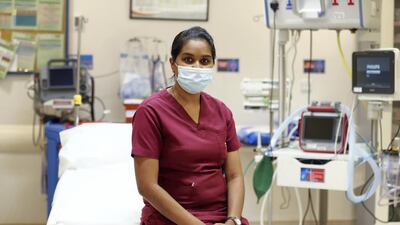
Nurse Renu Venugopal, who contracted Covid-19, recovered and continued to treat patients at Al Zahra Hospital, Sharjah. Chris Whiteoak / The National -
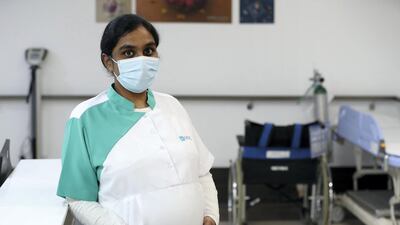
Ruth Deva Kiruba says being pregnant during a pandemic was surreal and sometimes lonely. Chris Whiteoak / The National -
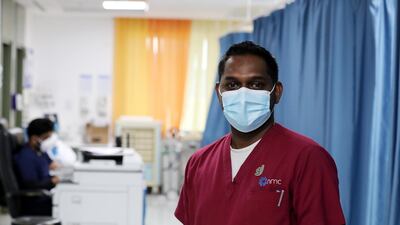
EMT nurse Jephy Antony, who contracted Covid-19, recovered and continued to treat patients at the NMC Royal Hospital, DIP, Dubai. Chris Whiteoak / The National -
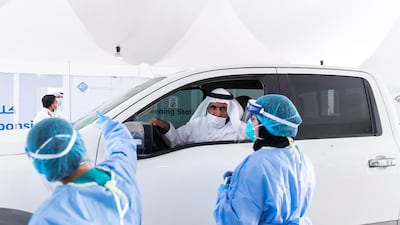
A visitor gets tested at the Ras Al Khaimah Covid-19 drive-through testing centre. Reem Mohammed / The National -
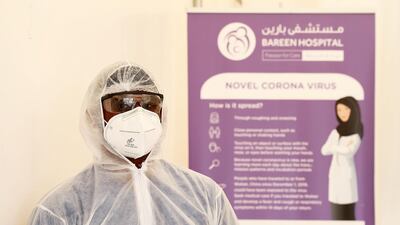
Nurse Nikhil Rajendran inside the fever clinic at the Bareen International Hospital in Mohamed Bin Zayed City in Abu Dhabi. Pawan Singh / The National -
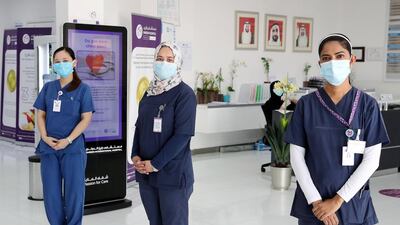
Shane Simeon Galang from Philippines, Mervat Aslan Mhgoub Mohamed from Egypt and Sowmya Kotian from India, who are nurses at the Bareen International Hospital in Mohamed bin Zayed City in Abu Dhabi. Pawan Singh / The National


The Emirates' world-leading health care owes a great deal to workers from around the world; in July, doctors who worked on the front line of the pandemic in the UAE were encouraged to apply for golden visas in recognition of their contribution. But more is being done to train doctors in the country. This week, for example, one of the region's biggest healthcare providers, VPS Healthcare, launched a consultation programme to inform a strategy for getting more UAE citizens into the sector. Other efforts with similar goals include the National Healthcare Programme, which aims to train UAE citizens in the field of nursing through paid scholarships. It is set to begin in 2022.
Abu Dhabi Stem Cell Centre is becoming a leading regional research centre. Dubai Healthcare City free zone has launched an Emirati training programme in fields such as business administration, finance, marketing and communications and information technology. The scope of the programme shows how modern healthcare systems run on more than simply doctors and nurses. The UAE's sector is aiming not to be up-to-date, but cutting-edge. Earlier this month, the Riayati national personal medical records database was announced as a key step in providing a world-class healthcare system by simplifying diagnosis, treatment and prescriptions.
Medical interest is also shaping the country's engagements abroad. Yesterday, The National revealed that the Beyond2020 initiative, launched by the Zayed Sustainability Prize, has brought healthcare services to about 20,000 people in rural Rwanda. Last year, the country launched the Reach Campaign, which focuses on combatting neglected tropical diseases. It announced in October that it was working to rid the world for good of two such illnesses, river blindness and lymphatic filariasis.
From frontline medical staff to administrators, humanitarian workers to IT experts, the pace at which healthcare is developing in the UAE is keeping the Middle East's tradition of being at the heart of medicine alive. This transformation, driven by international and, increasingly, national expertise, can be an asset for the country and the region.

