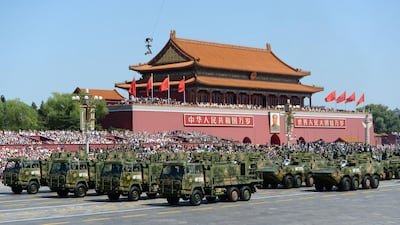

On September 2 1945, representatives from Japan signed an instrument of unconditional surrender, marking China's victory and a key date in the efforts throughout the Second World War against fascism. In China, September 3 has been designated as "Victory Day".
The Second World War was a conflict of unprecedented scale in human history. Its flames spread across Asia, Europe, Africa and Oceania. Around 2 billion people from more than 80 countries and regions were involved, and over 100 million military and civilian casualties were inflicted. Fascist forces brought untold suffering to the world and an unparalleled catastrophe to human civilisation. As the main theatre in the East, China made a national sacrifice of over 35 million casualties in its fighting against a larger force. It not only saved itself and its people from subjugation, but also gave strong support to other nations against aggression in the European and Pacific theatres, thus making a historic contribution to the Allied victory.
Seventy-five years ago, in the wake of that victory, countries of the world established an international order and a corresponding system with the United Nations at its core, underpinned by the purposes and principles of the UN Charter. It was a giant step forward in the history of humanity. The past 75 years have witnessed overall world peace and stability and unprecedented progress in human development. Productivity is rising and science and technology are advancing by leaps and bounds. Peace, development and co-operation have become common aspirations of all people around the world.
-

Residents wearing masks line up for a Covid-19 test outside the Worker's Stadium in Beijing on June 30. Test sites sprung up through the Chinese capital as frequent nasal swabs have become normal after the latest outbreak of the coronavirus. AP Photo -

An empty box office at the China Film Cinema in Beijing, which was closed due to the new coronavirus outbreak in Beijing. Reuters -

Security guards patrol outside the Dizhi Hall cinema, which was also closed. Reuters -
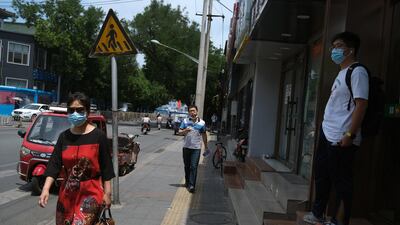
People wearing face masks are seen on a street, following a rise in cases in Beijing. Reuters -
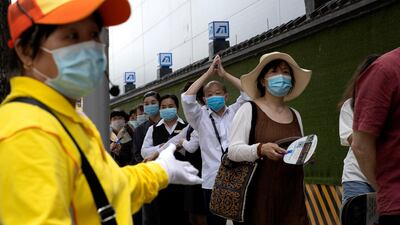
A resident makes a gesture as he lines up for a test outside the Worker's Stadium. AP Photo -

People wait in line for the nasal swab PCR test. China's capital partially lifted a weeks-long lockdown that was put in place to head off a feared second wave. AFP -
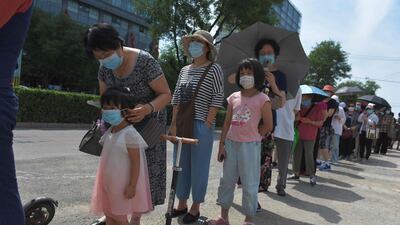
A woman adjusts a young girl's face mask as they wait in line. AFP -

An Air China plane sits on the tarmac at Beijing's Capital International Airport, which was nearly empty on June 30. AFP -
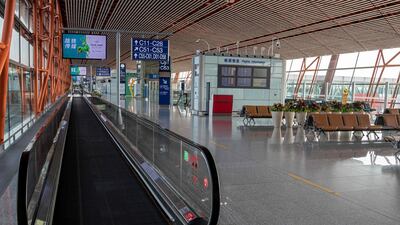
An almost empty terminal 3 at Capital International Airport. AFP -

Passengers in full protective suits make their way to their gate at terminal three. AFP -
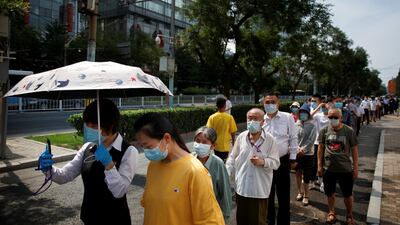
People line up in the heat for a test. Reuters -

A security guard is swabbed a testing station in Beijing. AFP -

Beijing has tested about 8 million people. Reuters -
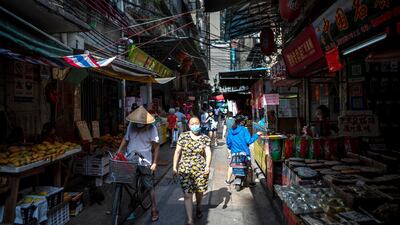
A woman walks through the wet market in Guangzhou, China. China races to contain a second wave of coronavirus cases mostly in Beijing. EPA -
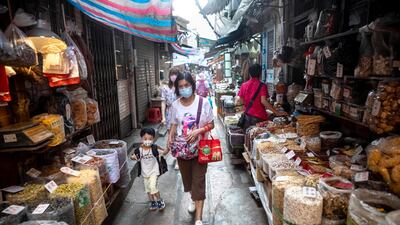
Wet markets have come under particular scrutiny following the coronavirus outbreak in late December, 2019. EPA


Meanwhile, we must not fail to see that our planet is still far from tranquil. Human society is still faced with grave challenges. Armed conflicts and regional wars arising from territorial, ethnic, religious and resource-based disputes have continued unabated. People in many countries are still living in poverty and face difficulties in economic development.
Environmental pollution and climate change have brought new threats to human security. In recent years, in particular, countries have had to cope with a sluggish global economy, geopolitical turbulence, the threat of terrorism and friction among civilisations. The existing international order and system are confronted with new challenges. On top of that, the Covid-19 pandemic this year has dealt a heavy blow.
Our planet is a common home to all people and nations. The challenges and problems facing human development have to be jointly addressed by everyone. In the interests of peace and development, we need to foster a keen sense of a global community of shared future. Taking history as a mirror can guide us better into the future. Prejudice, discrimination, hatred and war can only cause disaster and suffering, while mutual respect, equality, peaceful development and common prosperity represent the right path to take. It is the spirit of tolerance, coexistence and humanitarianism upheld by the UAE that makes it a stable and prosperous safe haven in the Middle East, a region marked by conflict elsewhere. The Emirates has set an example for countries in the region to achieve long-term peace and development.
All countries should jointly uphold the hard-won post-war international order, build a new type of international relations featuring win-win co-operation, and advance the noble cause of global peace and development. Let the vision of a world free of war and with lasting peace take root in our hearts. The best way to honour the heroes who gave their lives to uphold freedom, justice and peace, and to mourn the loss of innocent lives brutally taken during the war, is to ensure that this tragedy will never repeat itself.
Ni Jian is the People’s Republic of China’s ambassador to the UAE

