

If there is one takeaway from Thursday’s meeting between Turkey’s President Recep Tayyip Erdogan and his Russian counterpart Vladimir Putin, it is that their ceasefire deal will not bring long-term stability to Syria. The summit in Moscow might have offered some face-saving measures for both leaders, but it did not revive the political process or offer a roadmap for a lasting ceasefire.
For sure, the summit did not provide either leader with a win. Mr Erdogan received none of what he demanded – neither the withdrawal of Syrian regime forces back to the lines stipulated by an agreement made between Turkey and Russia last year, nor the end of Russian support for the regime’s offensives. Mr Putin, too, failed to receive what he was after – namely, a commitment from his Turkish counterpart to take action against groups in north-western Syria that Russia considers to be terrorists.
If the meeting had any positive outcome, it was that Russia’s foreign ministry had succeeded in urging Mr Putin to seek a diplomatic resolution rather than military confrontation with Turkey. That said, the joint news conference that followed the meeting did not inspire confidence. For his part, Mr Erdogan made it clear that if the Assad regime continued to attack Turkish forces, Ankara’s response would be even harsher than it has been so far.
In other words, the ceasefire might amount to a mere temporary cessation of hostilities. Even the safe corridor under discussion between the Turkish and Russian defence ministers holds little significance beyond keeping a channel open between their forces.
Missing from Moscow was a longer-term view on ending the Syrian conflict that began in 2011. This is a problem because, absent this, any ceasefire is bound to be short-lived and the quagmire will only expand in Syria with all the stakeholders further digging in their heels.
For Mr Erdogan in particular, this is a deepening crisis. Problems between Ankara and Moscow could deprive the Turkish president of an important bargaining chip in his ongoing negotiations with the US and Nato, of which Turkey is a member. Second, insistence upon Turkish dominance in northern Syria will inevitably lead to a confrontation with Russia, because Moscow will not cease its support for Syrian regime forces. In the absence of any sign of an imminent political settlement – and with Mr Erdogan’s public opposition to elections in Syria until the country’s refugees are repatriated – the Turkish president will struggle to resolve the many challenges facing his political career.
-

Turkish-backed Syrian fighter loads ammunition at a frontline near the town of Saraqib in Idlib province, Syria. AP Photo -

Turkey-backed Syrian fighters load their weapons at a position on outskirts of the villages of Afis and Salihiyah nearSaraqib in northwestern Syria. AFP -

A Turkey-backed Syrian fighter fires a truck-mounted gun toward the town of Saraqeb from the outskirts of the villages of Afis and Salihiyah. AFP -

Turkey-backed Syrian fighters load their weapon at a position on outskirts of the villages of Afis and Salihiyah. AFP -

Internally displaced Syrian children walk near the wall in Atmah IDP camp, located near the border with Turkey, in Syria. Reuters -

An internally displaced Syrian family sit together outside a tent near the wall in Atmeh IDP camp. Reuters -

Internally displaced Syrian boy stands outside a tent near the wall in Atmeh IDP camp. Reuters -

Clothes are hanged on a rope to dry near the wall in Atmah IDP camp. Reuters -

An internally displaced Syrian boy walks near the wall in Atmah IDP camp. Reuters -

A view of the Atmeh IDP camp, located near the border with Turkey, in Syria. Reuters


The fact that Mr Erdogan had to go to Moscow, and could not convince the Russian leadership to hold the meeting in Ankara is further evidence of the pressure Mr Erdogan is under. Adding to the voices against him are several from the European continent, where leaders are accusing him of blackmail: Mr Erdogan is currently encouraging the travel of large numbers of Syrian refugees from Turkey to Europe.
It has also not helped that Mr Erdogan’s position inside Nato is at an especially low point. Indeed, the US – the leading member of the alliance – does not trust Mr Erdogan and was unimpressed by his policy directions in recent times – including Ankara’s purchase of the Russian-made S-400 missile system, despite strong American and Nato opposition. The system is not yet operational in Turkey, with Washington considering the possibility of helping Ankara to replace it with the Patriot Missile system – although the idea is likely to fall through.
-
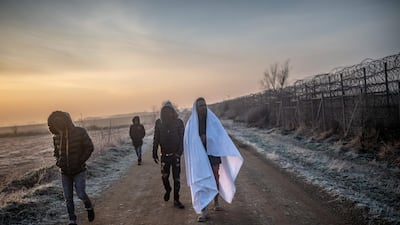
Migrants walk towards the Greek border in Pazarkule, in the Edirne district. Thousands of migrants stuck on the Turkey-Greece border clashed with Greek police. AFP -

Children sit on a beach near Skala Sykamineas on the Greek Lesbos island after crossing the Aegean sea between Turkey and Greece. AFP -
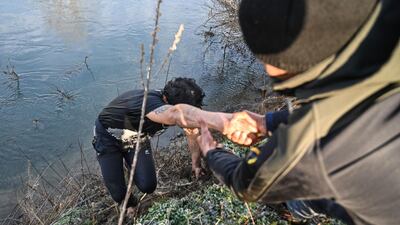
Migrants help each other after an attempt to enter Greece from a location near Edirne, Turkey, by crossing the Maritsa river. AFP -
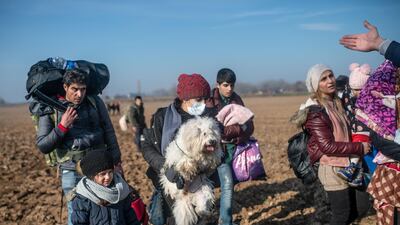
Migrants walk towards the Greek border in Pazarkule, in the Edirne district. AFP -

Migrants on a dinghy cross the Evros river to reach Greece, pictured from the Turkish border city of Edirne, Turkey. Reuters -
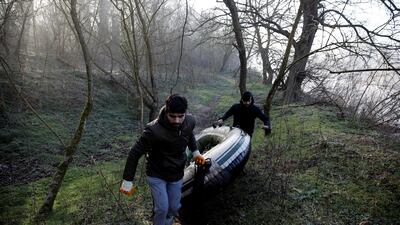
Migrants carry a dinghy to cross the Evros river to reach Greece, pictured near the Turkish border city of Edirne, Turkey. Reuters -
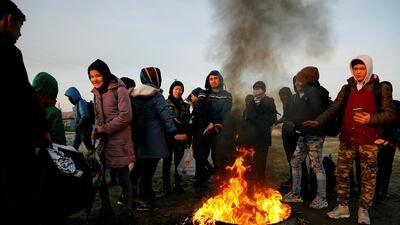
Migrants gather around a fire as they wait to cross the Evros river to reach Greece, near Doyran Village, near the Turkish border city of Edirne, Turkey. Reuters -
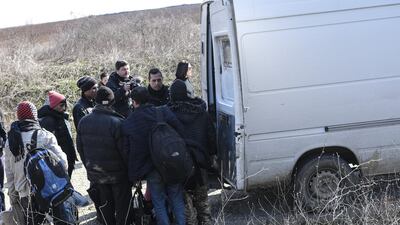
A group of migrants are detained after being caught by police on the side of the highway near the Greek-Turkish border. Getty Images -
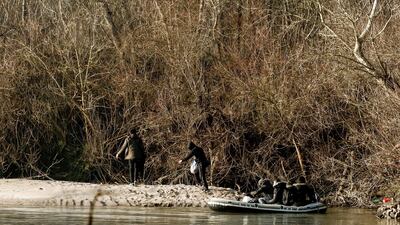
Migrants on a dinghy cross the Evros river and reach Greece, pictured from the Turkish border city of Edirne, Turkey. Reuters -
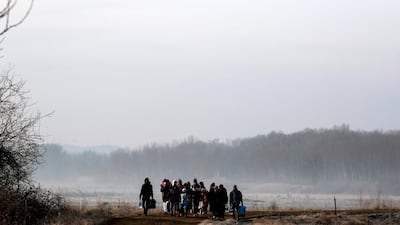
Migrants walk along the Evros river to reach Greece, near the Turkish border city of Edirne, Turkey. Reuters -

Migrants sit waiting near the buffer zone at Turkey-Greece border, at Pazarkule, in Edirne district. AFP -
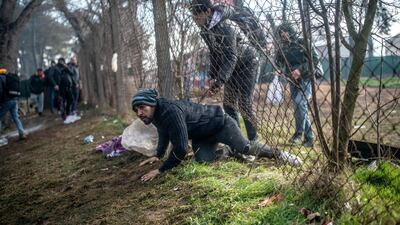
A migrant passes to the buffer zone during clashes with Greek police at the Turkey-Greece border, at Pazarkule, in Edirne distric. Thousands of migrants stuck on the Turkey-Greece border clashed with Greek police. AFP -
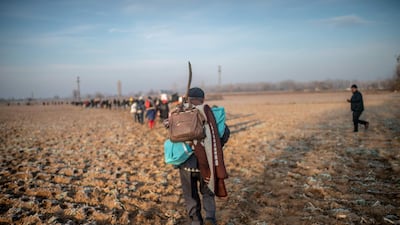
A migrant walk towards the Greek border in Pazarkule, in the Edirne district. AFP


Meanwhile, a notable absentee from the Moscow summit – aside from Mr Al Assad himself – was Iran. The regime in Tehran and Hezbollah, its ally in Lebanon, are knee-deep in Syria’s troubles for a variety of reasons. But both Iran and Lebanon are struggling through deepening crises in their own countries. Their choice today is between staying in Syria and participating in the conflict in a mere auxiliary role, or withdrawing to attend to their domestic problems, ranging from economic crises to mass popular discontent to the outbreak of coronavirus.
Indeed, coronavirus could threaten the fate of Iran’s regime, not only because the ruling clerics there have obstructed the measures necessary to prevent an epidemic, but also because authorities seem to have no system in place to measure how much the virus has spread. As one Iranian told me, the bazaar culture cannot be stopped and quarantines are a strange concept to their culture. So far, controlling the outbreak has proved extremely difficult, and the Iranian leadership might not be able to avert a larger disaster.
It is therefore possible that Iran’s external agenda, especially in Syria but also Iraq and Lebanon, could increasingly take a backseat. However, this does not mean that the Islamic Revolutionary Guard Corps – the regime’s militia – will suspend their operations in the various theatres across the Middle East. And it will not necessarily mean that Iran’s woes could force it to reconsider its policies and respond to US and European calls to renegotiate the nuclear deal and abandon its expansionist ambitions. As I have been told, flexibility is out of the question despite the regime being weighed down by sanctions.
Unfortunately, the policies pursued by all the stakeholders in Syria’s future do not take into consideration the humanitarian crisis. What is distressing about it is, there seems no light at the end of the tunnel for the millions of ordinary civilians.
Raghida Dergham is the founder and executive chairwoman of the Beirut Institute

