Today marks the beginning of one of the most momentous weeks in Abu Dhabi's cultural calendar this year. Our flagship art fair Abu Dhabi Art opens with a pioneering new online approach, and as the world celebrates the Unesco International Day of Tolerance tomorrow, Louvre Abu Dhabi and New York University Abu Dhabi play host to Reframing Museums. This symposium provides the stage for us to re-imagine the future and engage in meaningful dialogue about the critical issues of our time, bringing together an array of speakers and thinkers.
This year, we are celebrating Louvre Abu Dhabi's anniversary in a year like no other. In three short years the museum's achievements have made a remarkable impact on Abu Dhabi's cultural scene; a museum that began as an idea shared by the governments of Abu Dhabi and France is now a beacon for our community and the world.
Its collection continues to grow, bringing together hundreds of artworks and artefacts to tell an inspiring story of humanity’s history. Its building has established a new standard in museum architecture, an approach where the joy and mindfulness of the space itself are an integral part of the experience. And Louvre Abu Dhabi’s team has grown from strength to strength, bringing creative new thinking and deep cultural expertise to craft that offering.
Mohamed Khalifa Al Mubarak, Chairman of the Department of Culture and Tourism - Abu Dhabi. Chris Whiteoak / The National
Louvre Abu Dhabi and the symposium are the living embodiment of the Department of Culture and Tourism – Abu Dhabi's strategy of putting culture at the heart of the emirate's development. Culture offers us the ability to expand our minds and explore our world. A long-term commitment to developing an artistically conscious and creative city is therefore a vital pillar of Abu Dhabi's transition to a diversified, knowledge-driven economy.
Developments such as Louvre Abu Dhabi give our emirate an important voice in today’s global conversations around culture and allow us to be a convener of conversations and a platform for diverse voices. But even more importantly, they are fundamental to Abu Dhabi’s mission to find unity in diversity; to instil understanding and empathy across nationalities, borders and religions; and to make cultural expression in all its forms a key part of our everyday lives.
Nowhere is this clearer than in our vision for Saadiyat Island, which in the coming few years will develop into one of the world's most vibrant destinations.
Alongside Louvre Abu Dhabi and Manarat Al Saadiyat, the Saadiyat Cultural District will be home to arts institutions such as the Zayed National Museum, which is taking shape beautifully and will soon echo the stories of the UAE’s past, present and future, and Guggenheim Abu Dhabi, which empowers artists from all walks of life with a consciously global collection.
An artist's illustration of the Abrahamic Family House to be built on Saadiyat Island in Abu Dhabi. Courtesy Edelman
Saadiyat has also emerged as a regional centre for education and the liberal arts, with our partners at NYU Abu Dhabi producing research, thinking and programming that benefit and inspire the local community as well as students. Saadiyat Island is also developing into a physical manifestation of the UAE's fundamental values of tolerance, mutual understanding and harmonious co-existence, with the Abrahamic Family House – a multi-faith complex.
Each of these developments is underpinned by our vision of welcoming the world to celebrate our similarities and connections, not our differences or divisions. In these unprecedented times, that feeling of interrelatedness – being part of something larger than ourselves – is more important than ever.
The challenges of 2020 have affected us around the world on a personal and collective level. But throughout the uncertainty, I have come to reflect on how inspiringly adaptable, flexible and creative the world has shown itself to be. This year has compelled us to innovate, and we have done so successfully by putting people at the heart of our mission.
Culture plays a critical role in connecting people with one another, uniting us towards a common purpose, bridging inequalities, and uplifting our spirits, and this year’s obstacles have reminded us of that profound role. As a pillar of the Abu Dhabi community, DCT – Abu Dhabi has looked inwards to understand how we can better operate as a vital connector in society and a catalyst to forge mutual understanding.
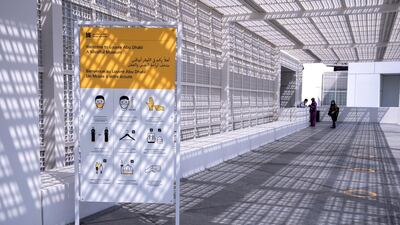
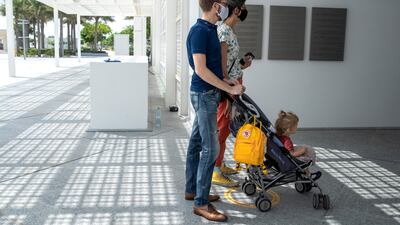
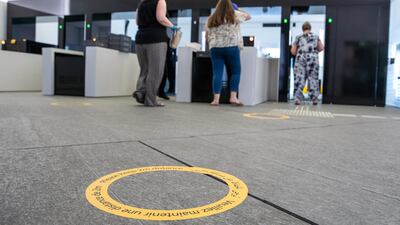
A sign reminding visitors to wear face masks and observe social distancing is seen at Louvre Abu Dhabi, which reopened after 100 days of being temporarily closed due to the Covid-19 pandemic. All photos by Victor Besa / The National
A sign welcoming visitors is seen at the recently reopened Louvre Abu Dhabi.
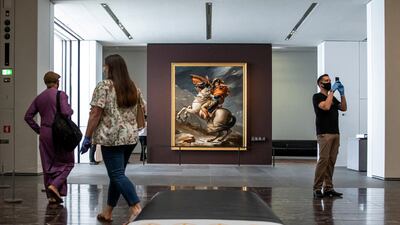
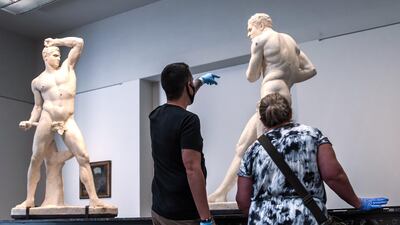
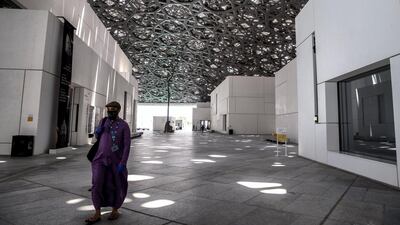
Visitors at the reopened Louvre Abu Dhabi.
Najoua Bour of The Louvre Abu Dhabi welcomes guests to the museum, which was closed for 100 days due to the Covid-19 pandemic.
Visitors at the reopened Louvre Abu Dhabi.
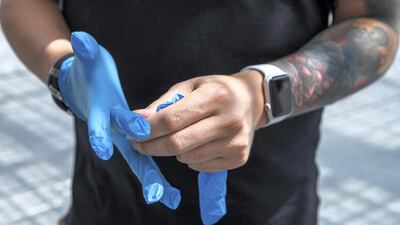
A visitor puts on gloves upon arrival at Louvre Abu Dhabi.
Visitors arrive at Louvre Abu Dhabi.
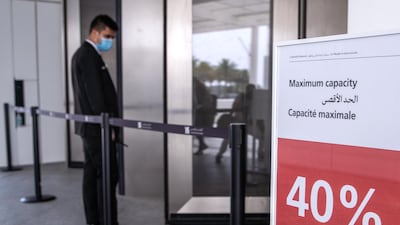
A sign showing the maximum capacity of 40% at the entrance of Louvre Abu Dhabi.
Visitors pass through the security area at Louvre Abu Dhabi.
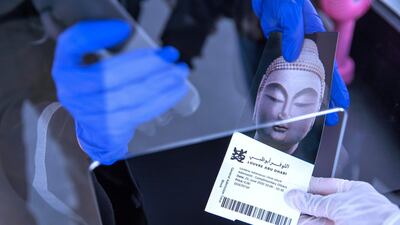
Visitors have their tickets scanned before entering Louvre Abu Dhabi.
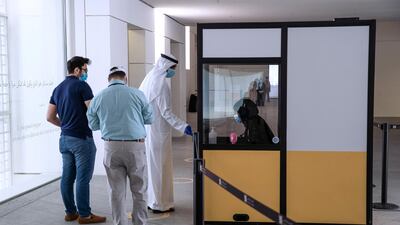
A ticket scanner booth at Louvre Abu Dhabi.
A team member at the ticket scanner booth at Louvre Abu Dhabi.
A ticket being scanned at the booth at Louvre Abu Dhabi.
Louvre Abu Dhabi reopened after 100 days of being temporarily closed due to the Covid-19 pandemic.
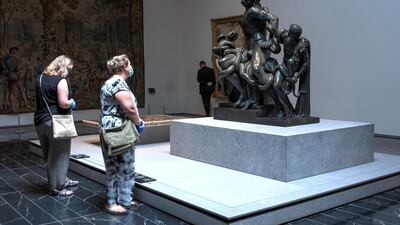
Visitors at the reopened Louvre Abu Dhabi.
Despite the disruption, we never lost sight of the role we play for the people we serve – our community, our employees and our audiences regionally and worldwide – who are, more than ever, at the heart of our efforts.
Granting access to cultural content on virtual channels to 4.5 million visitors is one way we have re-imagined the way we engage with our audiences. But for long-term change and impact, we must play a role in discussing, debating and exploring sustainable solutions for the future.
Abu Dhabi has continuously welcomed communities from all around the globe, acting as a junction point between continents. We take pride in championing our heritage and presenting distinctively local perspectives – in harmony with our diversity, our progressive thinking and our global communities.
Milestone moments like this symposium are the epitome of this cultural balance. Cross-cultural dialogue and understanding quite simply is Louvre Abu Dhabi’s raison d’etre, and more broadly Saadiyat Island’s too.
Abu Dhabi is a place that believes in striving for greatness: challenging ourselves to dream bigger, think differently, and create a new model for the future that we work every day to realise. This belief entails a responsibility to engage actively in dialogue that will help pave the way forward. Through continuous exchange and partnership, we will emerge stronger and better able to shape a collective future for everyone.
Mohamed Khalifa Al Mubarak is Chairman of the Department of Culture and Tourism – Abu Dhabi

The Bio
Name: Lynn Davison
Profession: History teacher at Al Yasmina Academy, Abu Dhabi
Children: She has one son, Casey, 28
Hometown: Pontefract, West Yorkshire in the UK
Favourite book: The Alchemist by Paulo Coelho
Favourite Author: CJ Sansom
Favourite holiday destination: Bali
Favourite food: A Sunday roast
Know your camel milk: Flavour: Similar to goat’s milk, although less pungent. Vaguely sweet with a subtle, salty aftertaste. Texture: Smooth and creamy, with a slightly thinner consistency than cow’s milk. Use it: In your morning coffee, to add flavour to homemade ice cream and milk-heavy desserts, smoothies, spiced camel-milk hot chocolate. Goes well with: chocolate and caramel, saffron, cardamom and cloves. Also works well with honey and dates.
Sector/About: Entrupy is a hardware-enabled SaaS company whose mission is to protect businesses, borders and consumers from transactions involving counterfeit goods.
Initial investment/Investors: Entrupy secured a $2.6m Series A funding round in 2017. The round was led by Tokyo-based Digital Garage and Daiwa Securities Group's jointly established venture arm, DG Lab Fund I Investment Limited Partnership, along with Zach Coelius.
Total customers: Entrupy’s customers include hundreds of secondary resellers, marketplaces and other retail organisations around the world. They are also testing with shipping companies as well as customs agencies to stop fake items from reaching the market in the first place.
The company offers payments/bribes to win key contracts in the Middle East
May 2017
The UK SFO officially opens investigation into Petrofac’s use of agents, corruption, and potential bribery to secure contracts
September 2021
Petrofac pleads guilty to seven counts of failing to prevent bribery under the UK Bribery Act
October 2021
Court fines Petrofac £77 million for bribery. Former executive receives a two-year suspended sentence
December 2024
Petrofac enters into comprehensive restructuring to strengthen the financial position of the group
May 2025
The High Court of England and Wales approves the company’s restructuring plan
July 2025
The Court of Appeal issues a judgment challenging parts of the restructuring plan
August 2025
Petrofac issues a business update to execute the restructuring and confirms it will appeal the Court of Appeal decision
October 2025
Petrofac loses a major TenneT offshore wind contract worth €13 billion. Holding company files for administration in the UK. Petrofac delisted from the London Stock Exchange
A fuel tax protest by French drivers appealed to wider anti-government sentiment
Unlike previous French demonstrations there was no trade union or organised movement involved
Demonstrators responded to online petitions and flooded squares to block traffic
At its height there were almost 300,000 on the streets in support
Named after the high visibility jackets that drivers must keep in cars
Clashes soon turned violent as thousands fought with police at cordons
An estimated two dozen people lost eyes and many others were admitted to hospital
Washmen Profile
Date Started: May 2015
Founders: Rami Shaar and Jad Halaoui
Based: Dubai, UAE
Sector: Laundry
Employees: 170
Funding: about $8m
Funders: Addventure, B&Y Partners, Clara Ventures, Cedar Mundi Partners, Henkel Ventures
Tailors and retailers miss out on back-to-school rush
Tailors and retailers across the city said it was an ominous start to what is usually a busy season for sales.
With many parents opting to continue home learning for their children, the usual rush to buy school uniforms was muted this year.
“So far we have taken about 70 to 80 orders for items like shirts and trousers,” said Vikram Attrai, manager at Stallion Bespoke Tailors in Dubai.
“Last year in the same period we had about 200 orders and lots of demand.
“We custom fit uniform pieces and use materials such as cotton, wool and cashmere.
“Depending on size, a white shirt with logo is priced at about Dh100 to Dh150 and shorts, trousers, skirts and dresses cost between Dh150 to Dh250 a piece.”
A spokesman for Threads, a uniform shop based in Times Square Centre Dubai, said customer footfall had slowed down dramatically over the past few months.
“Now parents have the option to keep children doing online learning they don’t need uniforms so it has quietened down.”
Investors: Palestine’s Ibtikar Fund, Abu Dhabi’s Gothams and angel investors
1,000 Books to Read Before You Die: A Life-Changing List
James Mustich, Workman
THE BIO
Favourite car: Koenigsegg Agera RS or Renault Trezor concept car.
Favourite book:I Am Pilgrim by Terry Hayes or Red Notice by Bill Browder.
Biggest inspiration: My husband Nik. He really got me through a lot with his positivity.
Favourite holiday destination: Being at home in Australia, as I travel all over the world for work. It’s great to just hang out with my husband and family.
How to apply for a drone permit
Individuals must register on UAE Drone app or website using their UAE Pass
Add all their personal details, including name, nationality, passport number, Emiratis ID, email and phone number
Upload the training certificate from a centre accredited by the GCAA
Submit their request
What are the regulations?
Fly it within visual line of sight
Never over populated areas
Ensure maximum flying height of 400 feet (122 metres) above ground level is not crossed
Users must avoid flying over restricted areas listed on the UAE Drone app
Only fly the drone during the day, and never at night
Trans fat is typically found in fried and baked goods, but you may be consuming more than you think.
Powdered coffee creamer, microwave popcorn and virtually anything processed with a crust is likely to contain it, as this guide from Mayo Clinic outlines:
Baked goods - Most cakes, cookies, pie crusts and crackers contain shortening, which is usually made from partially hydrogenated vegetable oil. Ready-made frosting is another source of trans fat.
Snacks - Potato, corn and tortilla chips often contain trans fat. And while popcorn can be a healthy snack, many types of packaged or microwave popcorn use trans fat to help cook or flavour the popcorn.
Fried food - Foods that require deep frying — french fries, doughnuts and fried chicken — can contain trans fat from the oil used in the cooking process.
Refrigerator dough - Products such as canned biscuits and cinnamon rolls often contain trans fat, as do frozen pizza crusts.
Creamer and margarine - Nondairy coffee creamer and stick margarines also may contain partially hydrogenated vegetable oils.
HAEMOGLOBIN DISORDERS EXPLAINED
Thalassaemia is part of a family of genetic conditions affecting the blood known as haemoglobin disorders.
Haemoglobin is a substance in the red blood cells that carries oxygen and a lack of it triggers anemia, leaving patients very weak, short of breath and pale.
The most severe type of the condition is typically inherited when both parents are carriers. Those patients often require regular blood transfusions - about 450 of the UAE's 2,000 thalassaemia patients - though frequent transfusions can lead to too much iron in the body and heart and liver problems.
The condition mainly affects people of Mediterranean, South Asian, South-East Asian and Middle Eastern origin. Saudi Arabia recorded 45,892 cases of carriers between 2004 and 2014.
A World Health Organisation study estimated that globally there are at least 950,000 'new carrier couples' every year and annually there are 1.33 million at-risk pregnancies.
What can victims do?
Always use only regulated platforms
Stop all transactions and communication on suspicion
Save all evidence (screenshots, chat logs, transaction IDs)