
When Saddam Hussein gave the order for Iraqi forces to enter Kuwait on August 1, 1990, he set off a chain of diplomatic, military and economic responses. The result was a decade-long peak of US presence and influence in the Middle East. In most respects, it was a period of positive accomplishments for the US and its regional partners.
Hussein thought he could get away with grabbing Kuwait and intimidating other governments on the Arabian Peninsula. This would have secured his ambitions for regional leadership and an influential role on the world stage.
-

Picture taken on August 14, 1990 at Ruwaished showing Arab refugees from different countries waiting for the permission to return to their homelands at the Iraq-Jordan border checkpoint as thousands of foreigners flee the war in Iraq and Kuwait. AFP -
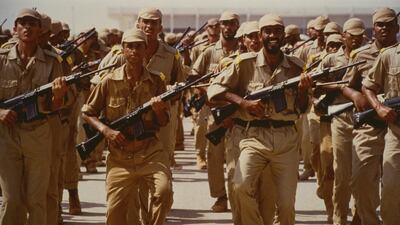
August 1990: A training camp for new recruits in the United Arab Emirates, following the country's appeal for servicemen on the 11th August 1990, during the Gulf Crisis. Getty -
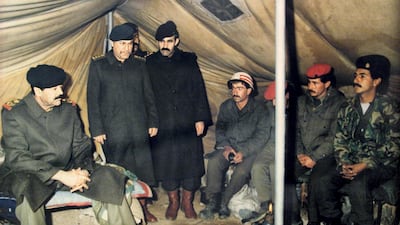
A reproduction of a picture displayed at the Nasr or Victory Museum in Baghdad shows Iraqi President Saddam Hussein (L) visiting Iraqi troops at a military camp in occupied territory in Kuwait after the August 2, 1990 invasion of the Gulf emirate. Getty -

The Emir of Kuwait Jaber Al Sabah (R) walks with Egyptian President Hosni Mubarak 9 August 1990 upon his arrival for the emergency Arab Summit to discuss Iraq's invasion of Kuwait and the worsening situation. AFP -
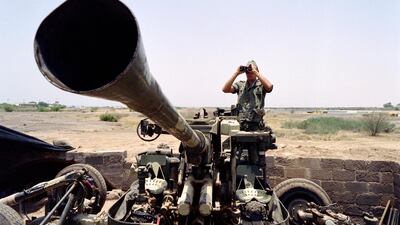
A French soldier looks through binoculars as he mans an anti-craft gun near Djibouti airport, on August 20, 1990, as French army was deployed in the Persian Gulf since Iraq's invasion of Kuwait on August 02, 1990, leading to a conflict between Iraq and Kuwait and an international military intervention. AFP -
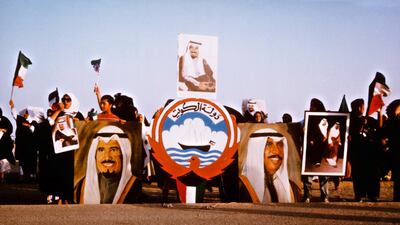
A demonstration in Kuwait, following the country's invasion by Iraq at the start of the Gulf War, 4th-6th August 1990. In the centre is the Emblem of Kuwait, adopted in 1962. Getty -
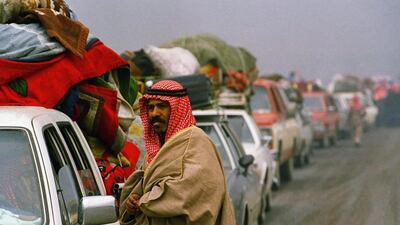
A Kuwaiti refugee stands beside his car outside Kuwait City after Iraq invaded 30 years ago. Scott Applewhite / AP


His miscalculations cost the Iraqi people dearly. Bad judgment was only part of the problem. A dictator with minimal exposure to world politics, he was misled by circumstances that seemed to invite him to take a gamble with great potential payoff.
Following its eight-year war with Iran, Iraq calculated that a much smaller and weaker adversary would be an easy target. His hubris was bolstered by a common belief that Saudi Arabia would not invite western forces onto its territory. Hussein expected that divisions among the GCC states could paralyse their response.
The summer of 1990 was a time when the US’s willingness to play an assertive strategic role in the Middle East was in great doubt. Memories of Vietnam and Lebanon, where American forces had suffered defeats and setbacks, were fresh, and popular opinion in the US was hostile to military ventures abroad.
Washington had taken on significant strategic responsibilities in the Gulf during the final years of the Iraq-Iran War by protecting commercial shipping from Iranian attacks. Operation Earnest Will, as the effort was known, was an assertion of US power that involved strategic interaction with members of the GCC.
Earnest Will was unprecedented, but it did not commit the US or any of the GCC countries to future military co-operation. Indeed, the US military presence in the region declined considerably in the following years, and by 1990, there were only a few small naval warships in the Gulf. US President George H W Bush was widely if incorrectly viewed as indecisive, and his freedom of action to commit US military force was constrained by political opponents in Congress.
Starting in May 1990, I was a Deputy Assistant Secretary of State with responsibility for Washington’s relations with all of the Arab states east of Egypt, plus Iran. Having served in Iraq for two assignments, I understood Iraqi capabilities and resentments of the relative per-capita wealth of its Arab neighbours. I knew Saddam Hussein was ruthless and ambitious.
-
-
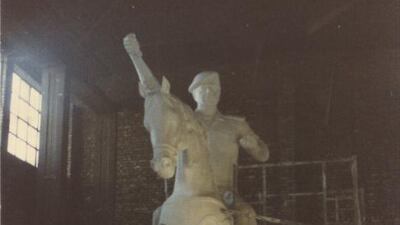
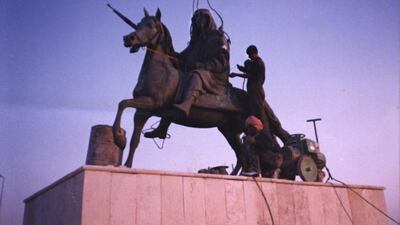
Saddam Hussein on a horse at the bronze foundry in Baghdad in 1998. The 10-metre high statue was placed one in Tikrit, another was put on the Boarder of Iraq and Jordan, an area called Trebil. Courtesy Natiq Al Alousi -
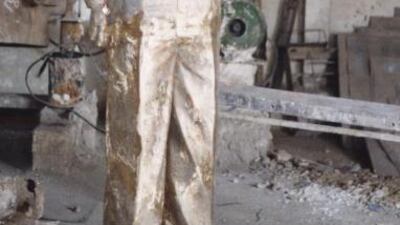
Statue for a Martyr at Natiq al Alousi’s workshop in Baghdad in 2000. Courtesy Natiq Al Alousi -
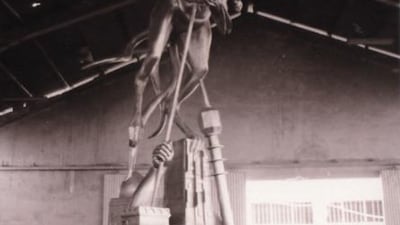
The Last Aggression Monument, for the Presidential Site in North Tikrit, in Natiq Al Alousi’s workshop in 1999. Courtesy Natiq Al Alousi -
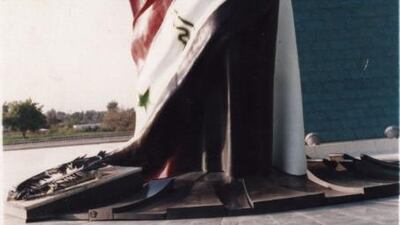
The 8-metre Statue of Iraq’s Flag for The Martyrs Memorial “Al Shaheed Monument�. The Monument was dedicated to the Iraqi soldiers who died in the Iran-Iraq war and opened in 1983, Al Alousi’s flag was placed in 1999. Courtesy Natiq Al Alousi -
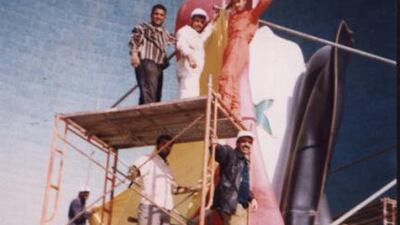
Natiq Al Alousi, bottom left, white hat, jeans and dark jacket, with the Statue of Iraq’s Flag for The Martyrs Memorial prior to its placing at Al Shaheed Monument on the East Side of the Tigris River. Courtesy Natiq Al Alousi -

From left, Taha Wohayib, Natiq Al Alousi and Anas Al Alousi in 1998 at the Bronze Foundry in Baghdad. Courtesy Natiq Al Alousi -
-
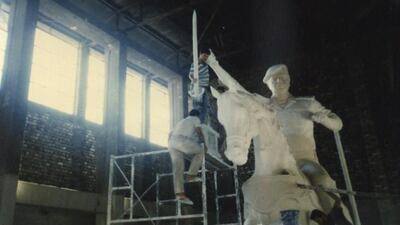
Laith Al Bayati (wearing white) and Anas Al Alousi (holding the sword) at the Bronze Foundry in Baghdad in 1998. Courtesy Natiq Al Alousi -

Saddam Hussein on a horse being placed at the town of Tharthar in the late 1990s. Courtesy Natiq Al Alousi


After three years as the US Ambassador to the UAE from 1986-1989, I was also aware of the military vulnerabilities of the GCC states at the time. Kuwait had made it clear that it preferred to minimise military co-operation with Washington, to the point that it did not welcome port calls by US Navy ships. Other Arab governments told us that the only way to deal with Saddam Hussein was through Arab diplomacy, and many had rebuffed our suggestions for consultations regarding a potential threat from Iraq.
When Iraq made public threats against Kuwait and the Emirates on July 17, 1990, the US privately warned top Iraqi officials of the consequences. At the same time, we publicly declared that we would protect our vital interests in the Gulf and were prepared to do so in co-operation with our “longstanding friends” – referring particularly to the GCC.
With one exception, the governments of the Middle East did not respond to our offer. The exception was the UAE. We began a joint military exercise with Emirati forces to protect UAE offshore oil facilities. This got Hussein’s attention, but it was far afield from Iraq. Meanwhile, neighbouring countries such as Saudi Arabia and Kuwait were avoiding the appearance of closeness with the US, and so Hussein figured we were bluffing.
In the end, Hussein’s calculations proved false. President Bush declared that the Iraqi occupation of Kuwait would not stand, and the US gained strong support for economic sanctions from the UN and countries around the world. The governments of the GCC all engaged in military co-operation with the US, along with our other strategic partners. After initial reservations, the US Congress supported the deployment of half a million US military personnel to expel Iraqi forces from Kuwait.
Drawing upon the success of Operation Desert Storm, as the US intervention was known, Mr Bush then turned his attention to economic co-operation with GCC states and to the Arab-Israeli dispute. The Madrid Conference launched a promising decade of peace-making. US prestige in the region was never so high.
What are the lessons?
Deterrence by GCC states against an external threat is strongest when they work together and with the US. Mutual interests will draw the US closer to countries that have different cultures and different politics. Co-operation will require persistent attention to those relations and respect for the views of those governments. The outcome of the mostly unilateral US invasion of Iraq in 2003 and the collapse of the peace process between Israel and the Palestinians show that the influence of Washington on events in the region fails without partnerships and careful diplomacy. Reckless leadership, whether by a regional actor or by US decision makers, can exact a heavy price.
David Mack is a Nonresident Senior Fellow at Atlantic Council, a former US Ambassador to UAE and a senior diplomat in Iraq, Jordan, Jerusalem, Libya, Lebanon, Saudi Arabia and Tunisia

