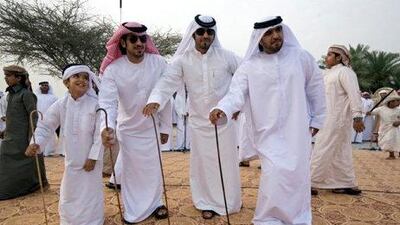
In the past few months, following the spread of coronavirus, we have seen Emiratis return to a tradition common in the 1970s and even earlier. In light of the pandemic, authorities restricted the number of people who could gather socially, leading many Emiratis to opt for smaller and simpler weddings.
This spared many newly-wed couples of the burden of high costs, and at times loans which Emirati men sometimes take on in order to pay for the exorbitant cost of ceremonies. In the past, I have known people to sell their cars to cover lavish wedding celebrations. But the new circumstances of Covid-19 have brought a welcome shift in expectations in Emirati society.
Simple weddings grew more frequent primarily due to the closure of wedding halls. Many had their weddings at home instead, with a limited number of guests – as required by the law, to help counter the pandemic.
Five of my Emirati friends have gotten married during this time. A few of them used the money they would have spent on arrangements for other important plans, such as paying for their homes.
Previously, a typical wedding could see 500 to 600 guests in attendance. In the pandemic era, when laws have allowed, they have taken place at home, with a handful of attendees comprised of close friends and relatives. Some have performed virtual weddings – an altogether new phenomenon. Besides a more intimate atmosphere, the condensed guest list also results in less waste of food and decorations. It is an outcome one can only hope becomes the norm once Covid-19 is behind us.
The UAE government has supported the new approach, and called upon the country's youth to maintain this modest and forward-looking approach. Pandemic-era weddings have become a golden chance for couples to begin their married lives free of debt.
The high cost of weddings is, in fact, a major reason why marriages are sometimes delayed in the UAE. Couples like to save a bit so they can splurge on their big day. The government has taken various initiatives over the years to stem the scale and expense of matrimony, but lavish weddings have been the norm over the past couple of decades.
Why does such a tradition persist among Emiratis, despite its evident downside? To answer that, it is worth asking what tradition really is.
We know it as set of beliefs and rituals passed on from one generation to the next. People follow these beliefs to differentiate themselves from other cultures and nationalities, to mark their identities. But traditions can change.
In the 1950s and 1960s, wedding culture was completely different from what we see today. My mother recalls that during her childhood, weddings took place at the bride’s house in the afternoons and were attended only by close relatives and friends. Wedding costs were reasonable. And instead of expensive gifts, the bride and groom sought the blessings of their elders.
But a lot has changed since those days. The union of the seven emirates in 1971 brought economic progress to the country and exposure to different cultures. Emiratis' lifestyles also changed. Ceremonies were no longer held at the bride’s house, but rather in wedding halls.
The “kosha”, or wedding stage, with a chair and decorations used for three to four hours, can range from Dh50,000 to Dh80,000, according to a wedding planner I spoke to. The cost of the ceremony itself can average at Dh300,000, leaving many newlyweds in debt during the early years of their married life.
"I preferred to have a simple wedding with my close friends and cousins but my mother refused, saying that people will judge our choice"
Unfortunately, when you ask some newlyweds about their decision to have sumptuous celebrations, they say it is not their choice but rather the wish of their families.
A friend of mine told me: “I preferred to have a simple ceremony with my close friends and cousins but my mother refused, saying that people will judge our choice." My friend's mother apparently told her: "This is our tradition and we cannot let go of our traditions.” Her newly formed family is still in debt – three years after the big day. This makes me wonder, when will we stop following precedents that do not benefit us, but rather set us back financially for years?
One of the rare positive outcomes of the Covid-19 restrictions is that I have seen families experience the joy of simple and small weddings attended by only their loved ones. They spared themselves the cost of inviting more than 500 people, some of whom the bride and groom sometimes do not even know.
Wedding traditions can change once again, as they have in the past. And if the pandemic can serve as a wake-up call, then so be it.
Roudha Al Shehhi is an Emirati researcher focusing on UAE's bilateral relations

UAE tour of the Netherlands
UAE squad: Rohan Mustafa (captain), Shaiman Anwar, Ghulam Shabber, Mohammed Qasim, Rameez Shahzad, Mohammed Usman, Adnan Mufti, Chirag Suri, Ahmed Raza, Imran Haider, Mohammed Naveed, Amjad Javed, Zahoor Khan, Qadeer Ahmed
Fixtures and results:
Monday, UAE won by three wickets
Wednesday, 2nd 50-over match
Thursday, 3rd 50-over match
How to donate
Send “thenational” to the following numbers or call the hotline on: 0502955999
2289 – Dh10
2252 – Dh 50
6025 – Dh20
6027 – Dh 100
6026 – Dh 200
Basquiat in Abu Dhabi
One of Basquiat’s paintings, the vibrant Cabra (1981–82), now hangs in Louvre Abu Dhabi temporarily, on loan from the Guggenheim Abu Dhabi.
The latter museum is not open physically, but has assembled a collection and puts together a series of events called Talking Art, such as this discussion, moderated by writer Chaedria LaBouvier.
It's something of a Basquiat season in Abu Dhabi at the moment. Last week, The Radiant Child, a documentary on Basquiat was shown at Manarat Al Saadiyat, and tonight (April 18) the Guggenheim Abu Dhabi is throwing the re-creation of a party tonight, of the legendary Canal Zone party thrown in 1979, which epitomised the collaborative scene of the time. It was at Canal Zone that Basquiat met prominent members of the art world and moved from unknown graffiti artist into someone in the spotlight.
“We’ve invited local resident arists, we’ll have spray cans at the ready,” says curator Maisa Al Qassemi of the Guggenheim Abu Dhabi.
Guggenheim Abu Dhabi's Canal Zone Remix is at Manarat Al Saadiyat, Thursday April 18, from 8pm. Free entry to all. Basquiat's Cabra is on view at Louvre Abu Dhabi until October
Retail gloom
Online grocer Ocado revealed retail sales fell 5.7 per cen in its first quarter as customers switched back to pre-pandemic shopping patterns.
It was a tough comparison from a year earlier, when the UK was in lockdown, but on a two-year basis its retail division, a joint venture with Marks&Spencer, rose 31.7 per cent over the quarter.
The group added that a 15 per cent drop in customer basket size offset an 11.6. per cent rise in the number of customer transactions.
Will the pound fall to parity with the dollar?
The idea of pound parity now seems less far-fetched as the risk grows that Britain may split away from the European Union without a deal.
Rupert Harrison, a fund manager at BlackRock, sees the risk of it falling to trade level with the dollar on a no-deal Brexit. The view echoes Morgan Stanley’s recent forecast that the currency can plunge toward $1 (Dh3.67) on such an outcome. That isn’t the majority view yet – a Bloomberg survey this month estimated the pound will slide to $1.10 should the UK exit the bloc without an agreement.
New Prime Minister Boris Johnson has repeatedly said that Britain will leave the EU on the October 31 deadline with or without an agreement, fuelling concern the nation is headed for a disorderly departure and fanning pessimism toward the pound. Sterling has fallen more than 7 per cent in the past three months, the worst performance among major developed-market currencies.
“The pound is at a much lower level now but I still think a no-deal exit would lead to significant volatility and we could be testing parity on a really bad outcome,” said Mr Harrison, who manages more than $10 billion in assets at BlackRock. “We will see this game of chicken continue through August and that’s likely negative for sterling,” he said about the deadlocked Brexit talks.
The pound fell 0.8 per cent to $1.2033 on Friday, its weakest closing level since the 1980s, after a report on the second quarter showed the UK economy shrank for the first time in six years. The data means it is likely the Bank of England will cut interest rates, according to Mizuho Bank.
The BOE said in November that the currency could fall even below $1 in an analysis on possible worst-case Brexit scenarios. Options-based calculations showed around a 6.4 per cent chance of pound-dollar parity in the next one year, markedly higher than 0.2 per cent in early March when prospects of a no-deal outcome were seemingly off the table.
Bloomberg
COMPANY%20PROFILE
%3Cp%3E%3Cstrong%3ECompany%20name%3A%3C%2Fstrong%3E%20Alaan%3Cbr%3E%3Cstrong%3EStarted%3A%3C%2Fstrong%3E%202021%3Cbr%3E%3Cstrong%3EBased%3A%3C%2Fstrong%3E%20Dubai%3Cbr%3E%3Cstrong%3EFounders%3A%3C%2Fstrong%3E%20Parthi%20Duraisamy%20and%20Karun%20Kurien%3Cbr%3E%3Cstrong%3ESector%3A%3C%2Fstrong%3E%20FinTech%3Cbr%3E%3Cstrong%3EInvestment%20stage%3A%3C%2Fstrong%3E%20%247%20million%20raised%20in%20total%20%E2%80%94%20%242.5%20million%20in%20a%20seed%20round%20and%20%244.5%20million%20in%20a%20pre-series%20A%20round%3Cbr%3E%3Cbr%3E%3C%2Fp%3E%0A
Our legal consultant
Name: Hassan Mohsen Elhais
Position: legal consultant with Al Rowaad Advocates and Legal Consultants
UAE currency: the story behind the money in your pockets
Profile of VoucherSkout
Date of launch: November 2016
Founder: David Tobias
Based: Jumeirah Lake Towers
Sector: Technology
Size: 18 employees
Stage: Embarking on a Series A round to raise $5 million in the first quarter of 2019 with a 20 per cent stake
Investors: Seed round was self-funded with “millions of dollars”
Overview
What: The Arab Women’s Sports Tournament is a biennial multisport event exclusively for Arab women athletes.
When: From Sunday, February 2, to Wednesday, February 12.
Where: At 13 different centres across Sharjah.
Disciplines: Athletics, archery, basketball, fencing, Karate, table tennis, shooting (rifle and pistol), show jumping and volleyball.
Participating countries: Algeria, Bahrain, Comoros, Egypt, Iraq, Jordan, Kuwait, Lebanon, Libya, Morocco, Oman, Palestine, Saudi Arabia, Sudan, Syria, Tunisia, Qatar and UAE.
WITHIN%20SAND
%3Cp%3EDirector%3A%20Moe%20Alatawi%3C%2Fp%3E%0A%3Cp%3EStarring%3A%20Ra%E2%80%99ed%20Alshammari%2C%20Adwa%20Fahd%2C%20Muhand%20Alsaleh%3C%2Fp%3E%0A%3Cp%3ERating%3A%203%2F5%3C%2Fp%3E%0A
Sugary teas and iced coffees
The tax authority is yet to release a list of the taxed products, but it appears likely that sugary iced teas and cold coffees will be hit.
For instance, the non-fizzy drink AriZona Iced Tea contains 65 grams of sugar – about 16 teaspoons – per 680ml can. The average can costs about Dh6, which would rise to Dh9.
Cold coffee brands are likely to be hit too. Drinks such as Starbucks Bottled Mocha Frappuccino contain 31g of sugar in 270ml, while Nescafe Mocha in a can contains 15.6g of sugar in a 240ml can.
