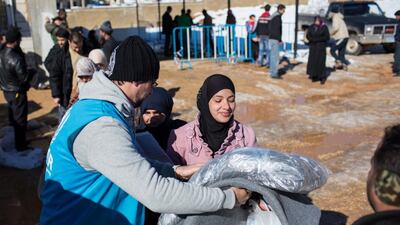
Syrian refugees in Lebanon. We need to find a new language, a world view and the tools to create the words that talks about the poor, the sick and crisis survivors as the owners of their fate. UNHCR

The damage aid workers can do – with just their words


  • English
  • Arabic

Try getting through this paragraph without becoming bored or confused:

“Our humanitarian field operations have focused on high-impact, cost-effective implementation of activities through local partners. We have provided the target population with platforms to empower our beneficiaries – particularly women, children, and other vulnerable groups – and provide them with sustainable and scalable solutions to build resilience and preserve dignity. Through the deployment of teams of expatriate staff to the front lines, our humanitarian operation allowed us to effectively address the needs and raise awareness, giving voice to the voiceless victims while building the capacity of local actors.”

If you work in the humanitarian sector, you could read through it without batting an eyelid. At first glance, it might sound like something (not particularly well-written) one finds in a report posted on a humanitarian or development organisation’s website. In this case, I invented it to illustrate a point.

The problem is not just the displeasure you experience trying to wade through the syntax. It’s what lies beyond the words – what they tell us both about humanitarians and, ultimately, the current state of humanitarian aid.

The obvious disclaimer here is that this view is neither a judgement on the character of any given humanitarian worker – I am one of them – nor a cliched “call to action” about humanitarian language (though by all means, feel free to act). It is, rather, an interrogation of the way humanitarianism teaches us to think, and what lurks beneath its surface.

The mid-20th century Martinique political philosopher Frantz Fanon once wrote about the effect of language: “To speak means to be in a position to use a certain syntax, to grasp the morphology of this or that language, but it means above all to assume a culture, to support the weight of a civilisation.”

Like every discipline, humanitarianism has developed its own language and imagery that reflects not only the means to communicate among its practitioners, but also its conception of the world and how it understands, and hence behaves, in it.

This language of humanitarianism is hardly static. It evolves with the changing contexts in which humanitarian action takes place, the pressures of donors and benefactors and the social and cultural norms of the societies – usually in the West – where those organisations are based and where western narratives are most important.

Despite the evolution, however, the abstractions, jargon, and acronyms so common to humanitarian-speak still aim for, and manage to achieve, several things.

First, it defines the field of action, humanitarianism, and draws its parameters, principles, and tactics; second, it justifies and moralises the act itself and asserts the legitimacy of its existence and consequences; and third, it sustains the power, worldview, and future of those who control the narrative.

'To speak means to assume a culture,' the political philosopher Frantz Fanon once wrote. Humanitarianism, like other disciplines, has developed its own language that reflects its conception of the world. AFP

Those goals are not explicit, that is to say they are not written in formal documents or articulated in strategic plans. They, however, can be discerned from the use of the language itself.

In my own attempt to resolve my long-standing discomfort with the language I was using every day, I posted a Tweet last month asking for words or expressions that we humanitarians use regularly but are inappropriate.

To my surprise, many answers came, and the objectionable words and phrases spanned beyond the obvious. The full list is too long to include here. However, some of them remain, and are difficult to excise from our daily professional lives. Others are widely agreed to be unacceptable now or because they are emerging as such influenced with a renewed debate about the asymmetries of power in the humanitarian sector.

Those include "beneficiaries" to describe people who receive aid in emergencies, "capacity building" as a main NGO activity, "target population", "speaking out on behalf of...", "vulnerability" (especially in formulations like "women, children, and other vulnerable groups"), "resilience" as something that can be built in communities by external actors. It even includes some of what are considered fundamental principles, such as “neutrality” or the word “humanitarian” itself.

And yet, all of these words linger.

While it is optimistic to see the changes that are gradually happening to humanitarian language and the way this has been raised into collective awareness, the road to moving humanitarian action away from its still-dominant Eurocentric view of the world is just beginning. Writing glossaries of more appropriate terms to use in communication is one step. But what language tells us about power hierarchies is far more interesting because it gives a window to the current state of humanitarian action, as well as its possible futures.

A Palestinian walks past a ceramic sign of a USAID project in Hebron in the West Bank in 2019. Reuters

For a humanitarian to exist and to be justified, his or her opposite – a beneficiary – is necessary. As the French philosopher Jacques Derrida once wrote, a concept is implicit in its opposite, and one cannot exist without the other.

For the humanitarian – a person defined by their highest moral impulse being to help others – the beneficiary has to exist as a helpless person with little agency, who is defined not by their communal or individual attributes, but rather their benefit from the moral action of the humanitarian.

There are plenty of other problematic oppositions: developing/developed, resilient/vulnerable, donor/recipient, and international/local. None of those is neutral or free from value judgement. They are based on generalisations and stereotypes, and all of them, as they are used today, assert the existing powers and their resistance to change.

Glossaries and style guides are unlikely in themselves to ever change the culture and power hierarchies that hide behind the language. But they are still a necessary step in going forward.

Edward Said in 2001. The Palestinian scholar wrote ‘Orientalism’, a critique of European perceptions. Getty
Edward Said once argued that the orientalist invents an oriental that only exists in their mind

As we have seen in growing social justice and solidarity movements concerned with racial and gender-based discrimination, the change of terms by those they dehumanise or oppress is being accepted as a necessary step in allowing people to assert their own self-perception. It also sets a threshold for response, by daring everyone else to recognise the imbalance and correct it.

Moreover, just like the Palestinian scholar Edward Said once argued that the orientalist invents an oriental that only exists in their mind rather than in reality, the humanitarian who accepts the narrative of a beneficiary without a say or agency, without knowledge or will, is prone to go to the "field" and act as if they are the only one with knowledge, will, or benevolence. In doing so, they further disempowering the very people they are meant to aid.

Forty years ago, the African-American writer and civil rights activist Audre Lorde, in talking about the lack of representation of people like her in society’s wider conversations reminded us that “the master’s tool will never dismantle the master’s house”. We need to find a new language, a world view and the tools to create the words that talk about the poor, the sick and crisis survivors as the owners of their fate, rather than an inconvenience that has to be overcome in the grand humanitarian narrative. It will not be simple to achieve, but then, no one should expect humanitarianism to be a simple matter.

Dr Tammam Aloudat is a Syrian physician and a senior strategic adviser to MSF in Geneva

Results

6.30pm: Mazrat Al Ruwayah – Group 2 (PA) $36,000 (Dirt) 1,600m, Winner: RB Money To Burn, Tadhg O’Shea (jockey), Eric Lemartinel (trainer)

7.05pm: Handicap (TB) $68,000 (Turf) 2,410m, Winner: Star Safari, William Buick, Charlie Appleby

7.40pm: Meydan Trophy – Conditions (TB) $50,000 (T) 1,900m, Winner: Secret Protector, William Buick, Charlie Appleby

8.15pm: Al Maktoum Challenge Round 2 - Group 2 (TB) $293,000 (D) 1,900m, Winner: Salute The Soldier, Adrie de Vries, Fawzi Nass

8.50pm: Al Rashidiya – Group 2 (TB) $163,000 (T) 1,800m, Winner: Zakouski, William Buick, Charlie Appleby

9.25pm: Handicap (TB) $65,000 (T) 1,000m, Winner: Motafaawit, Sam Hitchcock, Doug Watson

Blonde
%3Cp%3E%3Cstrong%3EDirector%3A%20%3C%2Fstrong%3EAndrew%20Dominik%3Cbr%3E%3Cstrong%3EStars%3A%20%3C%2Fstrong%3EAna%20de%20Armas%2C%20Adrien%20Brody%2C%20Bobby%20Cannavale%3Cbr%3E%3Cstrong%3ERating%3A%20%3C%2Fstrong%3E3%2F5%3Cbr%3E%3C%2Fp%3E%0A
Cinco in numbers

Dh3.7 million

The estimated cost of Victoria Swarovski’s gem-encrusted Michael Cinco wedding gown

46

The number, in kilograms, that Swarovski’s wedding gown weighed.

1,000

The hours it took to create Cinco’s vermillion petal gown, as seen in his atelier [note, is the one he’s playing with in the corner of a room]

50

How many looks Cinco has created in a new collection to celebrate Ballet Philippines’ 50th birthday

3,000

The hours needed to create the butterfly gown worn by Aishwarya Rai to the 2018 Cannes Film Festival.

1.1 million

The number of followers that Michael Cinco’s Instagram account has garnered.

The past winners

2009 - Sebastian Vettel (Red Bull)

2010 - Sebastian Vettel (Red Bull)

2011 - Lewis Hamilton (McLaren)

2012 - Kimi Raikkonen (Lotus)

2013 - Sebastian Vettel (Red Bull)

2014 - Lewis Hamilton (Mercedes)

2015 - Nico Rosberg (Mercedes)

2016 - Lewis Hamilton (Mercedes)

2017 - Valtteri Bottas (Mercedes)

The Birkin bag is made by Hermès. 
It is named after actress and singer Jane Birkin
Noone from Hermès will go on record to say how much a new Birkin costs, how long one would have to wait to get one, and how many bags are actually made each year.

Who's who in Yemen conflict

Houthis: Iran-backed rebels who occupy Sanaa and run unrecognised government

Yemeni government: Exiled government in Aden led by eight-member Presidential Leadership Council

Southern Transitional Council: Faction in Yemeni government that seeks autonomy for the south

Habrish 'rebels': Tribal-backed forces feuding with STC over control of oil in government territory

'Nope'
%3Cp%3E%3Cstrong%3EDirector%3A%3C%2Fstrong%3E%20Jordan%20Peele%0D%3Cbr%3E%3Cstrong%3EStars%3A%3C%2Fstrong%3E%20Daniel%20Kaluuya%2C%20Keke%20Palmer%2C%20Brandon%20Perea%2C%20Steven%20Yeun%0D%3Cbr%3E%3Cstrong%3ERating%3A%3C%2Fstrong%3E%203.5%2F5%3C%2Fp%3E%0A
Muslim Council of Elders condemns terrorism on religious sites

The Muslim Council of Elders has strongly condemned the criminal attacks on religious sites in Britain.

It firmly rejected “acts of terrorism, which constitute a flagrant violation of the sanctity of houses of worship”.

“Attacking places of worship is a form of terrorism and extremism that threatens peace and stability within societies,” it said.

The council also warned against the rise of hate speech, racism, extremism and Islamophobia. It urged the international community to join efforts to promote tolerance and peaceful coexistence.

How to report a beggar

Abu Dhabi – Call 999 or 8002626 (Aman Service)

Dubai – Call 800243

Sharjah – Call 065632222

Ras Al Khaimah - Call 072053372

Ajman – Call 067401616

Umm Al Quwain – Call 999

Fujairah - Call 092051100 or 092224411

Elvis
%3Cp%3E%3Cstrong%3EDirector%3A%3C%2Fstrong%3E%20Baz%20Luhrmann%3C%2Fp%3E%0A%3Cp%3E%3Cstrong%3EStars%3A%3C%2Fstrong%3E%20Austin%20Butler%2C%20Tom%20Hanks%2C%20Olivia%20DeJonge%3C%2Fp%3E%0A%3Cp%3E%3Cstrong%3ERating%3A%3C%2Fstrong%3E%204%2F5%3C%2Fp%3E%0A
What can victims do?

Always use only regulated platforms

Stop all transactions and communication on suspicion

Save all evidence (screenshots, chat logs, transaction IDs)

Report to local authorities

Warn others to prevent further harm

Courtesy: Crystal Intelligence

Sinopharm vaccine explained

The Sinopharm vaccine was created using techniques that have been around for decades. 

“This is an inactivated vaccine. Simply what it means is that the virus is taken, cultured and inactivated," said Dr Nawal Al Kaabi, chair of the UAE's National Covid-19 Clinical Management Committee.

"What is left is a skeleton of the virus so it looks like a virus, but it is not live."

This is then injected into the body.

"The body will recognise it and form antibodies but because it is inactive, we will need more than one dose. The body will not develop immunity with one dose," she said.

"You have to be exposed more than one time to what we call the antigen."

The vaccine should offer protection for at least months, but no one knows how long beyond that.

Dr Al Kaabi said early vaccine volunteers in China were given shots last spring and still have antibodies today.

“Since it is inactivated, it will not last forever," she said.

Results

Catchweight 60kg: Mohammed Al Katheeri (UAE) beat Mostafa El Hamy (EGY) TKO round 3

Light Heavyweight: Ibrahim El Sawi (EGY) no contest Kevin Oumar (COM) Unintentional knee by Oumer

Catchweight 73kg:  Yazid Chouchane (ALG) beat Ahmad Al Boussairy (KUW) Unanimous decision

Featherweight: Faris Khaleel Asha (JOR) beat Yousef Al Housani (UAE) TKO in round 2 through foot injury

Welterweight: Omar Hussein (JOR) beat Yassin Najid (MAR); Split decision

Middleweight: Yousri Belgaroui (TUN) beat Sallah Eddine Dekhissi (MAR); Round-1 TKO

Lightweight: Abdullah Mohammed Ali Musalim (UAE) beat Medhat Hussein (EGY); Triangle choke submission

Welterweight: Abdulla Al Bousheiri (KUW) beat Sofiane Oudina (ALG); Triangle choke Round-1

Lightweight: Mohammad Yahya (UAE) beat Saleem Al Bakri (JOR); Unanimous decision

Bantamweight: Ali Taleb (IRQ) beat Nawras Abzakh (JOR); TKO round-2

Catchweight 63kg: Rany Saadeh (PAL) beat Abdel Ali Hariri (MAR); Unanimous decision

UAE currency: the story behind the money in your pockets

GOLF’S RAHMBO

- 5 wins in 22 months as pro
- Three wins in past 10 starts
- 45 pro starts worldwide: 5 wins, 17 top 5s
- Ranked 551th in world on debut, now No 4 (was No 2 earlier this year)
- 5th player in last 30 years to win 3 European Tour and 2 PGA Tour titles before age 24 (Woods, Garcia, McIlroy, Spieth)

Another way to earn air miles

In addition to the Emirates and Etihad programmes, there is the Air Miles Middle East card, which offers members the ability to choose any airline, has no black-out dates and no restrictions on seat availability. Air Miles is linked up to HSBC credit cards and can also be earned through retail partners such as Spinneys, Sharaf DG and The Toy Store.

An Emirates Dubai-London round-trip ticket costs 180,000 miles on the Air Miles website. But customers earn these ‘miles’ at a much faster rate than airline miles. Adidas offers two air miles per Dh1 spent. Air Miles has partnerships with websites as well, so booking.com and agoda.com offer three miles per Dh1 spent.

“If you use your HSBC credit card when shopping at our partners, you are able to earn Air Miles twice which will mean you can get that flight reward faster and for less spend,” says Paul Lacey, the managing director for Europe, Middle East and India for Aimia, which owns and operates Air Miles Middle East.

Profile

Name: Carzaty

Founders: Marwan Chaar and Hassan Jaffar

Launched: 2017

Employees: 22

Based: Dubai and Muscat

Sector: Automobile retail

Funding to date: $5.5 million

Yemen's Bahais and the charges they often face

The Baha'i faith was made known in Yemen in the 19th century, first introduced by an Iranian man named Ali Muhammad Al Shirazi, considered the Herald of the Baha'i faith in 1844.

The Baha'i faith has had a growing number of followers in recent years despite persecution in Yemen and Iran. 

Today, some 2,000 Baha'is reside in Yemen, according to Insaf. 

"The 24 defendants represented by the House of Justice, which has intelligence outfits from the uS and the UK working to carry out an espionage scheme in Yemen under the guise of religion.. aimed to impant and found the Bahai sect on Yemeni soil by bringing foreign Bahais from abroad and homing them in Yemen," the charge sheet said. 

Baha'Ullah, the founder of the Bahai faith, was exiled by the Ottoman Empire in 1868 from Iran to what is now Israel. Now, the Bahai faith's highest governing body, known as the Universal House of Justice, is based in the Israeli city of Haifa, which the Bahais turn towards during prayer. 

The Houthis cite this as collective "evidence" of Bahai "links" to Israel - which the Houthis consider their enemy.
