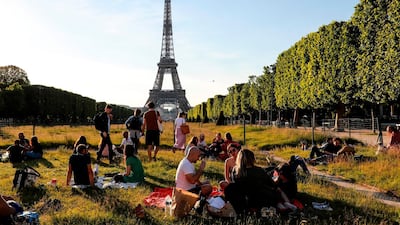

This week I went to the most perfect yet unexpected Parisian dinner party of my life. I say unexpected, because we were not one week out of confinement and yet it seemed as though nothing had happened. As though the two months I spent in isolation in the Alps in a village of less than 40 people was a distant dream.
I took a taxi, not brave enough to face the metro. Riding past Les Invalides, the complex that contains the military museums of France as well as a retirement home and hospital for veterans, I saw people everywhere. They were masked, but walking in family groups of threes or fours; laughing, chatting.

When I arrived, I waited to see my hostess’ reaction but she opened her arms so we hugged. She is a dear friend and our reunion was emotional. But we hugged gingerly, not testing fate.
We congratulated each other on surviving, and tried not to talk about coronavirus. Two friends arrived and gave each other 'la bise' the traditional French way of saying hello: a kiss on both cheeks.
Two more arrived and did not kiss but used the familiar elbow 'bise' we have been used to the past two months. "La Bise and social distancing do not go hand and hand," France 24 reported recently. Will this change French society?
Eight of us sat round a table breaking bread, eating wild boar that my friend’s son had shot during confinement in the country. We spoke of the Rolling Stones, opera, Emmanuel Macron and art.
It was the first time I had a conversation without talking about daily death rates and virus loads, although I did have a brief chat with the hostess about Kawasaki disease. I noticed that both of us shifted the subject quickly.
The month of May in France is traditionally a time of long weekends when people go to the country.
We still have a ban of only travelling 100 miles from our homes. But when I left the dinner, everyone seemed to have arranged to go away for the long weekend coming up, as though it were an ordinary year.
Some were planning to walk through the forests that are now open to the public and where people are crowding to get fresh air after months of confinement.
Some had rented Airbnb chateaux which are empty. Others were talking about their coming holidays in Italy – the borders open to tourists from June 1. One friend announced that Athens is opening up the Acropolis.
But over the strawberry tarts, I wondered if life would ever really return to normal – or will the psychological effect of Covid-19 forever float over us like a cloud – la flottement as the French call it.
Earlier that day I went out for a walk. I am still not used to being able to travel freely without my attestation – mandatory to move outside of one’s home.

A friend and I wanted to go for a drink, and I know a cafe where you can get a glass and stand outside with social distance. It was closed.
But we strolled and saw teenagers hanging out at the bus stop smoking cigarettes; elderly couples masked arm in arm, dog walkers and joggers. “Back to normal,” my friend observed, “or maybe not.”
The Luxembourg Gardens, the centre of all life on the Left Bank sixth arrondissement where I live, were still ominously locked and closed.
Then it struck me: Paris was packed with people, perhaps walking too closely and not observing the Covid-19 rules we have now internalised, but there were no tourists.
Usually I walk down my street in the summer and hear languages: Korean, Mandarin, Italian, Dutch; people looking at maps or stopping to ask me directions. Now, there was only French people walking, French being spoken.
Crossing the Seine to the apartment where my dinner was taking place, I selfishly mentioned to the taxi driver that Paris was beautiful without hordes of tourists. “It will kill us if they don’t come back,” he reprimanded me sharply. “Paris is the most visited destination in the world. We need them.”
The one subject everyone does talk about is money. At the dinner, I spoke to a friend who is a successful real estate broker. She told me she has never been so busy: not with rentals, but with people who lost their jobs and want to sell their apartments quickly.
“The market is crashing,” she said. “Which is good for me as I have a lot of work, but it means people are losing their homes.”
The anxiety that consumed us for two months seems to be shifting. Now we are less worried about getting the virus as to how we survive the economic fallout.
The end of lockdown has made me wonder what long-term psychological effect the lockdown will have on us as a society long term.
During the siege of Sarajevo, for instance, a psychiatrist friend told me that she reckoned the entire population suffered from extreme and untreated post traumatic stress disorder. That made sense.
Fierce daily bombardment, the death of nearly 14,000 people in the city alone, plus a medieval siege where they were deprived of water, heat, electricity, medical supplies and food, would naturally make people suffer psychologically.
But how will Covid-19 leave us damaged? I am lately researching the concept of moral injury, which has long been studied by the military.
It refers to an injury to a person’s moral compass – for instance, a soldier who is forced to watch or perform torture; or even a journalist like me who reported on war and witnessed events which go against everything I believe in.
Psychiatrists say it produces anger, shame and a sense of betrayal or moral disorientation.
I do believe the front line doctors and nurses who were forced to make terrible decisions like who got a ventilator or not will have some scar on their souls after this is over. But what about the rest of us?
In Europe, we are slowly coming out of our caves. Here, at least, during quarantine, we went inward: the French became more French; the Germans more German, the British, whose government fumbled the crisis badly, became more of an island than ever.
I wondered about xenophobia. How we will reintegrate with Asia again when many people I talk to have anger that the virus started there? I was meant to spend the summer teaching in Singapore. Will I ever get there now?
After the dinner, a friend drove me home, passing the Eiffel Tower. It has been closed to tourists since the quarantine but the lights were glowing over the waters of the Seine.
Since Gustave Eiffel built it in 1887, it has suffered the bombardment of the First World War and the German occupation. It was standing during the crucial 1968 civil unrest. It survived a spate of terrorist attacks in the 1980s and 90s, and the 2015 terrorist assaults on the Charlie Hebdo magazine and the Bataclan nightclub. It will survive Covid-19 just fine.

Of course the tourists will come back. Of course we will get on long-haul flights eventually. I will get to Asia someday. But like everyone, I am not sure we will emerge without, in the words of Dr Anthony Feinstein, an expert on moral injury, “our souls scarred.”
Not just from the virus aftermath but from the realisation that we live in a world where we must confront global issues with a different dynamic.
Now that borders are opening, we must consider how we can work together to take care of the most vulnerable when and if the second wave hits.
The lesson we have learnt, I hope, is that we don’t exist in isolated, nationalistic bubbles; we must think internationally. Especially when it comes to invisible threats that know no borders.
Janine di Giovanni is a Senior Fellow at Yale’s Jackson Institute and the author, most recently, of 'The Morning They Came for Us: Dispatches from Syria'

