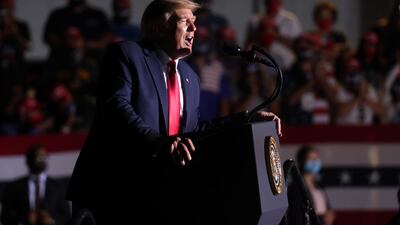

With less than eight weeks to go, US President Donald Trump's re-election campaign is in serious, and apparently growing, trouble. But, although he just suffered two of the worst weeks of a troubled presidency, it's not too late for him to turn it around.
The news is not all disastrous for Mr Trump. A better-than-expected jobs report certainly helps, although his claims that employment figures are doing "fantastically well" are jarring, given the ongoing economic crisis.
The Republican Party is so centred on him it appears to stand for little else. And, most encouragingly, the race seems to be measurably tightening in some swing states, notably Florida and Nevada.
But the latest polls don't measure the impact of two devastating revelations that could severely harm his chances, especially since he cannot afford to lose many voters in his passionate but narrow coalition.
The new book by veteran journalist Bob Woodward, Rage, may prove to be one of the biggest blows ever to Mr Trump's political career. He rashly granted Mr Woodward 18 late-night interviews, most of which the reporter recorded with permission.
Among many damaging revelations, one of the tapes from early February documents Mr Trump explaining that coronavirus is airborne, extremely deadly, much worse than the flu, and incredibly infectious. At the time and for many weeks after, he assured the public that the virus was under complete control, would magically disappear, was no worse than the flu, and everything would be perfectly fine.
What is it with Republican presidents and self-incriminating “smoking gun” tapes?
The potential damage with swing voters, a decreasing but still crucial group, could be devastating.
The White House at first denied Mr Trump had downplayed the virus, but he then conceded he had done so in an effort to prevent public panic. But given his penchant for stoking existential terror, especially on racial and ethnic grounds, this is highly unconvincing. And naturally there was no panic when these realities became widely understood.
Moreover, his aides confirm that the President was mainly concerned about a potential negative impact on the stock market if he had been truthful.
It's hard to estimate how many died as a consequence of this deliberate, admitted deception. But it is certainly a considerable figure as the US death toll from coronavirus is rapidly approaching 200,000.
-

The Manhattan skyline rises over the Borough of Brooklyn on March 31, 2020 in New York. AFP -
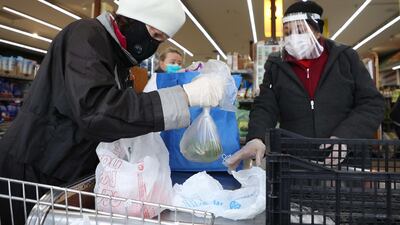
A shopper and cashier wear protective equipment at the checkout station at Pat's Farms grocery store in Merrick, New York. AFP -
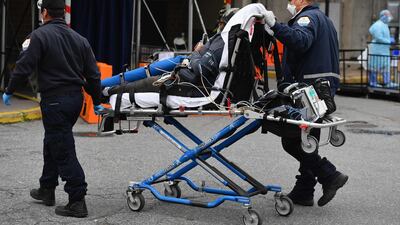
Paramedics push a gurney with a patient to Brooklyn Hospital Centre Emergency Room in the Brooklyn borough of New York. AFP -
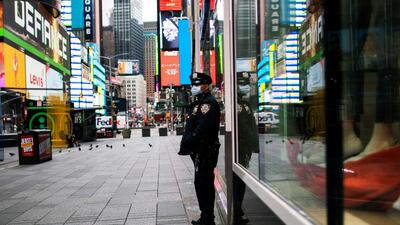
A New York Police officer stands guard in an almost empty Times Square during the outbreak of the coronavirus disease. Reuters -
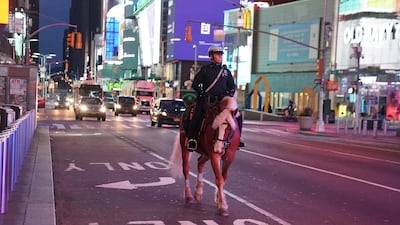
A mounted police officer rides though a mostly deserted Times Square during the outbreak of the coronavirus disease in the Manhattan. Reuters -
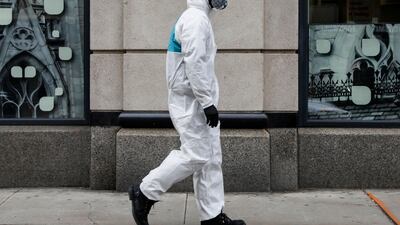
A man wears personal protective equipment as he walks on First Avenue, during the coronavirus disease outbreak in New York City. Reuters -
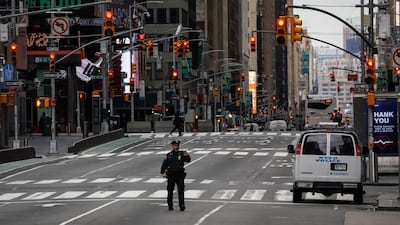
A New York City Police officer takes a selfie while in the middle of the street in an almost empty Times Square. Reuters -
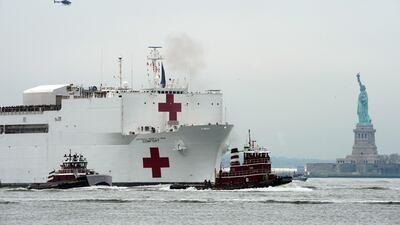
The US Navy hospital ship carrying 1,000 hospital beds moves past the Statue of Liberty as it arrives in New York. AFP -
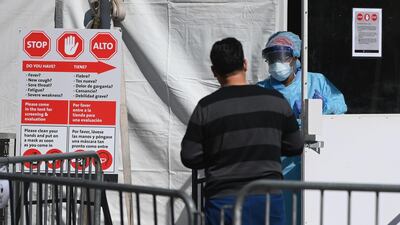
A medical worker walks out of a coronavirus testing tent at Brooklyn Hospital Centre in New York City. AFP -
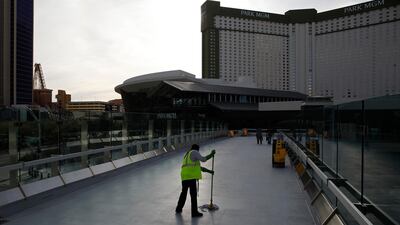
A worker cleans along the Las Vegas Strip devoid of the usual crowds as casinos and other business are shuttered due to the coronavirus outbreak. AP -

Members of the US Army Corps of Engineer Research Development Centre’s Directorate of Public Works construct two temporary hospital room prototypes in Vicksburg. The Vicksburg Post via AP -
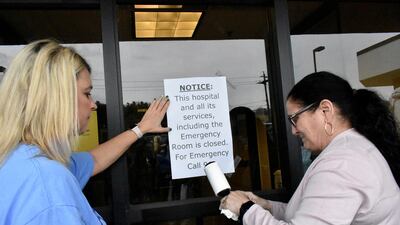
Carol Talkington helps Terri Bonasso tape a notice on the emergency room door following a vigil at the closing of the Fairmont Regional Medical Centre in Fairmont. Times-West Virginian via AP -

A motel sign is lit along a quiet Sunset Boulevard at dusk amid the coronavirus pandemic on March 31, 2020 in Los Angeles. AFP -
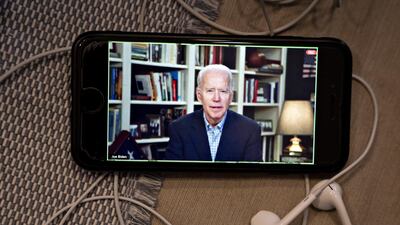
Democratic presidential candidate Joe Biden speaks during a virtual press briefing on March 25, 2020. Bloomberg


Indeed, what's striking is not only how clearly Mr Trump understood the nature and likely impact of the virus, including a very early appreciation of its deadly nature even for younger people, but also his relatively well-informed, fairly lucid and reasonable tone. It almost sounds like a different person. Even though he was a successful reality TV star, it's still jarring to realise how much of his caustic, blustering public personality is in many ways a well-honed act.
Perhaps almost as damaging is a report by The Atlantic editor Jeffrey Goldberg that quotes highly placed former administration sources that Mr Trump routinely disparaged dead and injured US soldiers as "suckers" and "losers". The President has strenuously denied this, and allies have come to his defence.
But notably silent are two key former generals widely understood to be Mr Goldberg's sources: former defence secretary James Mattis and former White House chief of staff John Kelly. Both men have said that Mr Trump is unfit for office, and neither has denied being a source for, or contested, Mr Goldberg's report.
While Mr Trump has tried to dismiss the article as a "fabrication by the bad editor of a hostile publication", much or all of it was confirmed by Fox News, Associated Press, The Washington Post, The New York Times and others.

George W Bush's former speechwriter David Frum, who also writes for The Atlantic and The National, argues that, in effect "everybody knows this is true", not only because its presumed sources are confirming the account by their silence, but also because it is consistent with Mr Trump's overall mentality, previous comments about killed, wounded and captured soldiers, and apparent incomprehension of the concepts of national service and personal sacrifice.
For a politician who poses as an ultranationalist and champion of the military, the revelation is potentially devastating. Surveys indicate his support within the military rank and file has dropped considerably from 2016, and that was before Mr Goldberg's article.
Despite appearances, Mr Trump is not immune from political damage. At some point such attrition take its toll.
Yet there is time.
He still faces three debates with his Democratic opponent, former vice president Joe Biden, who could stumble badly or Mr Trump might perform brilliantly. The President has reportedly not been preparing much, but given his habitual reliance on "alternative facts" evidently conjured on the fly, he may not need to. But the debates probably won't be a turning point.
Mr Trump keeps speculating about a coronavirus vaccine before the election, but he knows he can't count on that or any other suddenly transformative event.
Instead, he's trying to forge a broader coalition than in 2016, including the Republican base, white working-class voters in the Midwest, non-multinational business interests and his strikingly strong support among Hispanic men under the age of 50 (many of whom consider themselves white).
Mr Biden has held a lead of around seven points consistently for many months, a highly unusual feat. As it stands, the election is shaping up to be a referendum on Mr Trump, which is bad news for a historically unpopular president.
He could still change the narrative and alter the equation, but he's going to need some unanticipated dramatic development, a spectacular blunder by his opponent, or, the only one of these he could guarantee, a new way of presenting himself. But he seems to have only one political persona, and it doesn't appear well-suited to the moment.
With little time left, he almost certainly needs to change the basic parameters of the election in order to win. It is still essentially Mr Trump versus Mr Trump, and the President is clearly losing.
Hussein Ibish is a senior resident scholar at the Arab Gulf States Institute and a US affairs columnist for The National

