

The Abraham Accord, an agreement officially signed between the UAE and Israel at the White House on September 15, 2020, arguably represents a key strategic shift and a fundamental change in the values of conflict.
Of course, there is not yet consensus in the Middle East on this step. Thus far, the Palestinian leadership has rejected it, and the views of others vary. But it is likely that the Accord will have important implications, not only for ties between the parties, but for the Middle East and the international arena as well.
Although no one claims that it has solved the Palestinian-Israeli issue, the Abraham Accord has been dubbed as an “historic moment” or a “breakthrough” because it is the first peace Accord between an Arab country and Israel in more than 25 years. It is also a practical manifestation of the new thinking adopted by the Emirati leadership to tackle regional problems and challenges.

The Middle East has seen a real and tectonic shift over the past decade. The paradigm dominant since the end of the Second World War no longer exists. The region has also seen a shift from the states at its geographic centre to the ones on the periphery – a shift in leadership within the Arab world, as well as in visions, interests, priorities and threats.
The Arab world, in particular, has also witnessed the emergence of competing schemes and geopolitical strategies from non-Arab countries. The Gulf states have emerged as the party that shoulders the responsibility of interacting with these challenges and takes rational, realistic and practical decisions to preserve the stability of the region.
This has not been an easy task. The experience of grappling with it has seen many mistakes, entangled agendas and increasing polarisation. Huge resources were drained, and no one can say for sure that what has happened has been perfect.
The Abraham Accord arose in this geopolitical context. Its consequences may go beyond the relationship between Israel and the Gulf and include the possibility of ties between Israel and some other Arab countries. They may even impact other regions, such as South Asia and the Eastern Mediterranean.
The ultimate implications of the Accord include new arrangements in the region based on enhancing stability, development and prosperity. It represents a project for co-operation based on the vital interests of local populations, such as economy, technology, education, medicine, water, energy and agriculture.
The first and immediate benefit of the Accord was the freezing of a plan by Israeli Prime Minister Benjamin Netanyahu to annex one third of the land in Palestine’s West Bank and the Jordan Valley. Beyond that, however, and contrary to what some analysts think, the Accord also represents a new area of leverage for the Palestinians within the broader context of the Arab-Israeli conflict.
-
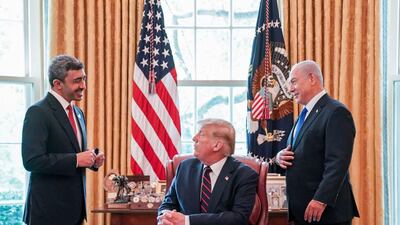
Sheikh Abdullah bin Zayed, UAE Minister of Foreign Affairs and International Co-operation, speaks to Donald Trump, US president at the time, and Israeli Prime Minister Benjamin Netanyahu in the Oval Office in September 2020. Ministry of Foreign Affairs and International Co-operation -
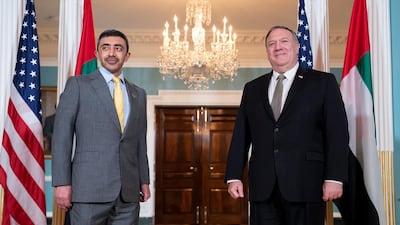
Sheikh Abdullah bin Zayed, UAE Minister of Foreign Affairs and International Co-operation, meets Mike Pompeo, US secretary of state at the time. Wam -
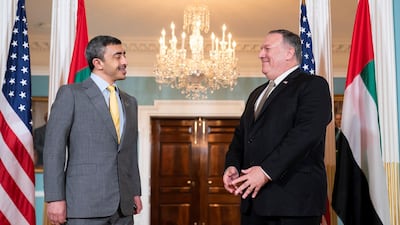
Sheikh Abdullah and Mr Pompeo in Washington. Wam -
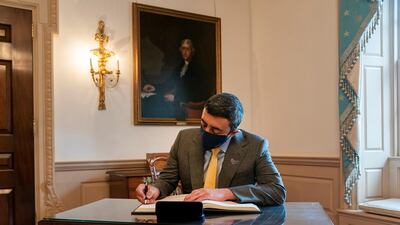
Sheikh Abdullah visits Washington in September last year. Wam -
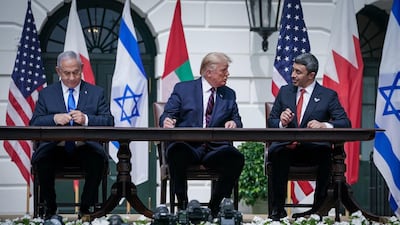
Sheikh Abdullah, UAE Minister of Foreign Affairs and International Co-operation, US President Donald Trump, centre, and Israeli Prime Minister Benjamin Netanyahu sign the Abraham Accord at the White House South Lawn. MOFAIC -
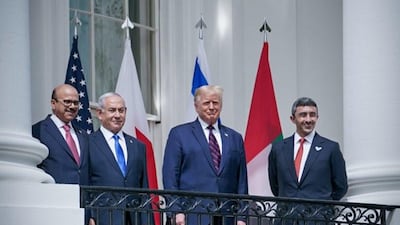
Sheikh Abdullah and, from left, Bahrain's Foreign Minister Abdullatif Al Zayani, Israeli Prime Minister Benjamin Netanyahu and US President Donald Trump at the White House. MOFAIC -
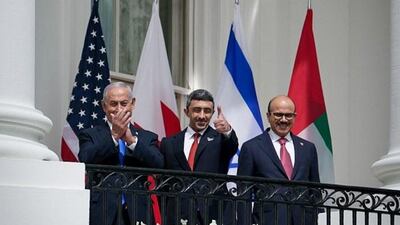
Sheikh Abdullah, Mr Al Zayani and Mr Netanyahu at the White House during the Abraham Accord signing ceremony. MOFAIC -
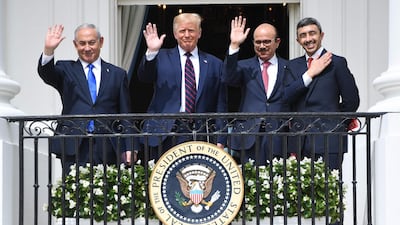
Sheikh Abdullah and, from left, Mr Netanyahu, Mr Trump and Mr Al Zayani wave from the Truman Balcony at the White House. AFP -
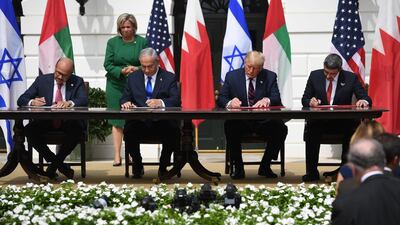
Sheikh Abdullah and, from left, Mr Al Zayani, Mr Netanyahu and Mr Trump sign the Abraham Accord. AFP -
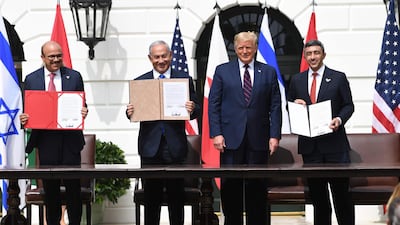
Sheikh Abdullah and, from left, Mr Al Zayani, Mr Netanyahu and Mr Trump after the signing ceremony. AFP -
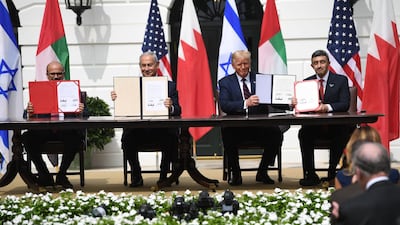
Sheikh Abdullah and, from left, Mr Al Zayani, Mr Netanyahu and Mr Trump after the signing ceremony. AFP -
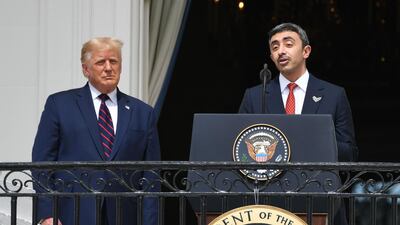
Sheikh Abdullah speaks from the Truman Balcony at the White House during the signing ceremony of the Abraham Accord. AFP -
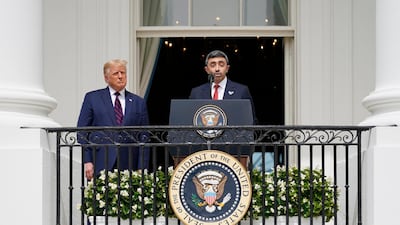
Sheikh Abdullah speaks as Mr Trump looks on before the signing of Abraham Accord on the South Lawn of the White House. AP -
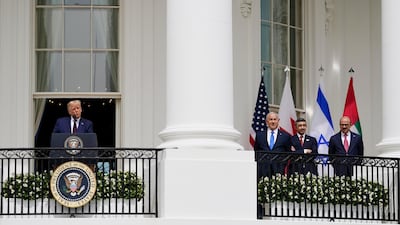
Sheikh Abdullah looks on from the White House as Mr Trump speaks at the Abraham Accord signing ceremony, also attended by Mr Al Zayani and Mr Netanyahu. AP -

Sheikh Abdullah bin Zayed, UAE Minister of Foreign Affairs and International Co-operation, Israeli Prime Minister Benjamin Netanyahu, left, and Bahraini Foreign Minister Abdullatif Al Zayani stand on the Blue Room Balcony during the signing ceremony. AP -
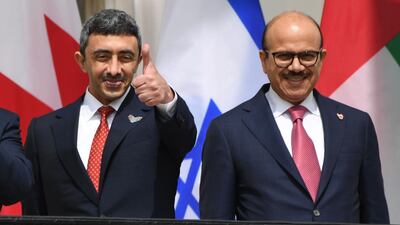
Sheikh Abdullah and Mr Al Zayani shortly before participating in the signing of the Abraham Accord. AFP -
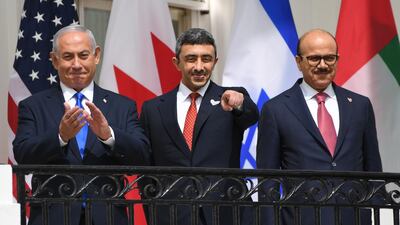
Sheikh Abdullah, with Mr Netanyahu, left, and Mr Al Zayani at the signing of the Abraham Accord on the South Lawn of the White House. AFP -
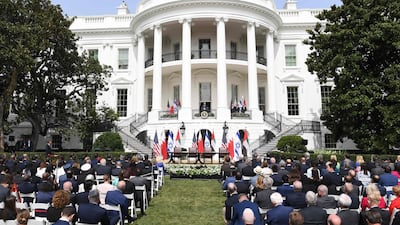
US President Donald Trump speaks from the Truman Balcony at the White House during the signing ceremony of the Abraham Accord. AFP -
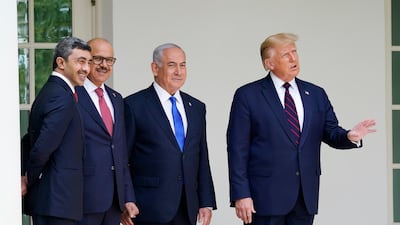
President Donald Trump walks to the Abraham Accord signing ceremony at the White House with Sheikh Abdullah bin Zayed, UAE Minister of Foreign Affairs and International Co-operation, Israeli Prime Minister Benjamin Netanyahu, and Bahrain's Foreign Minister Abdullatif Al Zayani. AP -
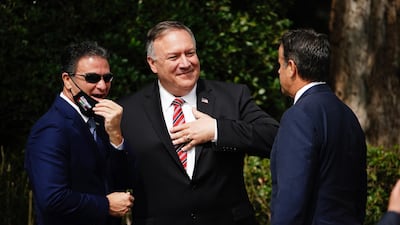
US Secretary of State Mike Pompeo arrives at the White House to attend the Abraham Accord signing ceremony hosted by President Donald Trump. EPA -
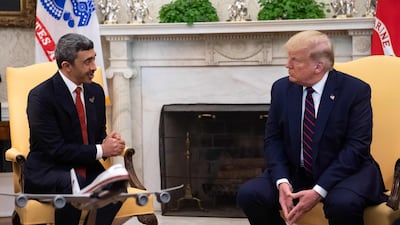
Sheikh Abdullah bin Zayed, UAE Minister of Foreign Affairs and International Co-operation, meets US President Donald Trump in the Oval Office of the White House before the signing of Abraham Accord. AFP -
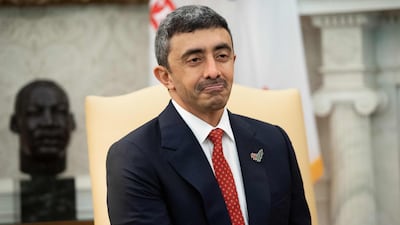
Sheikh Abdullah bin Zayed, UAE Minister of Foreign Affairs and International Co-operation, in the Oval Office. AFP -
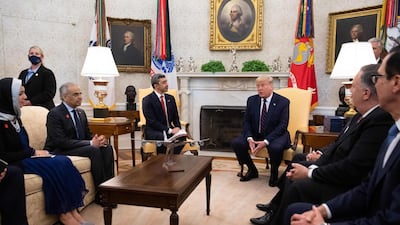
Sheikh Abdullah bin Zayed, UAE Minister of Foreign Affairs and International Co-operation, meets US President Donald Trump in the Oval Office of the White House. AFP -
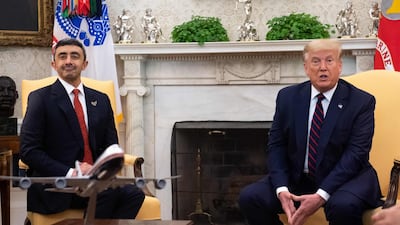
Sheikh Abdullah with Mr Trump in the Oval Office. AFP -
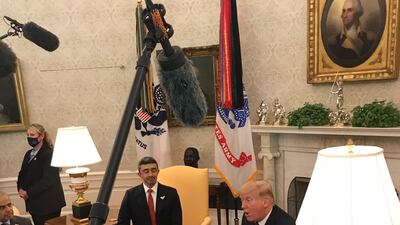
Sheikh Abdullah bin Zayed, UAE Minister of Foreign Affairs and International Co-operation, with by President Donald Trump at the White House. Mustafa Alrawi / The National -
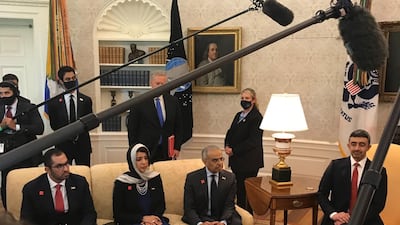
The UAE delegation led by Sheikh Abdullah bin Zayed, Minister of Foreign Affairs and International Co-operation, with US President Donald Trump at the White House. Mustafa Alrawi / The National -
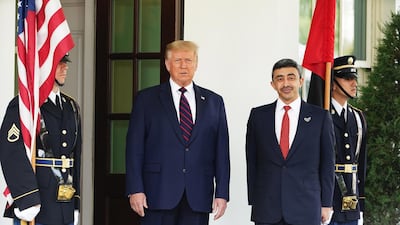
Sheikh Abdullah bin Zayed, UAE Minister of Foreign Affairs and International Co-operation, is welcomed to the White House by US President Donald Trump. EPA -
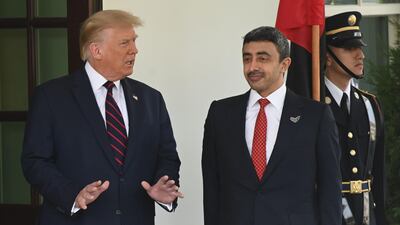
Sheikh Abdullah and Mr Trump outside the White House. AFP -
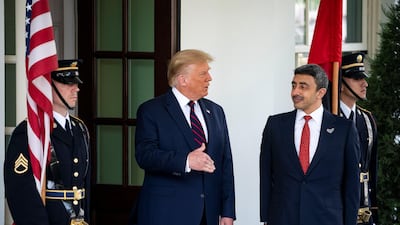
Sheikh Abdullah bin Zayed speaks to Mr Trump after arriving at the White House. Reuters -
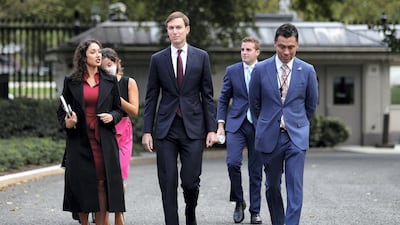
White House Senior Adviser Jared Kushner walks away following a television interview on the North Lawn at the White House in Washington. Reuters -
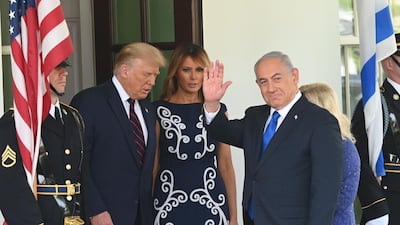
US President Donald Trump and First Lady Melania Trump welcome the arrival of Prime Minister of Israel Benjamin Netanyahu and his wife Sara on the North Lawn of the White House in Washington DC. AFP -
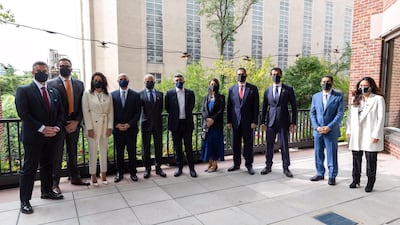
A delegation of senior UAE officials led by Sheikh Abdullah bin Zayed, UAE Minister of Foreign Affairs and International Co-operation, prepares to depart for the White House to sign the Abraham Accord. MOFAIC -
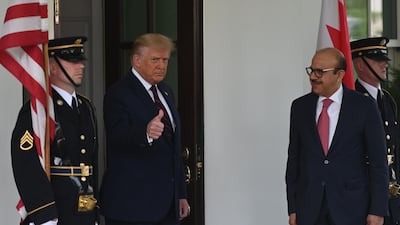
US President Donald Trump welcomes Bahraini Foreign Minister Abdullatif Al Zayani. AFP -

Bahraini Foreign Minister Abdullatif Al Zayani arrives at the White House in Washington DC. AFP -
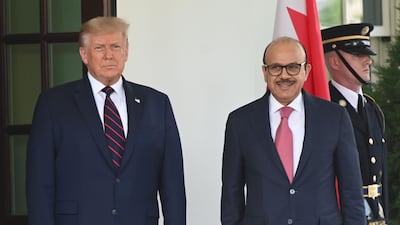
US President Donald Trump welcomes Bahraini Foreign Minister Abdullatif Al Zayani on the North Lawn of the White House in Washington, DC. AFP -
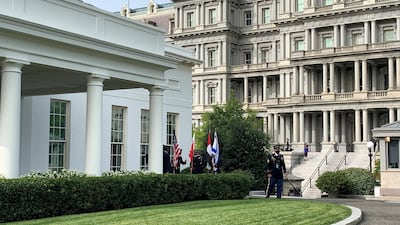
Preparations at the White House for the signing of the Abraham Accord. -
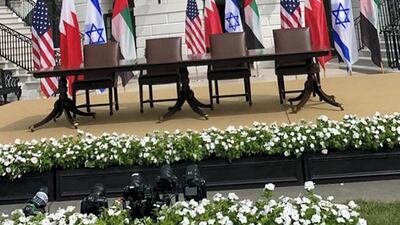
Preparations under way at the White House for the signing of the Abraham Accord. -
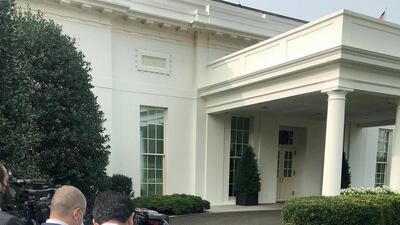
Preparations under way at the White House for the signing of the Abraham Accord. -

Preparation at the White House for the signing of the Abraham Accord. The National


As we all know, much of the Palestinian negotiating position was contained within the dynamics of American-Israeli and the American-Arab relations. But the UAE brings a new political weight to the table, providing Abu Dhabi with more leverage in the Palestinian-Israeli issue in a way that directly serves the Palestinian interests.
More importantly, the creation of an atmosphere of peace, co-operation and stability in the Middle East would help bring about a shift in Israeli public opinion. People in Israel may eventually realise that they win more when there is peace with Arabs – including Palestinians – and that it is in the best interests of their country to make more concessions. This alone would provide a new kind of leverage for Palestinians, thus generating momentum on both sides to reconsider the conflict’s narratives and enhance a culture of tolerance and justice in the region.
Iran and Turkey were critical of the Accord because their governments realise that such an agreement will help strengthen what historically has been known as the "axis of moderation and stability" in the region. The Accord would be a serious roadblock to Iran’s goal of regional hegemony. It will counter Iran’s destabilising policies, which threaten Arab nation-states through proxies and non-state actors. The same can be said for Turkey’s expansionist policies in Libya, Iraq, Syria and elsewhere.
As a so-called “revolutionary” state, Iran is bound to continue its strategy of regional destabilisation, and therefore feel anxious about the Accord. However, some UAE officials stressed that the country’s agreement with Israel is not a hostile message directed at Iran, but rather a step to enhance the development and collective security of the region as a whole.

Common sense says that this peace agreement can even create an opportunity for the UAE to provide a bridge for dialogue and de-escalation of tensions between Iran and Israel. Moreover, the emergent regional context will create an important opportunity for Iran, whether there is a new US administration next year or President Donald Trump is re-elected. Mr Trump has already stated that he can reach a deal with the Iranians in the first month of his second term – if he is re-elected, of course. Therefore, we may see a new pattern of relations between regional actors that can support a path to stability in the Middle East.
As for Turkey, it viewed the signing of the Accord as a seismic change in the local geopolitical theatre. Before Prime Minister Recep Tayyip Erdogan’s AK Party came to power in 2002, Turkey’s own co-operative relationship with Israel was one of the Middle East’s key alliances. Now, however, Turkey’s regional position seems to have become weaker, with the country adopting confused, provocative and hostile policies towards its neighbours in the Middle East and the Mediterranean.
Still, the Accord provides an important lesson to Turkish policymakers that the strategic benefits of dialogue and understanding surpass the short-term gains of coercion, threats and muscle flexing. If Turkey understands this lesson, it will create positive effects for its relationship with the EU, too. If that happens, the chances are the Abraham Accord will constitute a “game-changer” for de-escalation of conflicts and tensions in a way that goes well beyond Israel and the Arab states.
The UAE decision to sign a peace agreement with Israel is a rational strategy to establish real co-operation that serves both countries and their people. As the leader of this new approach in the Middle East, the UAE is confident that the outcomes and dividends – especially in terms of stability and quality of life – offered by the Abraham Accord will encourage other Arab countries to get on the “peace train”. This would make it possible for the Middle East to catch up with other regions of the world that have already succeeded in developing their countries through dialogue and understanding.
Dr Ebtesam Al Ketbi is a founder and head of the Emirates Policy Centre

