

Notwithstanding the tragic human loss due to Covid-19, the toll on the world economy is now being felt everywhere. It is expected to take a $5.3 trillion hit in 2020-21. Both the US and the eurozone are not expected to recover until 2023. No country has escaped the pain of this crisis, including oil-producing countries with large sovereign wealth funds, as they face a loss of equities and a drop in revenues.
The spread of Covid-19 is not a one-off black swan event. It is the ushering of a new era, one which a 2014 Bank of America/Merrill Lynch report called "the age of global pandemics". The World Health Organisation reports more than 100 public health events of varying magnitude and socio-economic effects annually in Africa. These incidents have been rising steadily over the past four decades and have spiked in the past 20 years. Taking into account the rapid growth and integration of African countries in the world economy, the risk that such domestic outbreaks would turn into pandemics is very high.
-
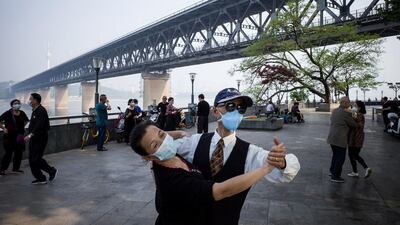
Couples dance under Wuhan Bridge in Wuhan, in China's central Hubei province on the first day of the 5-day May Day national holiday. AFP -
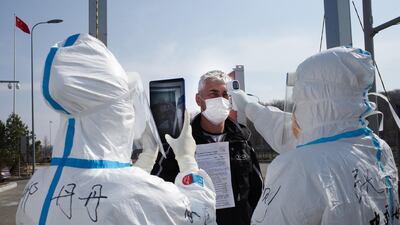
Staff check the temperature of a driver at a customs checkpoint on the border with Russia at Suifenhe, in China's northeast Heilongjiang province. AFP -
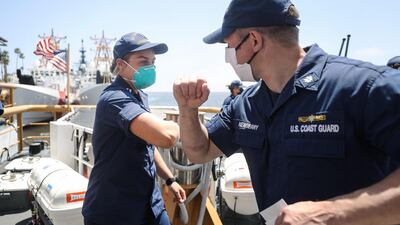
US Coast Guard Lieutenant Caroline Miller elbow bumps Commander Marshall Newberry aboard a patrol boat following monitoring of oil tankers anchored near the ports of Long Beach and Los Angeles amid the coronavirus pandemic off the coast of Long Beach, California. AFP -

A stylist receives clients at home in San Jose, Costa Rica. The Government of Costa Rica announced the limited opening of some activities, due to the decrease in COVID-19 cases. EPA -
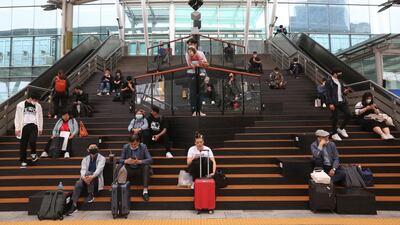
Passengers wait for their trains at the Seoul Railway Station in South Korea. South Korea reported fresh cases of the new coronavirus are continuing a month-long downturn. AP Photo -

Migrant workers disembark from a special train that arrived from Nasik during a government-imposed nationwide lockdown as a preventive measure against the COVID-19 coronavirus, at Misrod railway station in Bhopal. AFP -
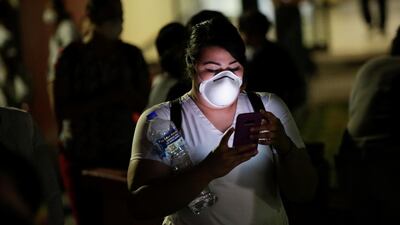
A nurse from General Hospital No. 6 of the Mexican Institute of Social Security checks her phone during a protest after the death of a colleague, due to what they say is the lack of equipment to treat patients with the coronavirus disease, in Ciudad Juarez, Mexico. Reuters -
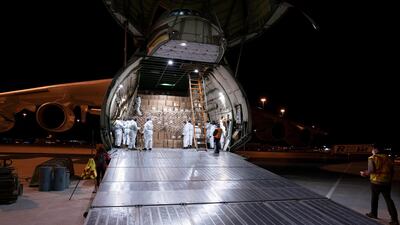
A crew gets ready to unload medical supplies from an Antonov AN-225 cargo transporter upon arriving from China at Mirabel Airport in Mirabel, Quebec. The Canadian Press via AP -
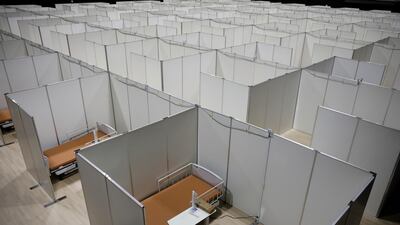
A facility is set up to accommodate coronavirus disease patients with mild or no symptoms at Nippon Foundation Para Arena in Tokyo Japan. Reuters -

Groom Risky Ekky and his bride Veriana Fallah check their wedding documents during their wedding ceremony amid coronavirus outbreak in Jakarta, Indonesia. EPA


The current crisis has significantly undercut the ability of people to participate in the economy. It has restricted "human agency" – which is our ability to participate in social and economic activities – to opportunities behind screens and closed doors. The response of governments – at least in the rich world – has been to inject trillions of dollars and euros into the markets to keep the economy on life-support. This has helped to keep people off the streets for a while and bought governments some time to prepare for the Covid-19 assault.
However, while entering an expensive lockdown seemed easy, exiting it is looking harder by the day.
Covid-19 poses a threat to human agency. As a result, both the demand and supply for non-essential goods and services have been drastically severed in automated and non-automated industries alike. In fact, Japan, a country with one of the highest rates of robot density, has had to introduce one of the highest stimulus packages in the world.
-
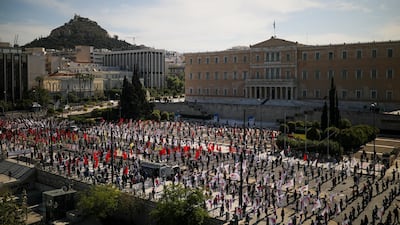
Members of the communist-affiliated trade union PAME practice social distancing during a rally commemorating May Day in Athens, Greece. Reuters -
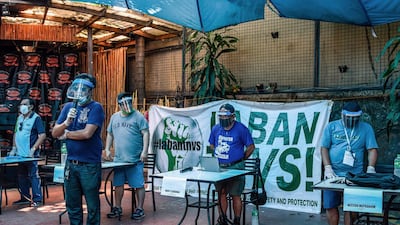
Members of a transport organisation hold a press conference to coincide with May Day, or International Workers' Day, in suburban Manila on May 1, 2020,. AFP -
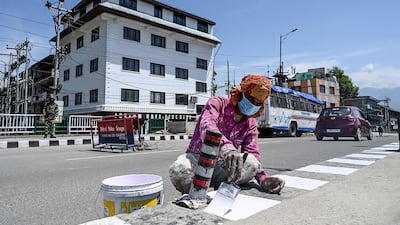
A migrant labourer paints white road markings on the International Labour Day in Srinagar. AFP -
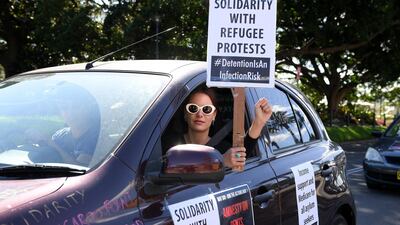
People take part in a May Day car convoy rally, to protest for workers rights during the coronavirus pandemic, in Sydney, Australia. EPA -

Protesters light flares on the balcony of a squatted house in the Friedrichshain district prior to May Day in Berlin, Germany. EPA -
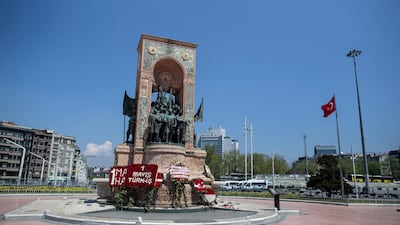
Wreaths at the empty Taksim Square during a May Day demonstration in Istanbul. EPA -
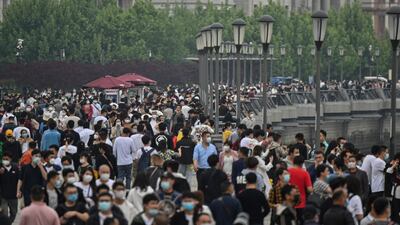
People wearing face masks visit the promenade on the Bund along the Huangpu River during a holiday on May Day, or International Workers' Day, in Shanghai. AFP -
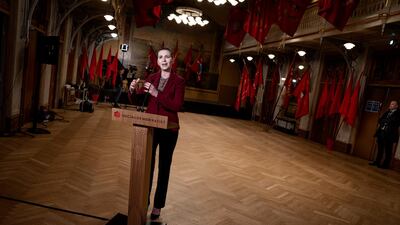
Danish Prime Minister and leader of the Social Democrats, Mette Frederiksen delivers her May Day speech during live broadcasting at the Labour Museum in Copenhagen, Denmark. EPA -
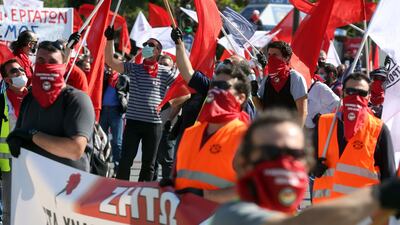
Members of the PAME movement and the KKE are holding flags, wear gloves and masks to protect themselves, and keep their distance from the rally for Labor Day on the Syntagma square in Athens, Greece. EPA -
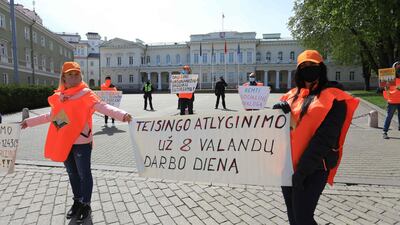
Members of the Lithuanian Trade Union "Solidarity", wearing protective masks and respecting the social distancing rules against the spread of the novel coronavirus, COVID-19, protest in front of the Lithuanian Presidential Palace during the Labour Day demonstration in Vilnius the poster reads "Equitable remuneration for the 8-hour day". AFP


Understanding that the response to the ensuing crisis is one that is fundamentally about recovering human agency opens up new prospects for economic recovery. It is important to realise that while robots can be used to secure vulnerable elements of the supply-side of the economy, it is humans who drive demand for goods and services. Human agency therefore cannot be left outside the economic loop – and technology has become an indispensable medium for it. Market dynamics, including resource allocation and value creation and capture, are being hampered by what is effectively a problem of technology scarcity.
Currently, face masks appear to be the world’s foremost technology for protecting human agency and, subsequently, our main tool for economic recovery. In fact, some governments are pledging to provide each citizen with such a mask. To add to the mask effectiveness, governments are introducing a myriad of potentially dubious social distancing apps and guidelines. The lack of adequate technology to protect human agency is therefore a case of market failure.
So there is an urgent need for governments and businesses to invest in human agency-enhancing technologies. For years, these so-called "assistive technologies" have been in development and use for the benefits of military personnel, senior citizens and people with disabilities or sports-related injuries. They involve the use of exoskeletons, companion and collaborative robots, drones and immersive technologies including "augmented reality" and "haptic technologies". They contribute directly to enhancing human agency by extending our capabilities while protecting us from potential hazards.
The demand for such technologies will only increase as businesses and people come to experience first-hand the need for them. Yet, for these technologies to work, they would require massive investment in new technology and infrastructure.
A good starting point is the newly extended category of "essential goods and services". Citizens, businesses and governments have come to recognise the existence of this category, which includes obvious things like government services, food and medical supplies, but also less obvious ones like repair shops and home maintenance services.

Ultimately, the definition of “essential” will vary between countries, communities and even organisations. This creates manifold opportunities for specialisation and differentiation across the board. While the list of what is deemed essential will only grow longer over time, in the short term, a priority list can be identified through stress tests, too.
Essential public services make a good starting point for public-private partnerships to leverage the stimulus packages to re-start the economy. Today there exists a window of opportunity for governments to decree that businesses operating in essential goods and services must invest in securing supply-chains or lose the right to trade in these services. Government decrees to that effect could unleash a wave of investments in new growth sectors that would help pull economies out of the downturn and provide greater resilience vis-a-vis similar risks in the future.
It would also be a much more strategic type of stimulus than the ones that are on offer today.
Sami Mahroum is the director of research and strategy at the Dubai Future Foundation

