Can the anti-Netanyahu protests grow into a larger movement?


  • English
  • Arabic

Israel is roiling with angry street protests that local observers have warned could erupt into open civil strife – a development Prime Minister Benjamin Netanyahu appears to be encouraging.

For weeks, Jerusalem and Tel Aviv have been the scene of large, noisy demonstrations outside the official residences of Mr Netanyahu and his public security minister, Amir Ohana.

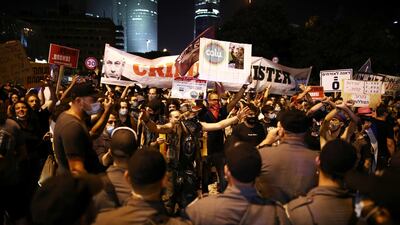
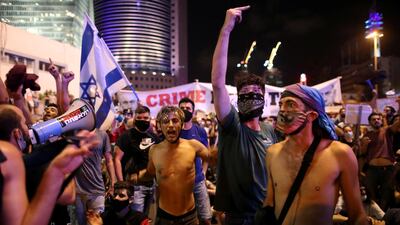
On Saturday night around 13,000 marched through Jerusalem shouting "Anyone but Bibi", Mr Netanyahu's nickname. Their calls were echoed by tens of thousands more at locations across the country.

Turnout has been steadily growing, despite attacks on demonstrators from both the police and Mr Netanyahu’s loyalists. The first protests abroad by Israeli expats have also been reported.

Demonstrators protest against Israel's Prime Minister Benjamin Netanyahu outside his residence in Jerusalem on Saturday. AP Photo

The protests, in defiance of physical distancing rules, are unprecedented by Israeli standards. They have bridged the gaping political divide between a small constituency of anti-occupation activists – disparagingly called “leftists” in Israel – and the much larger Israeli Jewish public that identifies politically as on the centre and the right.

For the first time, a section of Mr Netanyahu’s natural supporters is out on the streets against him.

In contrast to earlier protests, such as a large social justice movement that occupied the streets in 2011 to oppose rising living costs, these demonstrations have not entirely eschewed political issues.

The target of the anger and frustration is decidedly personal at this stage – focused on the figure of Mr Netanyahu, who is now Israel’s longest-serving Prime Minister. Protesters have renamed him Israel’s “crime minister”.

But also fuelling the protests is a larger mood of disenchantment as doubts grow about the state’s competence to deal with multiple crises unfolding in Israel. The virus has caused untold social and economic misery for many, with as much as one fifth of the labour force out of work. Mr Netanyahu’s supporters in the lower middle-classes have been hit hardest.

Now well into a second wave, Israel has a per capita rate of infection that outstrips even the US. The shadow of a renewed lockdown amid government mishandling of the virus has undermined Mr Netanyahu's claim to be "Mr Security".

Protesters have renamed Benjamin Netanyahu Israel’s 'crime minister'. EPA

There are concerns too about police brutality – starkly highlighted by the killing in May of an autistic Palestinian, Eyad Hallaq, in Jerusalem.

Police crackdowns on the protests, using riot squads, undercover agents, mounted police and water cannon, have underlined not just Mr Netanyahu’s growing authoritarianism. There is a sense too that the police may be ready to use violence on dissenting Israelis that was once reserved for Palestinians.

After manipulating his right-wing rival, the former military general Benny Gantz, into joining him in a unity government in April, Mr Netanyahu has effectively crushed any meaningful political opposition.

The agreement shattered Mr Gantz’s Blue and White party, with many of his legislators refusing to enter the government, and has widely discredited the ex-general.

Mr Netanyahu is reportedly preparing for a winter election – the fourth in two years – both to cash in on his opponents’ disarray and to avoid honouring a rotation agreement in which Mr Gantz is due to replace him late next year.

According to the Israeli media, Mr Netanyahu may find a pretext for forcing new elections by further delaying approval of the national budget, despite Israel facing its worst financial crisis in decades.

And, of course, overshadowing all this is the matter of the corruption charges against Mr Netanyahu. Not only is he the first sitting Prime Minister in Israel to stand trial, but he has been using his role and the pandemic to his advantage, including by delaying court hearings.

  • Israelis protest against the government's response to the financial fallout of the coronavirus disease (COVID- 19) crisis at Rabin square in Tel Aviv, Israel. REUTERS
    Israelis protest against the government's response to the financial fallout of the coronavirus disease (COVID- 19) crisis at Rabin square in Tel Aviv, Israel. REUTERS
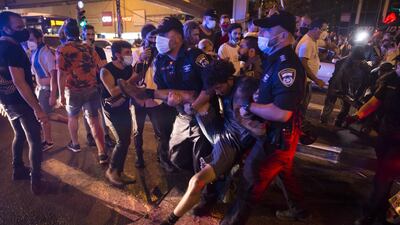
  • Police officers arrest a protester as he blocks a main junction during a protest against the government's economy response to the corona virus crisis in Tel Aviv. Getty Images
    Police officers arrest a protester as he blocks a main junction during a protest against the government's economy response to the corona virus crisis in Tel Aviv. Getty Images
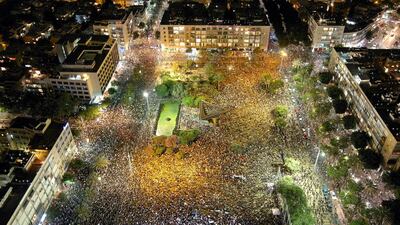
  • A general view shows Rabin square as Israelis protest against the government's response to the financial fallout of the coronavirus disease crisis in Tel Aviv. REUTERS
    A general view shows Rabin square as Israelis protest against the government's response to the financial fallout of the coronavirus disease crisis in Tel Aviv. REUTERS
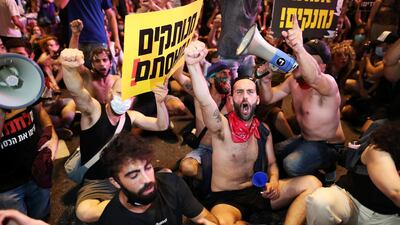
  • Israelis block a main junction in the city as they protest against the government's response to the financial fallout of the coronavirus crisis in Tel Aviv. REUTERS
    Israelis block a main junction in the city as they protest against the government's response to the financial fallout of the coronavirus crisis in Tel Aviv. REUTERS
  • Israeli border police confronts protesters during a self-employed business owners demonstration against the Israeli government in Rabin square in Tel Aviv. EPA
    Israeli border police confronts protesters during a self-employed business owners demonstration against the Israeli government in Rabin square in Tel Aviv. EPA
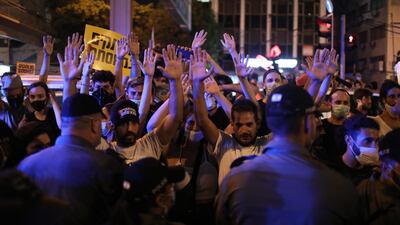
  • Police force stand in front of the protestors as they block a main junction in the city following a protest against the government's response to the financial fallout of the coronavirus disease (COVID- 19) crisis in Tel Aviv. REUTERS
    Police force stand in front of the protestors as they block a main junction in the city following a protest against the government's response to the financial fallout of the coronavirus disease (COVID- 19) crisis in Tel Aviv. REUTERS
  • Israelis block a main junction in the city as they protest against the government's response to the financial fallout of the coronavirus crisis in Tel Aviv, Israel. REUTERS
    Israelis block a main junction in the city as they protest against the government's response to the financial fallout of the coronavirus crisis in Tel Aviv, Israel. REUTERS
  • Police detain a protester as Israelis block a main junction in the city following a protest against the government's response to the financial fallout of the coronavirus disease (COVID- 19) crisis in Tel Aviv. REUTERS
    Police detain a protester as Israelis block a main junction in the city following a protest against the government's response to the financial fallout of the coronavirus disease (COVID- 19) crisis in Tel Aviv. REUTERS
  • Israeli Protester holds a fake bill with a photo of the Israeli Prime Minister Benjamin Netanyahu as she protests against the Government's economy response to the cororna virus crisis in Tel Aviv. Getty Images
    Israeli Protester holds a fake bill with a photo of the Israeli Prime Minister Benjamin Netanyahu as she protests against the Government's economy response to the cororna virus crisis in Tel Aviv. Getty Images
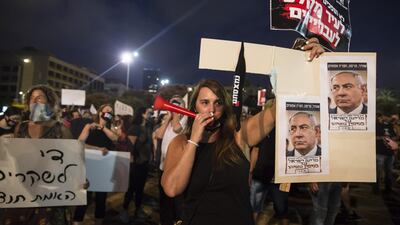
  • Israeli woman holds a sign with photos of Israeli Prime Minister Benjamin Netanyahu as she protests against the Government's economy response to the cororna virus crisis in Tel Aviv. Getty Images
    Israeli woman holds a sign with photos of Israeli Prime Minister Benjamin Netanyahu as she protests against the Government's economy response to the cororna virus crisis in Tel Aviv. Getty Images

In a time of profound crisis and uncertainty, many Israelis are wondering which policies are being pursued for the national good and which for Mr Netanyahu’s personal benefit.

The government's months-long focus on the annexation of swaths of Palestinian territory in the West Bank has looked like political pandering to his settler constituency, creating a dangerous distraction from dealing with the pandemic.

Similarly, a one-off handout this week to every Israeli – over the strenuous objections of finance officials – looks suspiciously like an electoral bribe. As a result, Mr Netanyahu is facing a rapid decline in support. A recent survey shows trust in him has fallen by half – from 57 per cent in March and April, when the Covid-19 pandemic began, to 29 per cent today.

Many Israelis increasingly see Mr Netanyahu less as a father figure and more as a drain on resources from the body politic. Capturing the popular mood is a new art work called the "Last Supper" that was covertly installed in central Tel Aviv. It shows Mr Netanyahu alone, gorging on a vast banquet by stuffing his hand into an enormous cake decorated with the Israeli flag.

A doll depicting Benjamin Netanyahu sits on a table simulating the 'Last Supper' during a protest performance by Israeli artist Itay Zalait in Tel Aviv last week. AFP
Observers have wondered whether the protests can transcend party political tribalism and develop into a grassroots movement demanding real change

In another move designed to highlight the case against Mr Netanyahu, better-off Israelis have been publicly organising to donate this week’s state handout to those in need.

Mr Netanyahu’s repeated incitement against the protesters – disparaging them as “leftists” and “anarchists”, and suggesting they are spreading disease – appears to have backfired. It has only rallied more people to the street.

But the incitement and Mr Netanyahu’s claims that he is the true victim – and that in the current climate he faces assassination – have been interpreted as a call to arms by some on the right. Last week five protesters were injured when his loyalists used clubs and broken bottles on them, with police appearing to turn a blind eye. Further attacks were reported at the weekend. Protest organisers said they had begun arranging defence units to protect demonstrators.

Mr Ohana has called for a ban on the protests and urged a heavy hand from the police. He has delayed appointing a new police chief – a move seen as incentivising local commanders to crack down on the protests to win favour. Large numbers of protesters have been forcefully arrested, with reports that police have questioned some on their political views.

Observers have wondered whether the protests can transcend party political tribalism and develop into a grassroots movement demanding real change. That might widen their appeal to even more disadvantaged groups, not least the one fifth of Israel’s citizens who belong to its Palestinian minority.

But it would also require more of the protesters to start drawing a direct connection between Mr Netanyahu’s personal abuses of office and the wider, systemic corruption of Israeli politics, with the occupation its beating heart.

That may yet prove a tall order, especially when Israel feels it can resist external pressure for change.

Jonathan Cook is a freelance journalist in Nazareth

Two products to make at home

Toilet cleaner

1 cup baking soda 

1 cup castile soap

10-20 drops of lemon essential oil (or another oil of your choice) 

Method:

1. Mix the baking soda and castile soap until you get a nice consistency.

2. Add the essential oil to the mix.

Air Freshener

100ml water 

5 drops of the essential oil of your choice (note: lavender is a nice one for this) 

Method:

1. Add water and oil to spray bottle to store.

2. Shake well before use. 

10 tips for entry-level job seekers
  • Have an up-to-date, professional LinkedIn profile. If you don’t have a LinkedIn account, set one up today. Avoid poor-quality profile pictures with distracting backgrounds. Include a professional summary and begin to grow your network.
  • Keep track of the job trends in your sector through the news. Apply for job alerts at your dream organisations and the types of jobs you want – LinkedIn uses AI to share similar relevant jobs based on your selections.
  • Double check that you’ve highlighted relevant skills on your resume and LinkedIn profile.
  • For most entry-level jobs, your resume will first be filtered by an applicant tracking system for keywords. Look closely at the description of the job you are applying for and mirror the language as much as possible (while being honest and accurate about your skills and experience).
  • Keep your CV professional and in a simple format – make sure you tailor your cover letter and application to the company and role.
  • Go online and look for details on job specifications for your target position. Make a list of skills required and set yourself some learning goals to tick off all the necessary skills one by one.
  • Don’t be afraid to reach outside your immediate friends and family to other acquaintances and let them know you are looking for new opportunities.
  • Make sure you’ve set your LinkedIn profile to signal that you are “open to opportunities”. Also be sure to use LinkedIn to search for people who are still actively hiring by searching for those that have the headline “I’m hiring” or “We’re hiring” in their profile.
  • Prepare for online interviews using mock interview tools. Even before landing interviews, it can be useful to start practising.
  • Be professional and patient. Always be professional with whoever you are interacting with throughout your search process, this will be remembered. You need to be patient, dedicated and not give up on your search. Candidates need to make sure they are following up appropriately for roles they have applied.

Arda Atalay, head of Mena private sector at LinkedIn Talent Solutions, Rudy Bier, managing partner of Kinetic Business Solutions and Ben Kinerman Daltrey, co-founder of KinFitz

Trump v Khan

2016: Feud begins after Khan criticised Trump’s proposed Muslim travel ban to US

2017: Trump criticises Khan’s ‘no reason to be alarmed’ response to London Bridge terror attacks

2019: Trump calls Khan a “stone cold loser” before first state visit

2019: Trump tweets about “Khan’s Londonistan”, calling him “a national disgrace”

2022:  Khan’s office attributes rise in Islamophobic abuse against the major to hostility stoked during Trump’s presidency

July 2025 During a golfing trip to Scotland, Trump calls Khan “a nasty person”

Sept 2025 Trump blames Khan for London’s “stabbings and the dirt and the filth”.

Dec 2025 Trump suggests migrants got Khan elected, calls him a “horrible, vicious, disgusting mayor”

At a glance - Zayed Sustainability Prize 2020

Launched: 2008

Categories: Health, energy, water, food, global high schools

Prize: Dh2.2 million (Dh360,000 for global high schools category)

Winners’ announcement: Monday, January 13


Impact in numbers

335 million people positively impacted by projects

430,000 jobs created

10 million people given access to clean and affordable drinking water

50 million homes powered by renewable energy

6.5 billion litres of water saved

26 million school children given solar lighting

WHAT IS A BLACK HOLE?

1. Black holes are objects whose gravity is so strong not even light can escape their pull

2. They can be created when massive stars collapse under their own weight

3. Large black holes can also be formed when smaller ones collide and merge

4. The biggest black holes lurk at the centre of many galaxies, including our own

5. Astronomers believe that when the universe was very young, black holes affected how galaxies formed

Earth under attack: Cosmic impacts throughout history

4.5 billion years ago: Mars-sized object smashes into the newly-formed Earth, creating debris that coalesces to form the Moon

- 66 million years ago: 10km-wide asteroid crashes into the Gulf of Mexico, wiping out over 70 per cent of living species – including the dinosaurs.

50,000 years ago: 50m-wide iron meteor crashes in Arizona with the violence of 10 megatonne hydrogen bomb, creating the famous 1.2km-wide Barringer Crater

1490: Meteor storm over Shansi Province, north-east China when large stones “fell like rain”, reportedly leading to thousands of deaths.  

1908: 100-metre meteor from the Taurid Complex explodes near the Tunguska river in Siberia with the force of 1,000 Hiroshima-type bombs, devastating 2,000 square kilometres of forest.

1998: Comet Shoemaker-Levy 9 breaks apart and crashes into Jupiter in series of impacts that would have annihilated life on Earth.

-2013: 10,000-tonne meteor burns up over the southern Urals region of Russia, releasing a pressure blast and flash that left over 1600 people injured.

EMIRATES'S%20REVISED%20A350%20DEPLOYMENT%20SCHEDULE
%3Cp%3E%3Cstrong%3EEdinburgh%3A%3C%2Fstrong%3E%20November%204%20%3Cem%3E(unchanged)%3C%2Fem%3E%3C%2Fp%3E%0A%3Cp%3E%3Cstrong%3EBahrain%3A%3C%2Fstrong%3E%20November%2015%20%3Cem%3E(from%20September%2015)%3C%2Fem%3E%3B%20second%20daily%20service%20from%20January%201%3C%2Fp%3E%0A%3Cp%3E%3Cstrong%3EKuwait%3A%3C%2Fstrong%3E%20November%2015%20%3Cem%3E(from%20September%2016)%3C%2Fem%3E%3C%2Fp%3E%0A%3Cp%3E%3Cstrong%3EMumbai%3A%3C%2Fstrong%3E%20January%201%20%3Cem%3E(from%20October%2027)%3C%2Fem%3E%3C%2Fp%3E%0A%3Cp%3E%3Cstrong%3EAhmedabad%3A%3C%2Fstrong%3E%20January%201%20%3Cem%3E(from%20October%2027)%3C%2Fem%3E%3C%2Fp%3E%0A%3Cp%3E%3Cstrong%3EColombo%3A%3C%2Fstrong%3E%20January%202%20%3Cem%3E(from%20January%201)%3C%2Fem%3E%3C%2Fp%3E%0A%3Cp%3E%3Cstrong%3EMuscat%3A%3C%2Fstrong%3E%3Cem%3E%20%3C%2Fem%3EMarch%201%3Cem%3E%20(from%20December%201)%3C%2Fem%3E%3C%2Fp%3E%0A%3Cp%3E%3Cstrong%3ELyon%3A%3C%2Fstrong%3E%20March%201%20%3Cem%3E(from%20December%201)%3C%2Fem%3E%3C%2Fp%3E%0A%3Cp%3E%3Cstrong%3EBologna%3A%3C%2Fstrong%3E%20March%201%20%3Cem%3E(from%20December%201)%3C%2Fem%3E%3C%2Fp%3E%0A%3Cp%3E%3Cem%3ESource%3A%20Emirates%3C%2Fem%3E%3C%2Fp%3E%0A
Going grey? A stylist's advice

If you’re going to go grey, a great style, well-cared for hair (in a sleek, classy style, like a bob), and a young spirit and attitude go a long way, says Maria Dowling, founder of the Maria Dowling Salon in Dubai.
It’s easier to go grey from a lighter colour, so you may want to do that first. And this is the time to try a shorter style, she advises. Then a stylist can introduce highlights, start lightening up the roots, and let it fade out. Once it’s entirely grey, a purple shampoo will prevent yellowing.
“Get professional help – there’s no other way to go around it,” she says. “And don’t just let it grow out because that looks really bad. Put effort into it: properly condition, straighten, get regular trims, make sure it’s glossy.”

From Zero

Artist: Linkin Park

Label: Warner Records

Number of tracks: 11

Rating: 4/5

Our family matters legal consultant

Name: Hassan Mohsen Elhais

Position: legal consultant with Al Rowaad Advocates and Legal Consultants.

RACECARD
%3Cp%3E%0D%3Cstrong%3E6pm%3A%3C%2Fstrong%3E%20Abu%20Dhabi%20Land%20Forces%20-%20Maiden%20(TB)%20Dh82%2C500%20(Dirt)%201%2C200m%0D%3Cbr%3E%3Cstrong%3E6.35pm%3A%20%3C%2Fstrong%3EDubai%20Naval%20Forces%20-%20Maiden%20(TB)%20Dh82%2C500%20(D)%201%2C400m%0D%3Cbr%3E%3Cstrong%3E7.10pm%3A%3C%2Fstrong%3E%20Sharjah%20Air%20Force%20-%20Maiden%20(TB)%20Dh82%2C500%20(D)%201%2C200m%0D%3Cbr%3E%3Cstrong%3E7.45pm%3A%20%3C%2Fstrong%3EAjman%20Presidential%20Guard%20-%20Handicap%20(TB)%20Dh95%2C000%20(D)%201%2C200m%0D%3Cbr%3E%3Cstrong%3E8.20pm%3A%3C%2Fstrong%3E%20Dubai%20Creek%20Mile%20%E2%80%93%20Listed%20(TB)%20Dh132%2C500%20(D)%201%2C600m%0D%3Cbr%3E%3Cstrong%3E8.55pm%3A%20%3C%2Fstrong%3EUmm%20Al%20Quwain%20and%20Ras%20Al%20Khaimah%20Joint%20Aviation%20-%20Rated%20Conditions%20(TB)%20Dh95%2C000%20(D)%201%2C600m%0D%3Cbr%3E%3Cstrong%3E9.30pm%3A%3C%2Fstrong%3E%20Fujairah%20National%20Service%20and%20Reserve%20-%20Handicap%20(TB)%20Dh82%2C500%20(D)%201%2C400m%3C%2Fp%3E%0A
UAE currency: the story behind the money in your pockets
Most sought after workplace benefits in the UAE
  • Flexible work arrangements
  • Pension support
  • Mental well-being assistance
  • Insurance coverage for optical, dental, alternative medicine, cancer screening
  • Financial well-being incentives 
French business

France has organised a delegation of leading businesses to travel to Syria. The group was led by French shipping giant CMA CGM, which struck a 30-year contract in May with the Syrian government to develop and run Latakia port. Also present were water and waste management company Suez, defence multinational Thales, and Ellipse Group, which is currently looking into rehabilitating Syrian hospitals.