
Israel is roiling with angry street protests that local observers have warned could erupt into open civil strife – a development Prime Minister Benjamin Netanyahu appears to be encouraging.
For weeks, Jerusalem and Tel Aviv have been the scene of large, noisy demonstrations outside the official residences of Mr Netanyahu and his public security minister, Amir Ohana.
On Saturday night around 13,000 marched through Jerusalem shouting "Anyone but Bibi", Mr Netanyahu's nickname. Their calls were echoed by tens of thousands more at locations across the country.
Turnout has been steadily growing, despite attacks on demonstrators from both the police and Mr Netanyahu’s loyalists. The first protests abroad by Israeli expats have also been reported.

The protests, in defiance of physical distancing rules, are unprecedented by Israeli standards. They have bridged the gaping political divide between a small constituency of anti-occupation activists – disparagingly called “leftists” in Israel – and the much larger Israeli Jewish public that identifies politically as on the centre and the right.
For the first time, a section of Mr Netanyahu’s natural supporters is out on the streets against him.
In contrast to earlier protests, such as a large social justice movement that occupied the streets in 2011 to oppose rising living costs, these demonstrations have not entirely eschewed political issues.
The target of the anger and frustration is decidedly personal at this stage – focused on the figure of Mr Netanyahu, who is now Israel’s longest-serving Prime Minister. Protesters have renamed him Israel’s “crime minister”.
But also fuelling the protests is a larger mood of disenchantment as doubts grow about the state’s competence to deal with multiple crises unfolding in Israel. The virus has caused untold social and economic misery for many, with as much as one fifth of the labour force out of work. Mr Netanyahu’s supporters in the lower middle-classes have been hit hardest.
Now well into a second wave, Israel has a per capita rate of infection that outstrips even the US. The shadow of a renewed lockdown amid government mishandling of the virus has undermined Mr Netanyahu's claim to be "Mr Security".

There are concerns too about police brutality – starkly highlighted by the killing in May of an autistic Palestinian, Eyad Hallaq, in Jerusalem.
Police crackdowns on the protests, using riot squads, undercover agents, mounted police and water cannon, have underlined not just Mr Netanyahu’s growing authoritarianism. There is a sense too that the police may be ready to use violence on dissenting Israelis that was once reserved for Palestinians.
After manipulating his right-wing rival, the former military general Benny Gantz, into joining him in a unity government in April, Mr Netanyahu has effectively crushed any meaningful political opposition.
The agreement shattered Mr Gantz’s Blue and White party, with many of his legislators refusing to enter the government, and has widely discredited the ex-general.
Mr Netanyahu is reportedly preparing for a winter election – the fourth in two years – both to cash in on his opponents’ disarray and to avoid honouring a rotation agreement in which Mr Gantz is due to replace him late next year.
According to the Israeli media, Mr Netanyahu may find a pretext for forcing new elections by further delaying approval of the national budget, despite Israel facing its worst financial crisis in decades.
And, of course, overshadowing all this is the matter of the corruption charges against Mr Netanyahu. Not only is he the first sitting Prime Minister in Israel to stand trial, but he has been using his role and the pandemic to his advantage, including by delaying court hearings.
-

Israelis protest against the government's response to the financial fallout of the coronavirus disease (COVID- 19) crisis at Rabin square in Tel Aviv, Israel. REUTERS -
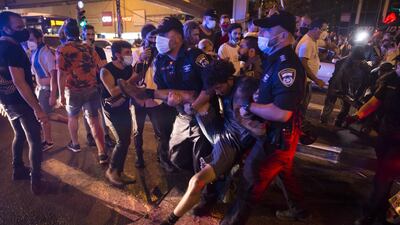
Police officers arrest a protester as he blocks a main junction during a protest against the government's economy response to the corona virus crisis in Tel Aviv. Getty Images -
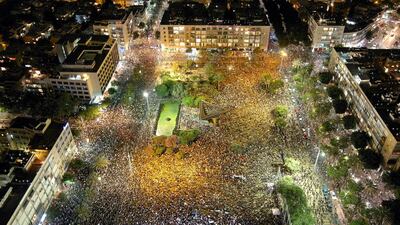
A general view shows Rabin square as Israelis protest against the government's response to the financial fallout of the coronavirus disease crisis in Tel Aviv. REUTERS -
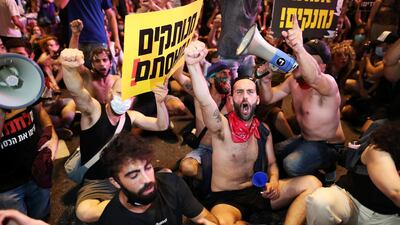
Israelis block a main junction in the city as they protest against the government's response to the financial fallout of the coronavirus crisis in Tel Aviv. REUTERS -
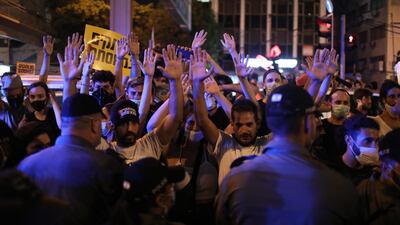
Israeli border police confronts protesters during a self-employed business owners demonstration against the Israeli government in Rabin square in Tel Aviv. EPA -
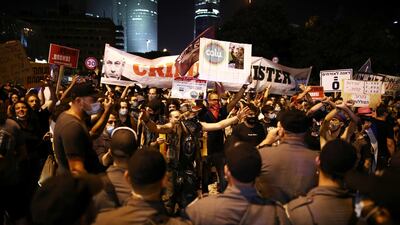
Police force stand in front of the protestors as they block a main junction in the city following a protest against the government's response to the financial fallout of the coronavirus disease (COVID- 19) crisis in Tel Aviv. REUTERS -
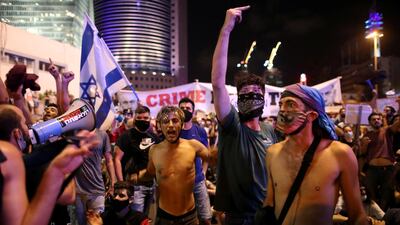
Israelis block a main junction in the city as they protest against the government's response to the financial fallout of the coronavirus crisis in Tel Aviv, Israel. REUTERS -

Police detain a protester as Israelis block a main junction in the city following a protest against the government's response to the financial fallout of the coronavirus disease (COVID- 19) crisis in Tel Aviv. REUTERS -

Israeli Protester holds a fake bill with a photo of the Israeli Prime Minister Benjamin Netanyahu as she protests against the Government's economy response to the cororna virus crisis in Tel Aviv. Getty Images -
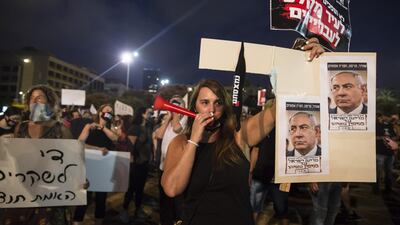
Israeli woman holds a sign with photos of Israeli Prime Minister Benjamin Netanyahu as she protests against the Government's economy response to the cororna virus crisis in Tel Aviv. Getty Images


In a time of profound crisis and uncertainty, many Israelis are wondering which policies are being pursued for the national good and which for Mr Netanyahu’s personal benefit.
The government's months-long focus on the annexation of swaths of Palestinian territory in the West Bank has looked like political pandering to his settler constituency, creating a dangerous distraction from dealing with the pandemic.
Similarly, a one-off handout this week to every Israeli – over the strenuous objections of finance officials – looks suspiciously like an electoral bribe. As a result, Mr Netanyahu is facing a rapid decline in support. A recent survey shows trust in him has fallen by half – from 57 per cent in March and April, when the Covid-19 pandemic began, to 29 per cent today.
Many Israelis increasingly see Mr Netanyahu less as a father figure and more as a drain on resources from the body politic. Capturing the popular mood is a new art work called the "Last Supper" that was covertly installed in central Tel Aviv. It shows Mr Netanyahu alone, gorging on a vast banquet by stuffing his hand into an enormous cake decorated with the Israeli flag.

In another move designed to highlight the case against Mr Netanyahu, better-off Israelis have been publicly organising to donate this week’s state handout to those in need.
Mr Netanyahu’s repeated incitement against the protesters – disparaging them as “leftists” and “anarchists”, and suggesting they are spreading disease – appears to have backfired. It has only rallied more people to the street.
But the incitement and Mr Netanyahu’s claims that he is the true victim – and that in the current climate he faces assassination – have been interpreted as a call to arms by some on the right. Last week five protesters were injured when his loyalists used clubs and broken bottles on them, with police appearing to turn a blind eye. Further attacks were reported at the weekend. Protest organisers said they had begun arranging defence units to protect demonstrators.
Mr Ohana has called for a ban on the protests and urged a heavy hand from the police. He has delayed appointing a new police chief – a move seen as incentivising local commanders to crack down on the protests to win favour. Large numbers of protesters have been forcefully arrested, with reports that police have questioned some on their political views.
Observers have wondered whether the protests can transcend party political tribalism and develop into a grassroots movement demanding real change. That might widen their appeal to even more disadvantaged groups, not least the one fifth of Israel’s citizens who belong to its Palestinian minority.
But it would also require more of the protesters to start drawing a direct connection between Mr Netanyahu’s personal abuses of office and the wider, systemic corruption of Israeli politics, with the occupation its beating heart.
That may yet prove a tall order, especially when Israel feels it can resist external pressure for change.
Jonathan Cook is a freelance journalist in Nazareth

