Last night was the winter solstice – the longest night of the year, an occasion celebrated in Afghanistan and other Persian-speaking countries, where it is known as “shab-e-Yalda”.
It isn’t the prolonged darkness that is celebrated during Yalda. Rather, it is the rebirth of the daylight. Until the next solstice, the days progressively get brighter.
But will Afghanistan's days really get any brighter?
Longer, perhaps. To Afghans who have witnessed ever more monstrous displays of violence on their streets this week, the days certainly feel long.
But brighter? That depends upon the country’s leadership – both within the national government that resides in Kabul and the senior command of the Taliban militant group whose forces occupy much of the nation’s rural areas.
The two were, until 10 days ago, in negotiations known as “intra-Afghan dialogue” in Doha, Qatar, attempting to wade through the morass of their decades-long conflict to find peace on the other side. Now, despite the unrelenting escalation of crisis in Afghanistan, which is caught between the coronavirus pandemic and the civil war, the two sides’ negotiating teams are in the middle of a three-week recess.
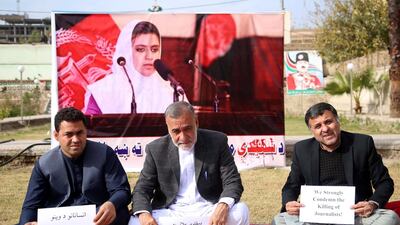
Journalists at a protest against the killing of Malala Maiwand, an Afghan journalist who was killed on 11 December. No group has claimed the attack. EPA
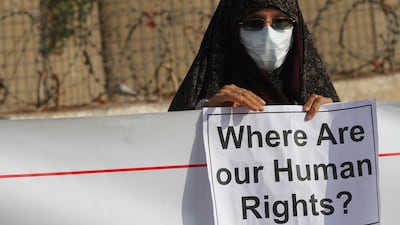
Activists gather in front of the UN office in Herat, Afghanistan, to demand peace and an end to war. EPA
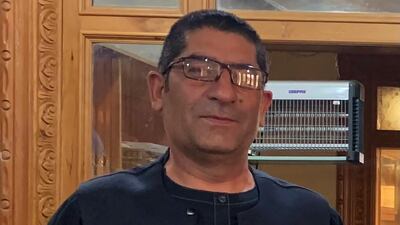
Afghan Journalist Rahmatullah Nikzad who was shot dead by unknown assailants in Afghanistan's central Ghazni province on Monday. AP
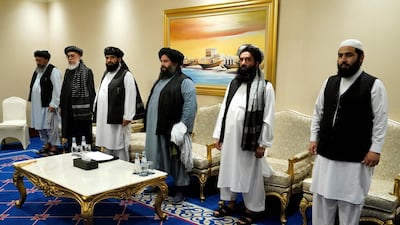
Members of the Taliban's peace negotiation team taking part in talks with the Afghan government in Doha. Reuters
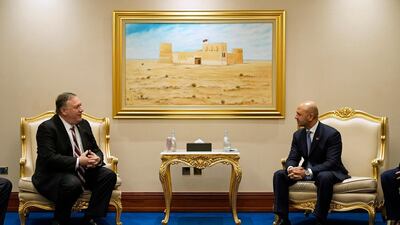
US Secretary of State Mike Pompeo talks to Afghanistan's State Minister for Peace Sayed Sadat Mansoor Naderi in Doha last November. The Afghan government and the Taliban are trying to hammer out a peace deal. AP
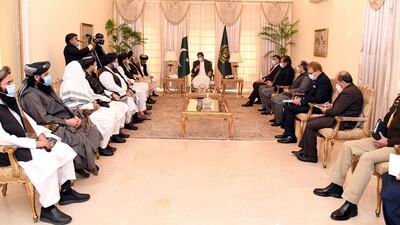
A Taliban delegation talking to Pakistan's Prime Minister Imran Khan in Islamabad last week. The two groups met to discuss an ongoing peace process. EPA
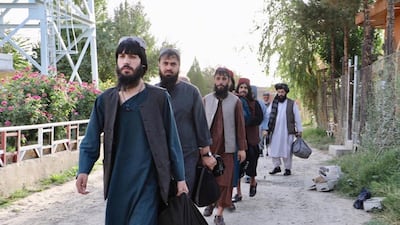
Taliban prisoners preparing to leave a government prison in Kabul, Afghanistan, as part of an arrangement to persuade the insurgent group to start peace talks. EPA
The recess is a holiday from the stressful negotiating environment of Doha’s luxury hotels, so that both teams can go back to their respective leaders and update them on their progress, which they and others have referred to as a “breakthrough”.
There has been no breakthrough, at least not one that will matter to historians who may one day reflect on the negotiations. The two achievements of the talks between September and now are, first, an agreement by both sides about the procedural rules they will follow during the negotiations and, second, the articulation of the distinct lists of topics they would like to discuss. They have decided – after 20 years of war, multiple years of back-channel communications and three months of the latest rounds of official talks – in what manner they wish to talk to each other and what each side wants to talk about.
The latter is hardly an achievement, as neither side approves of the other’s list of topics, nor the order in which to discuss the topics that overlap. Both sides want to discuss women’s rights, for example, but the Taliban only wants to discuss them within the context of its interpretation of Islamic principles. The Afghan government wants to discuss a ceasefire first. The Taliban wants to discuss it last.
The talks are due to resume on January 5. If that happens, then that may be the real breakthrough. In the history of talks between the Afghan government and the Taliban, no deadline has ever been adhered to.
Honouring this deadline is made less likely by the fact that the two sides now disagree about even the venue. The Afghan government wants it to be Afghanistan, but the Taliban fears that this means holding them in territory where the national government’s authority is recognised. Kabul’s response has been that the Taliban can choose any area of the country they like, but the distrust on both sides is so deep that they are now accusing one another of playing tricks.
“Afghans can negotiate under a tent, too, and in cold weather,” Afghan President Ashraf Ghani has said. “This is not the time for luxury hotels to be considered as preconditions.”
At this point, forcing negotiators to huddle together in a cold tent until they find a solution sounds like a constructive idea. The chasm between them is so vast otherwise. The quibbles over procedure and terminology (the Afghan government and Taliban were each insistent they be referred to by titles the other side doesn’t recognise) that have taken three months to hash out are utterly insignificant compared to the fundamental questions remaining, such as what kind of government and constitution Afghanistan should have. They are an absurdity compared to the overwhelming importance of securing an immediate and total ceasefire.
Car bombs have rocked Kabul this week. AFP
When the Doha talks began in September, the civilian death toll in Afghanistan’s war for 2020 stood at 2,100. The numbers continue to grow, and the attacks are so regular and ubiquitous that it begins to look like every Afghan life is under personal siege. Last week alone, 31 Afghan civilians were killed in the war. Several journalists have been killed this month. This morning, five people, including four doctors, were killed in a car bomb in Kabul. Last Friday, 15 children were killed when unexploded ordnance they were attempting to sell went off. Over the past 14 years, 26,000 Afghan children have been killed or maimed.
I have always found the phrase “intra-Afghan dialogue” to be curious. After all, why not “inter-Afghan dialogue”, which would more accurately reflect dialogue “between” Afghans? On reflection, however, “intra”, meaning “within”, is far more appropriate. Whoever coined it to describe these negotiations really knew the nature of the task.
The dialogue that has taken place thus far wasn’t really between Afghans at all. It has been within each side, as they struggle to continue pushing narrow strategies, pettiness and pride in the face of mounting casualties and a widening divide. They struggle to open their minds, and so delay any frank discussion of what an Afghanistan that really, practically works will look like.
Until that changes, the long night continues.
Sulaiman Hakemy is opinion editor at The National

UAE currency: the story behind the money in your pockets
More than 2.2 million Indian tourists arrived in UAE in 2023 More than 3.5 million Indians reside in UAE Indian tourists can make purchases in UAE using rupee accounts in India through QR-code-based UPI real-time payment systems Indian residents in UAE can use their non-resident NRO and NRE accounts held in Indian banks linked to a UAE mobile number for UPI transactions
Mercer, the investment consulting arm of US services company Marsh & McLennan, expects its wealth division to at least double its assets under management (AUM) in the Middle East as wealth in the region continues to grow despite economic headwinds, a company official said.
Mercer Wealth, which globally has $160 billion in AUM, plans to boost its AUM in the region to $2-$3bn in the next 2-3 years from the present $1bn, said Yasir AbuShaban, a Dubai-based principal with Mercer Wealth.
“Within the next two to three years, we are looking at reaching $2 to $3 billion as a conservative estimate and we do see an opportunity to do so,” said Mr AbuShaban.
Mercer does not directly make investments, but allocates clients’ money they have discretion to, to professional asset managers. They also provide advice to clients.
“We have buying power. We can negotiate on their (client’s) behalf with asset managers to provide them lower fees than they otherwise would have to get on their own,” he added.
Mercer Wealth’s clients include sovereign wealth funds, family offices, and insurance companies among others.
From its office in Dubai, Mercer also looks after Africa, India and Turkey, where they also see opportunity for growth.
Wealth creation in Middle East and Africa (MEA) grew 8.5 per cent to $8.1 trillion last year from $7.5tn in 2015, higher than last year’s global average of 6 per cent and the second-highest growth in a region after Asia-Pacific which grew 9.9 per cent, according to consultancy Boston Consulting Group (BCG). In the region, where wealth grew just 1.9 per cent in 2015 compared with 2014, a pickup in oil prices has helped in wealth generation.
BCG is forecasting MEA wealth will rise to $12tn by 2021, growing at an annual average of 8 per cent.
Drivers of wealth generation in the region will be split evenly between new wealth creation and growth of performance of existing assets, according to BCG.
Another general trend in the region is clients’ looking for a comprehensive approach to investing, according to Mr AbuShaban.
“Institutional investors or some of the families are seeing a slowdown in the available capital they have to invest and in that sense they are looking at optimizing the way they manage their portfolios and making sure they are not investing haphazardly and different parts of their investment are working together,” said Mr AbuShaban.
Some clients also have a higher appetite for risk, given the low interest-rate environment that does not provide enough yield for some institutional investors. These clients are keen to invest in illiquid assets, such as private equity and infrastructure.
“What we have seen is a desire for higher returns in what has been a low-return environment specifically in various fixed income or bonds,” he said.
“In this environment, we have seen a de facto increase in the risk that clients are taking in things like illiquid investments, private equity investments, infrastructure and private debt, those kind of investments were higher illiquidity results in incrementally higher returns.”
The Abu Dhabi Investment Authority, one of the largest sovereign wealth funds, said in its 2016 report that has gradually increased its exposure in direct private equity and private credit transactions, mainly in Asian markets and especially in China and India. The authority’s private equity department focused on structured equities owing to “their defensive characteristics.”
Timeline
2012-2015
The company offers payments/bribes to win key contracts in the Middle East
May 2017
The UK SFO officially opens investigation into Petrofac’s use of agents, corruption, and potential bribery to secure contracts
September 2021
Petrofac pleads guilty to seven counts of failing to prevent bribery under the UK Bribery Act
October 2021
Court fines Petrofac £77 million for bribery. Former executive receives a two-year suspended sentence
December 2024
Petrofac enters into comprehensive restructuring to strengthen the financial position of the group
May 2025
The High Court of England and Wales approves the company’s restructuring plan
July 2025
The Court of Appeal issues a judgment challenging parts of the restructuring plan
August 2025
Petrofac issues a business update to execute the restructuring and confirms it will appeal the Court of Appeal decision
October 2025
Petrofac loses a major TenneT offshore wind contract worth €13 billion. Holding company files for administration in the UK. Petrofac delisted from the London Stock Exchange
November 2025
180 Petrofac employees laid off in the UAE
Who's who in Yemen conflict
Houthis: Iran-backed rebels who occupy Sanaa and run unrecognised government
Yemeni government: Exiled government in Aden led by eight-member Presidential Leadership Council
Southern Transitional Council: Faction in Yemeni government that seeks autonomy for the south
Habrish 'rebels': Tribal-backed forces feuding with STC over control of oil in government territory
Starring: Kareena Kapoor Khan, Ash Tandon, Prabhleen Sandhu
Director: Hansal Mehta
Rating: 4 / 5
Cricket World Cup League Two
Teams
Oman, UAE, Namibia
Al Amerat, Muscat
Results
Oman beat UAE by five wickets
UAE beat Namibia by eight runs
Namibia beat Oman by 52 runs
UAE beat Namibia by eight wickets
Fixtures
Saturday January 11 - UAE v Oman
Sunday January 12 – Oman v Namibia
The Voice of Hind Rajab
Starring: Saja Kilani, Clara Khoury, Motaz Malhees
Director: Kaouther Ben Hania
Rating: 4/5
Mobile phone packages comparison
What vitamins do we know are beneficial for living in the UAE
Vitamin D: Highly relevant in the UAE due to limited sun exposure; supports bone health, immunity and mood. Vitamin B12: Important for nerve health and energy production, especially for vegetarians, vegans and individuals with absorption issues. Iron: Useful only when deficiency or anaemia is confirmed; helps reduce fatigue and support immunity. Omega-3 (EPA/DHA): Supports heart health and reduces inflammation, especially for those who consume little fish.
Key facilities
Olympic-size swimming pool with a split bulkhead for multi-use configurations, including water polo and 50m/25m training lanes
Premier League-standard football pitch
400m Olympic running track
NBA-spec basketball court with auditorium
600-seat auditorium
Spaces for historical and cultural exploration
An elevated football field that doubles as a helipad
Specialist robotics and science laboratories
AR and VR-enabled learning centres
Disruption Lab and Research Centre for developing entrepreneurial skills