• Ahmad al-Asmar, 84, and his wife Nouzat Awada, 79, perform Friday prayers inside their home as mosques are closed over concerns of the spread of coronavirus disease (COVID-19) in Sidon, Lebanon. Reuters
    Ahmad al-Asmar, 84, and his wife Nouzat Awada, 79, perform Friday prayers inside their home as mosques are closed over concerns of the spread of coronavirus disease (COVID-19) in Sidon, Lebanon. Reuters
  • A woman on her balcony reaches out to catch a rose delivered to her via a drone on Mother's day, in the Lebanese coastal city of Jounieh, north of the capital Beirut as people remain indoors in an effort to limit the spread of the novel coronavirus. Three young Lebanese came up with the idea of delivering roses attached to drones, offered to mothers by their children as a surprise gift. The funds collected from this initiative will be donated to the Lebanese Red Cross to help fight against the CIVID-19 pandemic. AFP
    A woman on her balcony reaches out to catch a rose delivered to her via a drone on Mother's day, in the Lebanese coastal city of Jounieh, north of the capital Beirut as people remain indoors in an effort to limit the spread of the novel coronavirus. Three young Lebanese came up with the idea of delivering roses attached to drones, offered to mothers by their children as a surprise gift. The funds collected from this initiative will be donated to the Lebanese Red Cross to help fight against the CIVID-19 pandemic. AFP
  • A woman on her balcony reaches out to catch a rose delivered to her via a drone on Mother's day, in the Lebanese coastal city of Jounieh, north of the capital Beirut, as people remain indoors in an effort to limit the spread of the novel coronavirus. Three young Lebanese came up with the idea of delivering roses attached to drones, offered to mothers by their children as a surprise gift. The funds collected from this initiative will be donated to the Lebanese Red Cross to help fight against the CIVID-19 pandemic. AFP
    A woman on her balcony reaches out to catch a rose delivered to her via a drone on Mother's day, in the Lebanese coastal city of Jounieh, north of the capital Beirut, as people remain indoors in an effort to limit the spread of the novel coronavirus. Three young Lebanese came up with the idea of delivering roses attached to drones, offered to mothers by their children as a surprise gift. The funds collected from this initiative will be donated to the Lebanese Red Cross to help fight against the CIVID-19 pandemic. AFP
  • A Lebanese policeman fines a man for violating lockdown rules in Beirut's Hamra street. AFP
    A Lebanese policeman fines a man for violating lockdown rules in Beirut's Hamra street. AFP
  • An aerial view of the Achrafiyeh district of Lebanon's capital Beirut is seen as streets empty to minimise social contact as part of efforts against COVID-19 coronavirus disease. AFP
    An aerial view of the Achrafiyeh district of Lebanon's capital Beirut is seen as streets empty to minimise social contact as part of efforts against COVID-19 coronavirus disease. AFP
  • A woman standing on her balcony, reaches out to catch a rose delivered to her via a drone on Mother's day, in the Lebanese coastal city of Jounieh, north of the capital Beirut, as people remain indoors in an effort to limit the spread of the novel coronavirus. In a quiet Lebanese town under lockdown over the novel coronavirus, a drone buzzed towards a balcony on Saturday to deliver a red rose to a mother grinning in surprise. The COVID-19 pandemic may have put a damper on Mother's Day this year, but three students have come up with a novel service to celebrate the occasion without flouting social distancing restrictions. AFP
    A woman standing on her balcony, reaches out to catch a rose delivered to her via a drone on Mother's day, in the Lebanese coastal city of Jounieh, north of the capital Beirut, as people remain indoors in an effort to limit the spread of the novel coronavirus. In a quiet Lebanese town under lockdown over the novel coronavirus, a drone buzzed towards a balcony on Saturday to deliver a red rose to a mother grinning in surprise. The COVID-19 pandemic may have put a damper on Mother's Day this year, but three students have come up with a novel service to celebrate the occasion without flouting social distancing restrictions. AFP
  • Young men prepare roses to be delivered via drone to women on Mother's day, in Haret Sakher near the coastal city of Jounieh, north of the capital Beirut. AFP
    Young men prepare roses to be delivered via drone to women on Mother's day, in Haret Sakher near the coastal city of Jounieh, north of the capital Beirut. AFP
  • A woman who just received a rose delivered to her via a drone on Mother's day, thanks her daughter with a kiss, in the coastal city of Jounieh, north of the capital Beirut. AFP
    A woman who just received a rose delivered to her via a drone on Mother's day, thanks her daughter with a kiss, in the coastal city of Jounieh, north of the capital Beirut. AFP
  • Young men prepare roses to be delivered via drone to women on Mother's day, in Haret Sakher near the coastal city of Jounieh, north of the capital Beirut, as people remain indoors in an effort to limit the spread of the novel coronavirus. Three young Lebanese came up with the idea of delivering roses attached to drones, offered to mothers by their children as a surprise gift. The funds collected from this initiative will be donated to the Lebanese Red Cross to help fight against the CIVID-19 pandemic. AFP
    Young men prepare roses to be delivered via drone to women on Mother's day, in Haret Sakher near the coastal city of Jounieh, north of the capital Beirut, as people remain indoors in an effort to limit the spread of the novel coronavirus. Three young Lebanese came up with the idea of delivering roses attached to drones, offered to mothers by their children as a surprise gift. The funds collected from this initiative will be donated to the Lebanese Red Cross to help fight against the CIVID-19 pandemic. AFP
  • A man wears a tear gas mask to help protect himself from the new coronavirus as he walks at Beirut's seaside corniche, or waterfront promenade, along the Mediterranean Sea, which is almost empty of residents and tourists in Beirut, Lebanon. For most people, the new coronavirus causes only mild or moderate symptoms, such as fever and cough. For some, especially older adults and people with existing health problems, it can cause more severe illness, including pneumonia. AP Photo
    A man wears a tear gas mask to help protect himself from the new coronavirus as he walks at Beirut's seaside corniche, or waterfront promenade, along the Mediterranean Sea, which is almost empty of residents and tourists in Beirut, Lebanon. For most people, the new coronavirus causes only mild or moderate symptoms, such as fever and cough. For some, especially older adults and people with existing health problems, it can cause more severe illness, including pneumonia. AP Photo
  • A view of closed shops as part of the preventive measures against the ongoing coronavirus pandemic at Nejmeh square in Sidon (Saida), Lebanon. According to reports, Lebanon registered 163 cases from the COVID-19 disease caused by the SARS-CoV-2 coronavirus. EPA
    A view of closed shops as part of the preventive measures against the ongoing coronavirus pandemic at Nejmeh square in Sidon (Saida), Lebanon. According to reports, Lebanon registered 163 cases from the COVID-19 disease caused by the SARS-CoV-2 coronavirus. EPA
  • A view of a closed Sidon port as part of the preventive measures against the ongoing coronavirus pandemic, in Sidon (Saida), Lebanon. According to reports, Lebanon registered 163 cases from the COVID-19 disease caused by the SARS-CoV-2 coronavirus. EPA
    A view of a closed Sidon port as part of the preventive measures against the ongoing coronavirus pandemic, in Sidon (Saida), Lebanon. According to reports, Lebanon registered 163 cases from the COVID-19 disease caused by the SARS-CoV-2 coronavirus. EPA

A doctor's view from the frontlines of Lebanon's coronavirus fight


  • English
  • Arabic

Lebanon has been reeling under the burden of economic, social, political and financial crises that crystallised last November and have yet to be addressed.

A dream of possible change for a better Lebanon began on October 17, 2019, when more than a million Lebanese took to the streets demanding the downfall of a corrupt, sectarian elite. Two weeks later, the government resigned and a financial crisis that has yet to be resolved gripped the fragile nation.

Given this recent history, it is no exaggeration to say that the nightmare of Covid-19 reached Lebanon at the worst possible time.

As a doctor working in a Beirut hospital, I can tell you that the pandemic has added incredible strain on a healthcare sector already in turmoil.

Lebanon’s crisis caused a scarcity of medical supplies necessary to deal with the outbreak, months before it had reached Beirut. The country’s financial crisis includes a drastic shortage of foreign currencies, mainly dollars, which are used interchangeably with the Lebanese pound. The dollar scarcity has impacted the ability of medical suppliers to import vital supplies such as masks, gloves, ventilators and spare parts, all bought in dollars.

The government, medical personnel, hospitals, the media, the army as well as ordinary people are all joining their efforts to minimise the spread of the disease. A quarantine was announced earlier in March, with shops and bakeries encouraged to limit opening hours and people fined for leaving their houses without a valid reason.

Yet, the number of coronavirus patients is increasing by the day despite these measures, as well as efforts to raise awareness among the population.

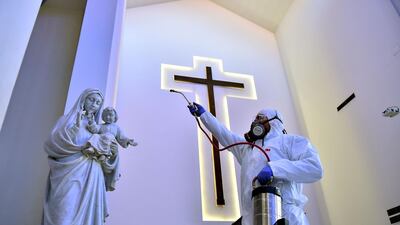
  • Sanitary workers disinfect a church in Beirut. AFP
    Sanitary workers disinfect a church in Beirut. AFP
  • Lebanon's health minister said hospitals were ready to deal with any further spread of the novel coronavirus Covid-19 in the country. AFP
    Lebanon's health minister said hospitals were ready to deal with any further spread of the novel coronavirus Covid-19 in the country. AFP
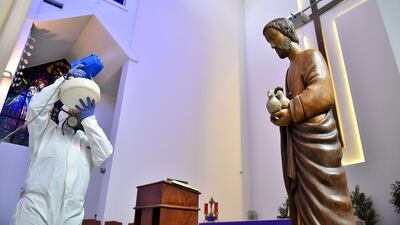
  • Sanitary workers disinfect a church in Beirut. AFP
    Sanitary workers disinfect a church in Beirut. AFP
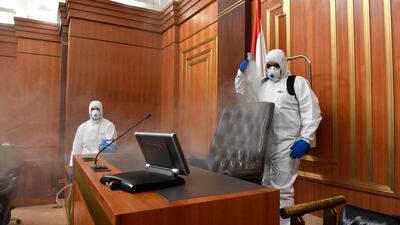
  • Sanitary workers disinfect the desks and chairs of the Lebanese Parliament in central Beirut. AFP
    Sanitary workers disinfect the desks and chairs of the Lebanese Parliament in central Beirut. AFP
  • A Lebanese Health Ministry official said on Tuesday that a man has died from the coronavirus, marking the first known death from the Covid-19 illness in the country. Lebanese Parliament Media Office
    A Lebanese Health Ministry official said on Tuesday that a man has died from the coronavirus, marking the first known death from the Covid-19 illness in the country. Lebanese Parliament Media Office
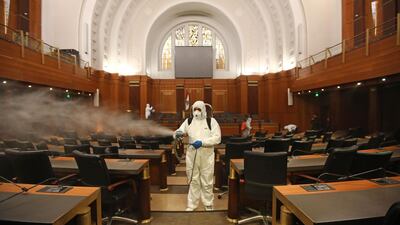
  • Sanitary workers disinfect the desks and chairs of the Lebanese Parliament in central Beirut. AFP
    Sanitary workers disinfect the desks and chairs of the Lebanese Parliament in central Beirut. AFP
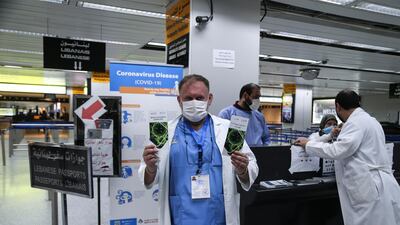
  • Lebanese doctor holds awareness brochures on coronavirus to be distributed on arriving passengers at Rafic Hariri international airport in Beirut. EPA
    Lebanese doctor holds awareness brochures on coronavirus to be distributed on arriving passengers at Rafic Hariri international airport in Beirut. EPA
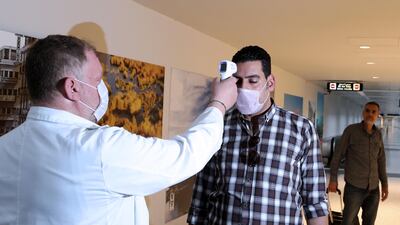
  • A Lebanese doctor checks the temperature of a passenger as a precautionary measure against the coronavirus, upon his arrival at the Rafic Hariri International Airport in Beirut. EPA
    A Lebanese doctor checks the temperature of a passenger as a precautionary measure against the coronavirus, upon his arrival at the Rafic Hariri International Airport in Beirut. EPA

The number of infected patients is also believed to be higher than the official rate for many reasons. Firstly, the severity of the symptoms will vary depending on the person, and those with little to no signs of illness are unlikely to seek medical advice.

Secondly, the number of testing kits at hand in the country are limited, and they are only available in a few Beirut hospitals, limiting their reach deep within other provinces and in refugee camps. Thirdly, although literacy levels in Lebanon are well above those of neighbouring nations, nearly three out of 10 Lebanese live below the poverty line, and three quarters of Syrian refugees, who amount to one-sixth of the country's residents, are poor, according to statistics by the United Nations Development Programme.

Health-care workers, doctors, nurses and staff at the Rafik Hariri University Hospital, where most of the Lebanese coronavirus cases are treated, as they are saluted by Lebanese policemen. EPA

When people live in destitution, they have no choice but to continue working. This means a wide range of people simply cannot afford to respect the guidelines imposed by the government as they need to leave their houses to make a living and provide for their families.

For all these reasons, we as medical professionals cannot assume that the disease is not spreading rapidly or that it is somehow contained.

But despite these challenges, the pandemic has also allowed for the resilience of the Lebanese people to shine.

The Lebanese residing in the country and the diaspora are donating money to help the medical centres treating coronavirus cases, as well as to aid organisations such as the Lebanese Red Cross. More importantly, many are lending a helping hand to thousands of families that can no longer provide for themselves during these difficult times.

And at a time when few leaders in the medical field are teaming up to invent locally made ventilators, Lebanese institutions and companies are making masks, gowns and personal protective equipment for doctors and nurses.

A wide range of people simply cannot afford to rstay in as they need to make a living and provide for their families

The Lebanese health ministry is also trying to play a positive role and equip 12 additional public hospitals outside Beirut and its immediate surroundings with the necessary tools to treat coronavirus patients. A few private hospitals have also begun to receive some Covid-19 patients, who were so far quarantined in a separate wing at the Rafik Hariri Governmental University Hospital, a public healthcare centre.

Still, Lebanon needs help to make it through the Covid-19 crisis. Our hospitals need funds to become well-equipped. We must also prepare all medical facilities across the country to be able to admit coronavirus patients and to carry out more testing. It is the government's prerogative to keep spreading awareness and encouraging people to comply with the new rules that have been put in place for our own safety.

Solidarity, love and patience are required for Lebanon to survive this pandemic, the newest in a series of crises that have struck our country.

Joumana Alameh is medical director of neonatal intensive care at the Clemenceau Medical Centre in Beirut