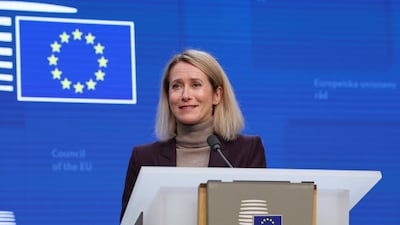

Europe, according to certain media sources, fears being sidelined after the continent was not part of the trilateral meeting between the Chinese, Russian and American leaders in Shenzhen last week, while its representatives were not included in the US-mediated negotiations between Russia and Ukraine in Abu Dhabi earlier this month.
If so, the EU foreign policy chief, Kaja Kallas, is not exactly helping the cause. A clip of her has recently gone viral in which Ms Kallas said she had just been at an Asean meeting. “Russia was addressing China,” she said, “like Russia and China, we fought the Second World War, we won the Second World War... And I was like, ‘okay, that is something new... You can see that they buy these narratives.”
For the EU’s top diplomat to say it is “something new” to her that both the Soviet Union and China fought on the Allied side during the Second World War - around 25 million Russians and 20 million Chinese died during that conflict - is so extraordinary that it is hard to believe she has no knowledge of it. To fail to acknowledge the suffering of those two states, and to suggest these undisputed historical facts are merely “narratives”, is so offensive that one wonders how she could possibly remain in her post.
Sadly, though, such ignorance of the wider Asian continent (75 per cent of Russia’s landmass in Asia) is widespread in the West. In September, a report in a well-known British newspaper stated that “Taiwan… is a self-governed democracy that Beijing claims as its territory despite never having controlled the island.” This would have been “something new” for the leaders of both sides of the Chinese civil war, Mao Zedong and Chiang Kai-Shek, and indeed for the Chinese Qing dynasty who ruled the island for over 200 years.
At his senate confirmation hearings in January 2025, US Defence Secretary Pete Hegseth was stumped when asked if he could name one member of Asean (the Association of Southeast Asian Nations), explain what kind of agreement the US had with it, and say how many countries were in the group. Mr Hegseth replied that he couldn’t give the number, but “I know we have allies in South Korea and Japan, and in AUKUS with Australia.” It was pointed out to him that none of those are part of the nearly 700 million strong bloc which would be the world’s fifth largest economy.
In April last year, US commentator Bill O’Reilly said during President Xi’s state visits to Vietnam, Malaysia and Cambodia: “Hey, President Xi, let me just break it to you. Those folks have no money at all. They cannot help you. They are not gonna buy your stuff because they don’t have any money.” Mr O’Reilly may not be aware that Malaysia – where I live – now handles around 13 percent of global back-end chip processing, and he might change his mind about locals not having money if he saw the permanent queues outside the Louis Vuitton store near my home. As the country’s prime minister Anwar Ibrahim put it: “He is still trapped in an imperialist mindset.”
I could go on, but I’ll list just two more examples. In 2006 the then British deputy prime minister John Prescott said on a visit “It's very nice to be here in Malaya” – which has not been the country’s name since 1963; and around the same time I was working at a news magazine in London when I was surprised to see the new issue contained a map of the Arabian Gulf which omitted one GCC state completely. During all the editing and proofing, nobody, it seemed, had noticed.
In some quarters this issue is occasionally admitted. “Could you pass a test on Asia?” was the headline on a 2023 column in the Financial Times, adding: “Ignorance of the continent is the biggest hole in Western education.” It’s not just about the facts and figures – although a few old-fashioned history and geography lessons wouldn’t go amiss. It’s also about perspectives. How would a French, American or British person feel if their country had suffered the “century of humiliation” that China did? Rarely does the thought appear to be entertained.
And it’s also about the lens. The Westphalian idea of the nation state with a clearly defined territory and boundaries, for instance, may still be a useful framing in the Western hemisphere. It has not, however, been historically the norm in many of the sultanates and kingdoms in Southeast Asia, where authority ebbed the further you went from the capital, a variety of – often fairly nominal – tributary arrangements were common, and borderlands, rather than strictly demarcated boundaries, were a regular feature. Context is crucial.
This is why the Indian political scientist Amitav Acharya has proposed changing what he and others believe to be the Western theory-dominated field of International Relations (IR) into a Global IR. The key to the approach, he has written, “is to ‘bring the Rest in’: to end the marginalisation of the non-Western and Global South’s ideas, history, voices, and agency.”
Readers need no reminding of how power and wealth have been growing inexorably in the Asian continent, which is now reckoned to make up around 50 percent of global GDP in PPP terms. So, it should be obvious that the lack of awareness, the cluelessness, and the lingering assumptions of Western superiority demonstrated in the instances I mention above are simply insupportable today. Quite apart from anything else, it is in the self-interest of ageing, low growth Western societies that need trade with Asia to learn more about it.
As for the EU and Europe’s fears of being left out: they might want to find a more diplomatic foreign affairs chief, or at least one with the slightest grasp of history. It is hard to see Asian countries being delighted to see Ms Kallas at the table after her casually dismissive words about the tens of millions from the continent who died in defence of the freedoms she so frequently claims to be fighting for.

