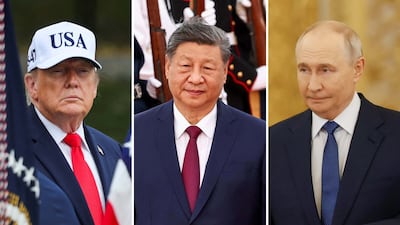

Next week, Chinese President Xi Jinping, US President Donald Trump and Russian President Vladimir Putin are expected to have a meeting on the sidelines of the Asia-Pacific Economic Co-operation summit in Shenzhen. Two words have been attached to this encounter, which all three governments have confirmed is being discussed: “historic” and “Yalta”.
“Historic”, because the three heads of state have never had a formal trilateral before; indeed, it has also been described as “unprecedented”. And “Yalta”, because many see parallels with the 1945 conference held in the Crimean city in which the “big three” – British prime minister Winston Churchill, US president Franklin Roosevelt and Soviet leader Joseph Stalin – discussed the post-Second World War status of Europe after it was liberated from the Nazis.
The second comparison is not a compliment: the conference is seen as having set the stage for the communist domination of Eastern Europe that lasted until the fall of the Berlin Wall in 1989. Those who warn of a second Yalta are suggesting that the three leaders may use the planned meeting next week to divide the world between them.
This is alarmist, for a variety of reasons – not the least of which is that, while history is certainly a useful guide, the habit of constantly viewing current events through the era of the Second World War ignores the realities of the very different time we are living in.
For starters, the “big three” were aptly named and could make decisions as though other states were mere pieces on a chessboard. In 1945, the US share of global gross domestic product alone was about 50 per cent; today it is about half that. The US, China and Russia are great powers still, yes, but we are moving into an age of increasing multipolarity where middle powers and associations of smaller countries can – and do – exert agency. The fact that the expected meeting will be during a gathering of Apec, which has 21 member states, is a case in point.
Could the three men talk about each of their countries having agreed “spheres of influence”? Mr Trump and Mr Putin might like to do so; Chinese officials have explicitly rejected the term.
But while we should be realistic about the fact that great powers inevitably have influence on their smaller neighbours – and always have done – neither the US nor Russian presidents have had it all their way in their “near abroad” of late. Mr Trump’s favoured candidate, Flavio Bolsonaro, recently lost Brazil’s presidential election to the veteran leftist Lula da Silva, while Mr Putin’s “special military operation” in Ukraine has achieved nothing like what it was clearly intended to do at the beginning.
-

US President Donald Trump, right, and Russian President Vladimir Putin shake hands at the end of a joint press conference after participating in a US-Russia summit on Ukraine at Joint Base Elmendorf-Richardson in Anchorage, Alaska, on August 15. AFP -

US President Donald Trump meets Russian President Vladimir Putin in Anchorage, Alaska. Reuters -

Mr Trump and Mr Putin pose on a podium on the tarmac after they arrived at Joint Base Elmendorf-Richardson in Anchorage. AFP -

Mr Trump steps off of Air Force One on arrival at Joint Base Elmendorf-Richardson in Anchorage. AFP -

Mr Putin arrives at Joint Base Elmendorf-Richardson. Reuters -

US Defence Secretary Pete Hegseth and Secretary of State Marco Rubio arrive in Anchorage. AP -

Russian President Vladimir Putin is accompanied by Kremlin spokesman Dmitry Peskov, following a meeting with US President Donald Trump at Joint Base Elmendorf-Richardson in Anchorage, Alaska. EPA -

US President Donald Trump and Russian President Vladimir Putin (L) speak before a joint news conference following their meeting at Joint Base Elmendorf-Richardson in Anchorage, Alaska. EPA -

Discussions between President Donald Trump and Russian counterpart Vladimir Putin concluded after more than two-and-a-half hours at their summit in Alaska, marking their longest in-person meeting and offering a sign that by the US leader's own judgement the talks have gone well. Bloomberg -

Russian President Vladimir Putin arrives for a joint news conference with US President Donald Trump after talks in Anchorage, Alaska. Bloomberg -

Russian President Vladimir Putin places flowers at the graves of Soviet soldiers at Fort Richardson National Cemetery in Anchorage, Alaska. Reuters -

US President Donald Trump boards Air Force One as he leaves Joint Base Elmendorf-Richardson in Anchorage, Alaska. AFP -

Russian President Vladimir Putin boards a plane upon departure in Anchorage, Alaska. Reuters


Do any of the three leaders want to turn, by military force, a large group of countries into satellite states, as Stalin did after Yalta? There is not a shred of evidence for this. China has always emphasised that its rise will be peaceful, and it has not fought a war since 1979. Europeans obsessed with the idea that Mr Putin wants to restore the USSR are fond of quoting him saying that “the demise of the Soviet Union was the greatest geopolitical catastrophe of the century”, but conveniently forget to add that he has also frequently said: “Anyone who wants to restore it doesn’t have a head.”
Another supposed “danger” of this proposed G3 is that Mr Trump would be so beguiled by the company of two men who have authority over their states he can only dream of, that he might give too much away on, say, nuclear weapons or Ukraine. But last month, China’s foreign ministry said that it would be “neither fair, reasonable nor realistic to ask China to join the so-called trilateral nuclear disarmament negotiations at this stage” – so that’s not up for discussion.
And German President Frank-Walter Steinmeier recently said that Mr Xi had told him that Ukraine was a European conflict and “Europeans must sit at the table”. On Ukraine, the trilateral that is much more likely to make a difference is the one currently taking place in Abu Dhabi.

Mr Xi, Mr Putin and Mr Trump are three of, if not the three, most powerful people on the planet. Instead of this bizarre insistence that if they meet, it would bode ill for everyone else, why not think of the possible positive outcomes, on AI governance, perhaps, or on ending the war with Iran? On a podcast this week, Da Wei, a professor at Tsinghua University, suggested the leaders could encourage a Track 1.5 or Track 2 dialogue – regular gatherings of scholars, officials and civil society actors, including government participation in the first case, and excluding that in the second, from China, Russia and the US.
That would be a very worthwhile result. Having taken part in countless such meetings when I was at Malaysia’s national think tank for four years, I can attest to how such dialogues – often off-the-record – can greatly expand mutual understanding, when the likes of former foreign ministers and ambassadors can speak freely and their remarks are not to be taken as the stated, formal positions of their respective countries.
As it is, we don’t know for sure that the Trump-Putin-Xi meeting will take place, and the latest reports are that Beijing is asking for prepared statements and predetermined outcomes while Washington wants a more flexible format. If it does happen, it could be that its significance is mostly symbolic. It would be remarkable in itself, and it would be historic.
Can we leave it at that? For it is not 1945, and the fate of half a continent is most unlikely to be up for grabs in Shenzhen next week. Sometimes, to paraphrase a saying attributed to Sigmund Freud, a meeting is just a meeting.

