By now there is an almost overwhelming consensus that the old international order as we knew it has failed, or is fading away. Inasmuch as America trumpeted that it should be “rules-based”, while constantly carving out exceptions for itself and its allies, that veneer has been fully stripped away.
That process became fully recognisable when former US president Joe Biden stood by while Israel bombed Gaza into rubble, which showed, as Jordan’s King Abdullah observed: “Palestinian lives matter less than Israeli ones. Our lives matter less than other lives. The application of international law is optional.”
Then when the administration of current President Donald Trump illegally kidnapped a head of state – Venezuela’s Nicolas Maduro – the collapse was laid bare.
The UN has appeared to be near powerless, while Secretary General Antonio Guterres has been unable or unwilling to wield the moral authority of his office to any notable effect. All this is underpinned by a grim statistic: the widely respected Uppsala Conflict Data Programme registered 65 state-based conflicts last year – the highest number since it began counting them just after the Second World War.
So are there any institutions or groups emerging to take the place of the old order?
There has been plenty of attention this week on the 10-nation Shanghai Co-operation Organisation, which celebrated its 25th anniversary with a conference in Bishkek, Kyrgyzstan. Consisting of four nuclear powers – China, Russia, India and Pakistan – four Central Asian states, plus Belarus and Iran, the group now accounts for 42 per cent of the world’s population.
The SCO has moved on from being “a limited regional framework for confronting the ‘three threats’, namely terrorism, separatism and extremism”, as China’s Global Times put it, and now represents “not only a demographic force but also the largest human market and potential workforce” and is “one of the platforms where the rules of the new international balance of power will be forged”. Sounds impressive.
Then there is Brics – the acronym coined for the group’s founders, Brazil, Russia, India, China and South Africa – which now includes the UAE, Saudi Arabia, Egypt, Iran, Indonesia and Ethiopia, and claims to cover 49.5 per cent of the world’s population and 40 per cent of global gross domestic product (at purchasing power parity).
At last year’s summit, Brazilian President Lula da Silva said that “Brics is a manifestation of the Bandung non-aligned movement”, but the group has been more dynamic on one measure than the old “Nam” ever was. The original core five overtook the G7 in terms of GDP in 2019, and their lead has only grown since. Plenty to celebrate when India hosts the next Brics summit later this month?
The real work, on economic co-operation, investment, food and energy security and so on, takes place behind the big headline figures. The Brics’ New Development Bank has approved financing of nearly $43 billion in more than 120 infrastructure projects since its founding in 2015, for instance, while Chinese officials released a statement this week praising the SCO for finding “the right way of co-existence featuring non-alliance, non-confrontation and not targeting any third party, enabling regional countries to build a common home together”.
-
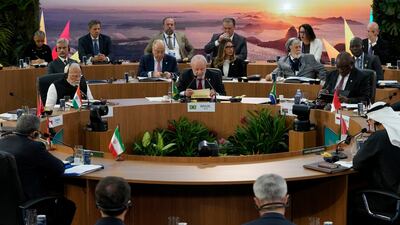
World leaders at the 17th annual Brics summit in Rio de Janeiro, Sunday. AP -
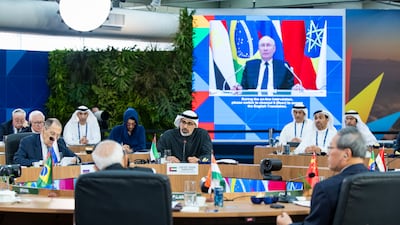
Sheikh Khaled bin Mohamed, Crown Prince of Abu Dhabi, with Russia's President Vladimir Putin projected on a screen during the first plenary session of the Brics summit in Rio de Janeiro. UAE Presidential Court -

Iran's Foreign Minister Abbas Araghchi, left, and Egypt's Prime Minister Mostafa Madbouly, right, at the Brics summit second plenary session. AFP -
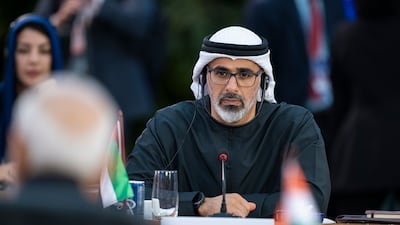
Sheikh Khaled during the first plenary session. UAE Presidential Court -
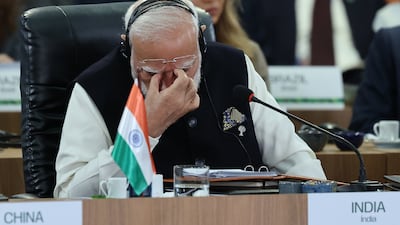
India's Prime Minister Narendra Modi gestures during Lula speech at the Brics summit. Getty Images -
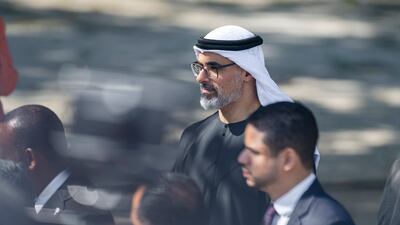
Sheikh Khaled is leading the UAE delegation at the 17th Brics summit. UAE Presidential Court -

Sheikh Khaled with the other leaders and high-level ministers at the summit. Reuters -
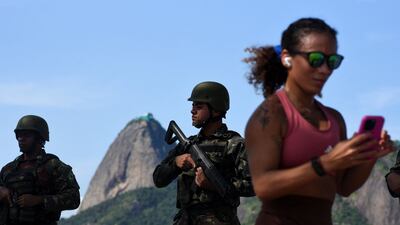
Members of the military stand guard near the Botafogo Beach. Reuters -

Brazilian President Luiz Inacio Lula da Silva greets Sheikh Khaled ahead of the summit in Rio de Janeiro. UAE Presidential Court -
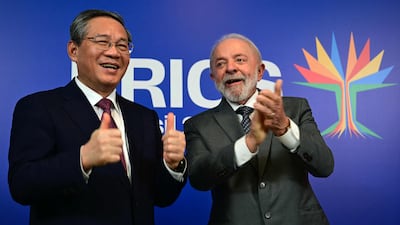
Mr da Silva with China's Premier Li Qiang in Rio de Janeiro. AFP -

Mr Li Qiang and President of the Republic of Indonesia Prabowo Subianto at the event. Reuters -

Mr da Silva with Mr Modi. Reuters -
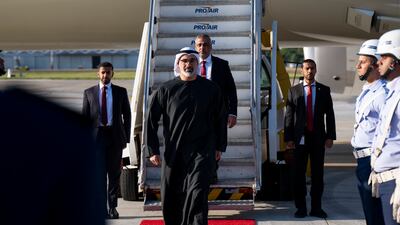
Sheikh Khaled arrives in Brazil to lead the UAE delegation. Abu Dhabi Media Office -
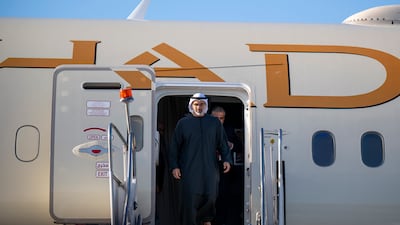
Sheikh Khaled is attending the Brics summit in Brazil on behalf of President Sheikh Mohamed. Photo: Abu Dhabi Media Office -
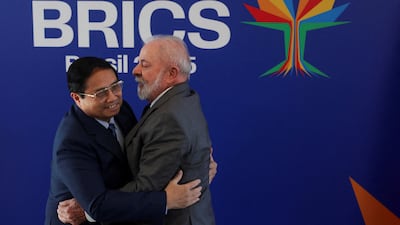
Mr da Silva with Vietnam Prime Minister Pham Minh Chinh. Reuters -

Mr da Silva receives Nigerian President Bola Tinubu. AP -

Mr da Silva greets Prime Minister of the Federal Democratic Republic of Ethiopia Abiy Ahmed Ali. AP


Nevertheless, there are sceptics of both groupings. “Is the Shanghai Co-operation Organisation performance art or meaningful collaboration?” was the title of one recent US analysis. Critics of Brics have varied from the dismissive to those, like Mr Trump, who accuse the organisation of trying to replace the US dollar. His typically dire threats have been met with the response that Brics seek less dollar-dependence, and not complete displacement of the greenback.
It is true that both Brics and the SCO follow consensus-based decision-making, which naturally slows the pace; both contain members with serious rivalries or deep disputes; and the integration – particularly on trade and infrastructure – that both seek has not happened overnight. One riposte to that would be to update the old proverb and reply that Nusantara, the planned new capital of Indonesia, won’t be built in a day either.
But as with some other organisations in the Global South and East, I believe the negative remarks about the SCO and Brics are based on a fallacy. They are not meant to be a Nato of the East, in the first case, or some nascent federal superpower, in the second. President Kassym-Jomart Tokayev of Kazakhstan put it well in Bishkek on Tuesday. “The SCO operates outside the logic of military-political blocs and is not directed against any state,” he said. “It is based on a completely different political philosophy – the ‘Shanghai Spirit’, whose foundation is the idea of joint work for the sake of progress.”
In the sense that neither the SCO nor Brics can replace the fading old order, we may be in for a “long in-between” before a new world order emerges. Although it should be stressed that neither group has that as a goal and, to the contrary, both place huge emphasis on the UN and its charter – with big reforms, of course.
But both the SCO and Brics do offer another model to the zero-sum approach adopted by many western countries, where disagreements are often treated as moral absolutes that must encompass all spheres of life. Disapproval of Russia’s invasion of Ukraine led, for instance, not just to official sanctions and retaliations from the West but also to the dismissal of Valery Gergiev, one of the world’s greatest conductors, from his podium at the Munich Philharmonic, while there were absurd calls for students to stop reading Russian literature.
SCO and Brics countries, on the other hand, may have serious political and territorial issues with one another; but it doesn’t stop them working together on the vast areas where agreement and mutual benefit can be found. This is the day-to-day reality where I live, in South-East Asia, where many countries have competing claims on the resource-rich South China Sea. The notion that this dispute should turn near-neighbours into enemies is rejected by almost all. I’ve quoted before the old saying about the Association of South-East Asian Nations – that its members “agree to disagree without being disagreeable” – but it strikes me as being part of the philosophy of the SCO and Brics as well.
It’s an over-simplification, of course. As words to bear in mind as a new world order emerges, however, you could do worse. We need a new paradigm. Whether it’s the “Shanghai spirit”, the Asean Way, or the example of Brics, an approach that stresses consensus and progress for all has to be better than an over-eager recourse to war. If I say I can think of some leaders who might benefit from trying it, I'm sure you can guess who they are.