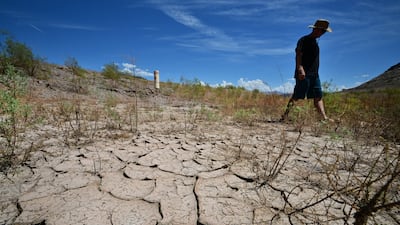

For three decades, the international response to climate change has focused on reducing greenhouse gas emissions. The energy transition has become central to this effort, shaping national policies, mobilising investment and driving innovation. Now, as the world confronts the consequences of climate change already under way, we must give water the same prominence in our approach to adaptation.
Water is how most people first experience climate change. Whether through prolonged drought, devastating floods or increasingly unpredictable rainfall, its effects reach directly into people’s lives, threatening food production, livelihoods, public health and economic security.
So, if energy has been the defining concern of climate mitigation, water must become the defining concern of adaptation, and to be effective, recognition must be matched by resources. Water already features in the national climate plans of most countries and is the sector most frequently identified in their adaptation measures. Yet inclusion in a national plan is not the same as meaningful action. Investment remains insufficient, fragmented and poorly co-ordinated.

The scale of the shortfall is considerable. The World Bank estimates that closing the annual financing gap for universal access to safe drinking water and sanitation requires between $131 billion and $141 billion. Behind this figure are communities without reliable drinking water, children exposed to preventable disease and populations whose livelihoods and security are threatened by drought and flooding.
-

A man washes clothes on the banks of the river Brahmaputra on World Water Day (March 22) in Guwahati, India. AP Photo -

The cracked earth of the Sau reservoir north of Barcelona, Spain. AP Photo -

With no running water at home, a woman fills a container at a water fill station in Port-au-Prince, Haiti. AP Photo -

Carmelo Del Valle, displaced from his home by the rising waters of the Paraguay River, fills buckets to haul to his temporary shelter in Asuncion, Paraguay. AP Photo -

Women carry water on the outskirts of Sanaa, Yemen. More than 17 million of Yemen's 30-million population lack access to safe water, the UN says. EPA -

A woman returns home after collecting drinking water from a tanker on World Water Day in New Delhi, India. Wednesday is the 30th anniversary of World Water Day. AP Photo -

A man in Abidjan, Ivory Coast, a day before World Water Day. Ivorian Prime Minister Patrick Achi announced an investment of about $5 billion to achieve universal access to drinking water by 2030. EPA -

People wash clothes in a public pool of spring water in Japakeh, Indonesia, on World Water Day. AFP -

A photograph taken on March 16, 2023 shows the dried-up lake Serre-Poncon, near Embrun in the French Alps. AFP -

A woman washing up outside her house in a slum on the eve of World Water Day in Mumbai, India. AP Photo -

The Satluj river in the valley below the snowy peaks in Kinnaur district of the Himalayan state of Himachal Pradesh, India. AP Photo -

Wind pumps in Kinderdijk, Netherlands. The pumps prevent the region from being flooded, since a third of the Netherlands lies below sea level. AP Photo -

Franklin Caceres checks a water pump used to collect water from a well in the Petare neighborhood of Caracas, Venezuela. Caceres supplies water to more than 400 people. AP Photo -

A man puts empty water containers back on a lorry belonging to a private distributor in Caracas, Venezuela. AFP


Leaders must close the gap between their commitments and the resources allocated to deliver them. Water infrastructure, sanitation and resilient water management cannot remain underfunded priorities in national adaptation strategies. They require sustained investment, clear accountability and political leadership capable of translating plans into tangible improvements in people’s lives.
There are encouraging examples of the leadership required. The Madrid Compact, endorsed by 30 governments, offers a framework for stronger political commitment, integrated policies, sustainable financing and accountability. The Heads of State Initiative, supported by Sanitation and Water for All, has demonstrated how national leadership can translate commitments on water and sanitation into action. These approaches deserve wider application.
The same determination is needed internationally. Water connects the three Rio Conventions, addressing climate change, biodiversity loss and land degradation. Yet their respective work does not always reflect the interconnected nature of these challenges, or the central role water plays across all three.
Cop31 offers an opportunity to change this. I call on world leaders to give water a stronger and more systematic place across the Rio Conventions, ensuring that their policies, programmes and investments are better aligned. This does not require new institutions or additional bureaucracy. It requires greater co-ordination through the structures we already have, with water recognised as a shared priority rather than an issue confined to individual policy discussions.
This commitment should then be carried forward to the UN Water Conference in Abu Dhabi in December, co-hosted by the UAE and Senegal. The conference provides an important opportunity to turn the political momentum generated at Cop31 into a more coherent international approach, with water firmly embedded in the global response to interconnected environmental challenges.
We cannot afford to treat adaptation as secondary to mitigation, or water as secondary to adaptation. Leaders must recognise water as fundamental to the security, prosperity and well-being of their people, to match their commitments with the necessary investment, and to work together across the Rio Conventions.
The decisions made at Cop31 and carried forward to Abu Dhabi can help establish the political foundations for a more water-secure future. What is needed now is the determination to act.

