
One of the defining characteristics of UN conferences is the opportunity to bring together perspectives and stakeholders whose paths might otherwise rarely cross.
During the high-level week at the 81st UN General Assembly in New York last month, I engaged to technology leaders on artificial intelligence, investors on infrastructure, policymakers on climate resilience, business leaders on opportunity, and researchers and development institutions on sustainable development.
These conversations reflected different priorities, yet increasingly converged around a common question: how can we build a future that is more resilient, more prosperous and better equipped to withstand disruption?
Time and again, the conversation came back to water.
This was not simply a matter of increased attention to water as a standalone issue. Rather, it reflected a growing recognition of its fundamental role in addressing the interconnected challenges facing communities, countries and economies.
Food security depends on water. The energy transformation depends on water. Economic strength depends on water. And thriving communities require reliable access to safe water.
For many years, those working to advance the global water agenda have emphasised the importance of integrating water into discussions on climate, food, energy, infrastructure, economic growth and development.
Increasingly, however, water is being recognised as an integral part of these discussions in its own right. This shift reflects an important evolution in how the international community understands the relationship between water and sustainable development.
We are increasingly recognising water not only as a resource we need to conserve, but also as a strategic asset we need to invest in – one that underpins resilience, enables opportunity and supports long-term prosperity.
The scale of the challenge is clear. Agriculture accounts for about 70 per cent of global freshwater withdrawals, while millions of livelihoods depend on water-intensive sectors. When water becomes unreliable, the consequences extend well beyond the water sector, affecting food prices, employment, businesses, communities and investment.
Yet the human impact is even more significant.
When water is scarce or unsafe, women and girls often carry a disproportionate burden. Globally, women and girls are responsible for fetching water in more than 70 per cent of households. Instead of receiving an education, learning a new skill or joining the workforce, women and girls are collectively spending 200 to 250 million hours every single day collecting and hauling water.
Water security is fundamentally about people. It is about peace, stability and human dignity.
When water systems are disrupted, livelihoods are disrupted. When scarcity puts pressure on communities, resilience is tested. And when countries share rivers, aquifers and water systems, co-operation becomes essential.
Water can be a source of pressure. But it can also be a reason to co-operate and collaborate. That matters even more at a time when faith in international co-operation is under increasing pressure.
We are living through a period of profound global change, when trust between countries and confidence in multilateral institutions cannot be taken for granted. Yet there are challenges that no country can solve alone – and water is one of them.
Every country depends on water, every economy depends on it, and every family needs it.
That gives us an opportunity to demonstrate that international co-operation can still deliver something tangible: solutions that improve lives, strengthen resilience and create opportunity.
Here in the UAE, we understand this connection particularly well. We live in one of the world’s most water-scarce regions. For us, water has shaped how we think about our cities, our economy and our future. This understanding also informs our approach to international co-operation.
At Cop28, hosted by the UAE in 2023, the adoption of the historic UAE Consensus by 198 Parties demonstrated the importance of collective action in addressing interconnected climate challenges. It reinforced the need to advance climate ambition through practical solutions, international co-operation and implementation.
Beyond that event, we have spent years talking about climate, energy, food, technology and water as separate agendas. But now those boundaries are disappearing.
Climate change is intensifying droughts, floods and water variability around the world. Extreme weather is placing greater pressure on economies, infrastructure and communities. At the same time, the world is rapidly electrifying, investing in new technologies, expanding digital infrastructure and seeking pathways to sustainable growth.
Water systems require energy. Energy systems require water. Food production depends on both. And the rapid growth of AI and digital infrastructure is creating a new set of demands on these interconnected systems.
This is why we recently launched the Crosscurrents Report, examining the growing relationship between AI, water and energy.
The report highlights a dual challenge. As digital infrastructure expands, its demand for energy and water will grow. But there is another side to the story: AI is also helping us manage water better – from detecting leaks and improving irrigation to forecasting drought, optimising infrastructure and strengthening decision-making.
-

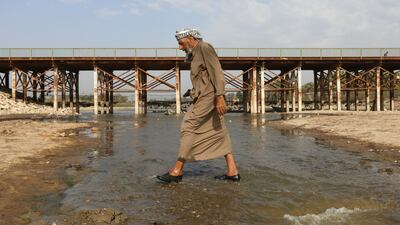
A boy untangles a net as he stands fishing in an almost dried-up stream in Mishkhab, in Najaf province, Iraq, where years of drought have depleted the fauna and flora. All photos: AFP -

Ducks gather and a water buffalo cools down in a stream in Mishkhab, Iraq -

Waterways in Mishkhab are more thoroughfares than sources of vital supplies as poor winter rains fail to replenish groundwater -

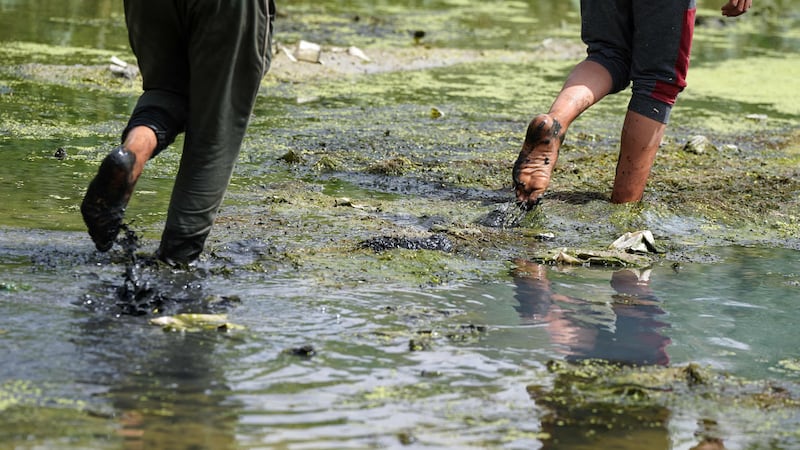
Children continued to play in the streams and rivers of Mishkhab despite nature's inability to provide them with adequate water -

As children who live by the rivers and streams of Mishkhab grow, so their natural heritage is depleted -

An almost dried-up stream flows between fields in Mishkhab, in Najaf province -

Water buffalo cool down in a stream in Mishkhab




The significance of this extends beyond AI itself. It points to a broader truth: the systems that underpin our economies can no longer be planned in isolation. Decisions about energy affect water. Decisions about water influence food production, industry, communities and economic growth. Climate adaptation affects all of them.
The future will not be built by solving one issue at a time. It will depend on how effectively we understand these connections and plan for them together.
What gave me optimism during our discussions in New York was the scale of the coalition engaging with these challenges and opportunities. The most encouraging discussions were not confined to governments or traditional water stakeholders – instead, they involved investors, technology companies, financial institutions, entrepreneurs, researchers, young leaders and development organisations. There is growing recognition that resilience is a shared responsibility.
But awareness alone will not close the gap. We know many of the solutions. We have better technologies, better data and better tools than we did a decade ago. We know more about reuse, storage, loss reduction and efficient desalination.
The challenge is getting those solutions out of the pilot phase – to translate ideas into impact.
How do we connect capital to projects? Innovation to deployment? Technology to communities? And international commitments to action on the ground? These are the questions I heard often in New York. And they are the questions that will matter most at the UN Water Conference in Abu Dhabi in December.
The conference, co-hosted by the UAE and Senegal, will bring these conversations together. The event will hold special significance as the first UN Water Conference to be co-hosted by two nations from the Global South, reflecting their role as active partners in shaping solutions and driving international action on water.
It is also the first UN conference focused on accelerating the implementation of SDG 6, which addresses clean water and sanitation services. Our ambition is to build momentum around investment, international co-operation, innovation and implementation – and to keep that momentum going long after December.
That means bringing governments together with investors, development institutions with the private sector, technology companies with communities, researchers with policymakers. And, critically, giving youth a seat at the table – not simply asking them to listen to the decisions of today, but empowering them to help shape the solutions of tomorrow.
We understand that the future of water will not be solved by one government, one institution nor one technology – it will be solved by what we do together.
The strongest lesson I took away from the General Assembly last month was that for the first time the global conversation is truly changing.
Water is moving from the margins to the centre – of economic planning, climate and humanitarian resilience, sustainable development, technology, food and energy transformations, and international co-operation.
At a time when global confidence in international co-operation is being tested, water gives us a practical opportunity to prove what it can achieve.
If we get water right, the benefits will be boundless – healthier communities, greater opportunity for women and girls, stronger economies, more resilient food and energy systems, stronger digital infrastructure, and greater peace and stability.
The conversation has shifted. Now, the water conference will turn that momentum into action. Together, we invite everyone, no matter where they may be in the world, to join us in reimagining water’s role in creating a better future for all, driving co-operation, growth, resilience and opportunity.

